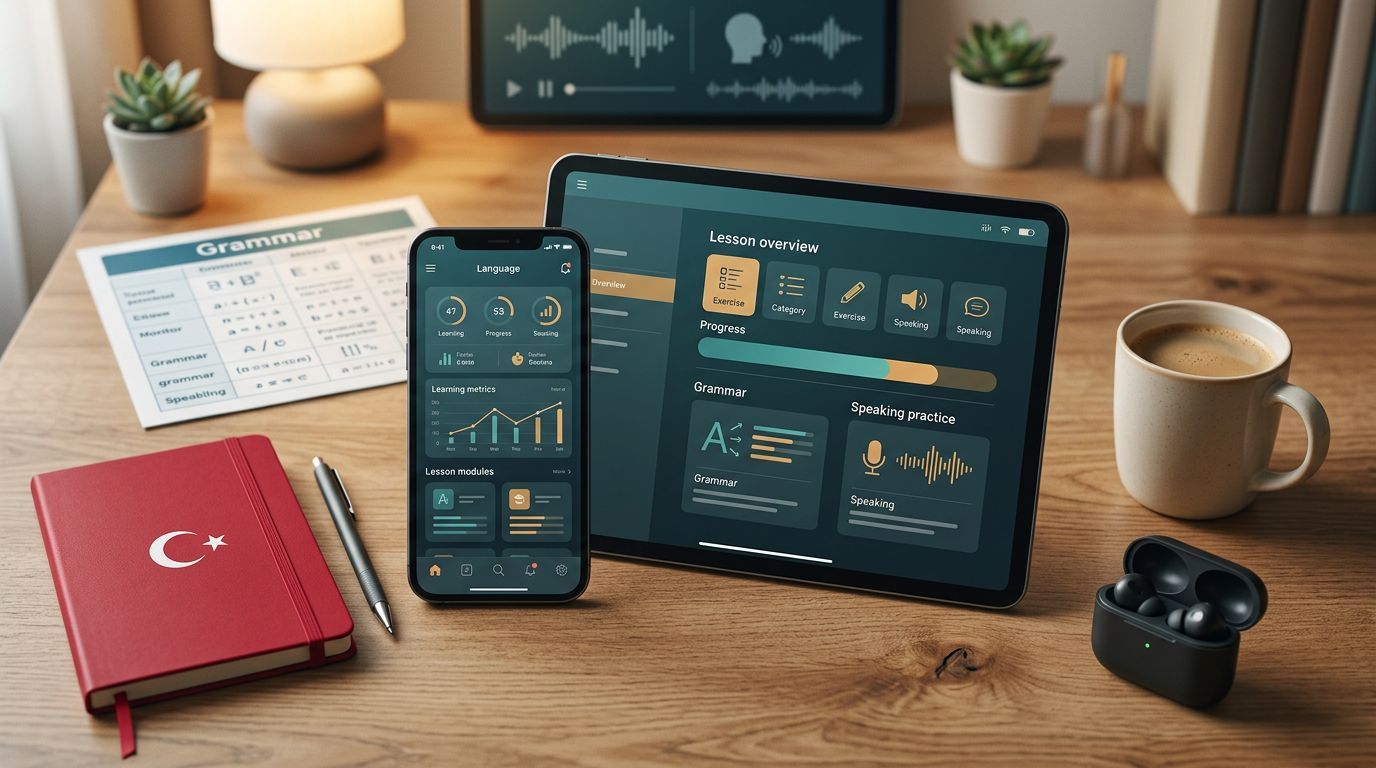
If you want to move past tourist Turkish, the app has to do more than hand out flashcards. Turkish rewards structure, and it punishes sloppy sentence building fast.
That means the best Turkish learning apps in 2026 are the ones that help you study in layers, with grammar, listening, speaking, and review working together. One app can carry the load for a while, but serious progress usually comes from a strong core app plus one or two support tools.
What serious Turkish learners need from an app
Turkish is not hard because every word looks strange. It is hard because the parts of the word carry a lot of meaning. Endings change, word order shifts, and small mistakes can hide the point of a sentence.

If an app never makes you produce Turkish, it will not carry you far.
A serious app should give you structure, some form of speaking practice, enough grammar depth to explain what is happening, and a way to review words over time. Tutor access is a bonus, not a luxury, if you want correction on real output.
Turkish learning apps at a glance
The table below shows how the main options compare for serious study.
| App | Best at | Pricing model | Best level | Feature fit | Main limitation |
|---|---|---|---|---|---|
| Babbel | Structured lessons and grammar | Subscription | A1 to B1, early B2 | Structured yes, speaking partial, grammar yes, SRS partial, tutor no | Limited open-ended conversation |
| Preply | Live speaking with a tutor | Per lesson | A2 to C1 | Structured no, speaking yes, grammar depends, SRS no, tutor yes | Quality and cost vary |
| Pimsleur | Audio-first speaking practice | Subscription | Beginner to lower intermediate | Structured yes, speaking yes, grammar light, SRS partial, tutor no | Weak for reading and writing |
| Busuu | Guided study plus native feedback | Freemium or subscription | A1 to B1, early B2 | Structured yes, speaking partial, grammar moderate, SRS partial, tutor no | Can feel light at higher levels |
| TurkishClass101 | Big lesson library | Subscription | A1 to C1 | Structured partial, speaking partial, grammar moderate, SRS partial, tutor no | Can feel scattered |
| Anki | Long-term vocabulary review | Mostly free, paid iOS app | All levels | Structured no, speaking no, grammar no, SRS yes, tutor no | You must build or find decks |
Babbel, Preply, and Pimsleur cover the biggest needs. The rest help in different ways, but they rarely work best as your only tool.
Babbel works best as your main study spine
Babbel is the safest pick if you want a clear path through Turkish. It gives you ordered lessons, solid vocabulary work, and enough grammar to keep you moving without guessing.
That matters because Turkish rewards pattern recognition. If you understand how endings change meaning, you start seeing the language as a system. A sentence-building approach, like the one discussed in this 2026 Turkish app comparison, is often stronger than random phrase practice.
Babbel is best for learners who like routine and want a course feel. It is also good for self-studiers who need discipline without hiring a tutor right away. The limitation is simple, though. It will not give you enough real conversation on its own. Once you reach solid beginner level, you still need output practice.
Speaking-first apps for live use
Preply gives you the fastest feedback
Preply is the strongest option when your goal is real conversation. You book lessons with a tutor, speak Turkish, and get corrected in real time. That is hard to replace with an app.
This is especially useful if you are an expat, a professional, or an advanced beginner who already knows some basics. A tutor can spot weak verb forms, awkward case use, and sentence-order mistakes that self-study apps often miss. The main drawback is cost, since you pay per lesson. Tutor quality also varies, so you need to choose carefully.
Preply works best when you already have a study routine. It does not give you a built-in curriculum in the same way Babbel does, so it shines as a speaking layer, not a whole plan.
Pimsleur is strong for speaking confidence
Pimsleur is still one of the best audio-first choices for Turkish. It pushes you to answer out loud, which helps with pronunciation, rhythm, and recall under pressure.
That makes it a good fit for commuters, travelers, or anyone who freezes when speaking. It is also useful if you want Turkish in your ears every day without staring at a screen. The tradeoff is that reading, writing, and deep grammar explanation stay limited. You will learn to say useful things, but you will not build a full picture of the language from Pimsleur alone.
For serious learners, Pimsleur is best as a supplement or as a starter tool before moving into a more grammar-rich app.
Busuu and TurkishClass101 help once you want more variety
Busuu is a good bridge for guided practice
Busuu sits in a useful middle ground. It gives you a guided course, but it also lets you get feedback from native speakers. That makes it stronger than many casual apps for learners who want correction without paying for every conversation.
Its structure works well for beginners and lower-intermediate learners. You get a sense of progress, and the app keeps the path fairly clear. Still, Busuu can feel thin once you move past the basics. If you are around B1, pairing it with an intermediate Turkish course will usually give you a better long-term path.
Busuu is a smart pick if you want one app for daily study and another source for human feedback.
TurkishClass101 brings range, not perfect order
TurkishClass101 is useful when you want a large library of lessons, audio, and video. It gives you more material than many app-based courses, which helps if you like mixing listening, vocabulary, and grammar practice.
Its weakness is organization. The catalog can feel broad without always feeling tight. That is why it often works best for self-studiers who are disciplined enough to pick their own route. If you want more grammar support, Seda’s Turkish grammar lessons can fill in the gaps. If you are already moving into higher-level input, Advanced Turkish gives you longer dialogue and transcripts that are closer to real speech.
TurkishClass101 is a useful library. It is less convincing as a single roadmap.
Support tools that should sit beside a main app
Anki deserves attention because Turkish vocabulary sticks better when review is spaced out. It is not a course, and it will not teach grammar by itself. What it does well is keep endings, verbs, and tricky words from fading after you study them.
That makes Anki useful at every level. Beginners can review core words. Intermediate learners can store case endings and verb patterns. Advanced learners can keep idioms and sentence frames alive. If you like control, it is one of the best tools you can add.
Duolingo can still help if you want free daily contact with Turkish. The lessons are shallow, but they make it easy to keep the language in your routine. Use it as background practice, not as your main path.
Mondly belongs in the same support group. If you want something light and low-pressure, our Mondly review explains why it works better beside a stronger app than in place of one.
Conclusion
The best Turkish setup in 2026 is rarely a single app. It is usually one tool for structure, one for speaking, and one for review. That mix matters because Turkish asks you to build sentences with care, not just recognize words.
If your budget is tight, start with Anki and a free app like Duolingo, then add lessons when you can. If you can pay for one core app, Babbel is the safest choice. If speaking matters most, put your money into Preply or Pimsleur. If you are already past beginner level, choose the app that gives you correction and real input, not another streak badge.
Ready to Take Your Language Learning Further?
Your favorite language-learning app is a great place to start. Rocket Languages can help you go further with interactive audio lessons, pronunciation practice, real-world conversations, and structured learning.
Explore Rocket Languages →Affiliate disclosure: We may earn a commission if you purchase through this link, at no additional cost to you.