
Your grammar can be right and still sound wrong. That usually means the issue isn’t meaning, it’s tone.
In language apps, this happens all the time. A sentence may be correct, but too stiff for a friend or too relaxed for a teacher. The good news is that formal vs casual speech is often easy to spot once you check the context. In about 10 minutes, you can test who is speaking, where the exchange happens, what the goal is, and whether the line sounds like a friend, coworker, customer, or stranger would actually say it.
Why language apps often blur formal and casual speech
Many apps teach sentences in a vacuum. You tap, repeat, and move on, but the social setting stays fuzzy. As a result, learners remember words without knowing when those words fit.
Think of it like clothes. A suit and a hoodie both cover you, but you wouldn’t wear them to the same event. Speech works the same way. “Could you please assist me?” and “Can you help me?” can mean nearly the same thing, yet they create very different social signals.
In English, the clues are often easy to hear. Formal lines use titles, fewer contractions, and more careful wording. Casual lines sound shorter and looser. If you want a quick English refresher, Formal vs Informal English: When to Switch and How to Know gives clear examples.
Still, every language marks this in its own way. Japanese, for example, often changes verb forms and social distance more directly, as shown in when to use casual forms in Japanese. Other languages may rely more on pronouns, endings, set phrases, or tone of voice.
So don’t chase one universal rule. Look for patterns instead. If you’re already testing whether app lessons feel realistic, LanguaVibe’s 10-minute reality check for language learning apps is a smart companion test.
The 10-minute check you can run in any lesson
Open one lesson, one chat example, or one speaking prompt. Then stop asking, “Is this correct?” Ask something better: “Who says this to whom, and why?”

Use this quick check:
- Identify the relationship
Is the speaker talking to a friend, teacher, coworker, customer, or stranger? If the app doesn’t make that clear, treat the example with caution. - Name the setting
A classroom, office, shop, text thread, and family dinner all push speech in different directions. Setting changes tone fast. - Check the goal
Is the speaker greeting someone, asking a favor, apologizing, inviting, or complaining? Formal speech shows up more often when the stakes are higher. - Listen for signals
Formal speech often sounds longer, softer, and more careful. Casual speech is often shorter, more direct, and full of contractions or slang. In other languages, watch for pronouns, honorifics, or verb endings. - Swap the audience
Say the line to a friend, then imagine saying it to a customer. If it sounds wrong in one version, you’ve found a register problem.
A few short examples make this easy:
- “Good morning, Professor Kim. Could I ask for an extension?”
- “Hey, can I get one more day?”
- “I apologize for the delay.”
- “Sorry I’m late.”
If a line sounds like it belongs in an office email, don’t use it in a group chat.
This is also a useful app-quality check. Good lessons show who is speaking and why. Weak lessons give one “safe” sentence and leave you guessing. When that happens, make your own second version. Rewrite the formal line as casual, or the casual one as formal. That tiny habit builds judgment fast.
Side-by-side examples, and what good apps should show you
This quick table uses English, because it’s easy to scan, but the pattern applies across languages.
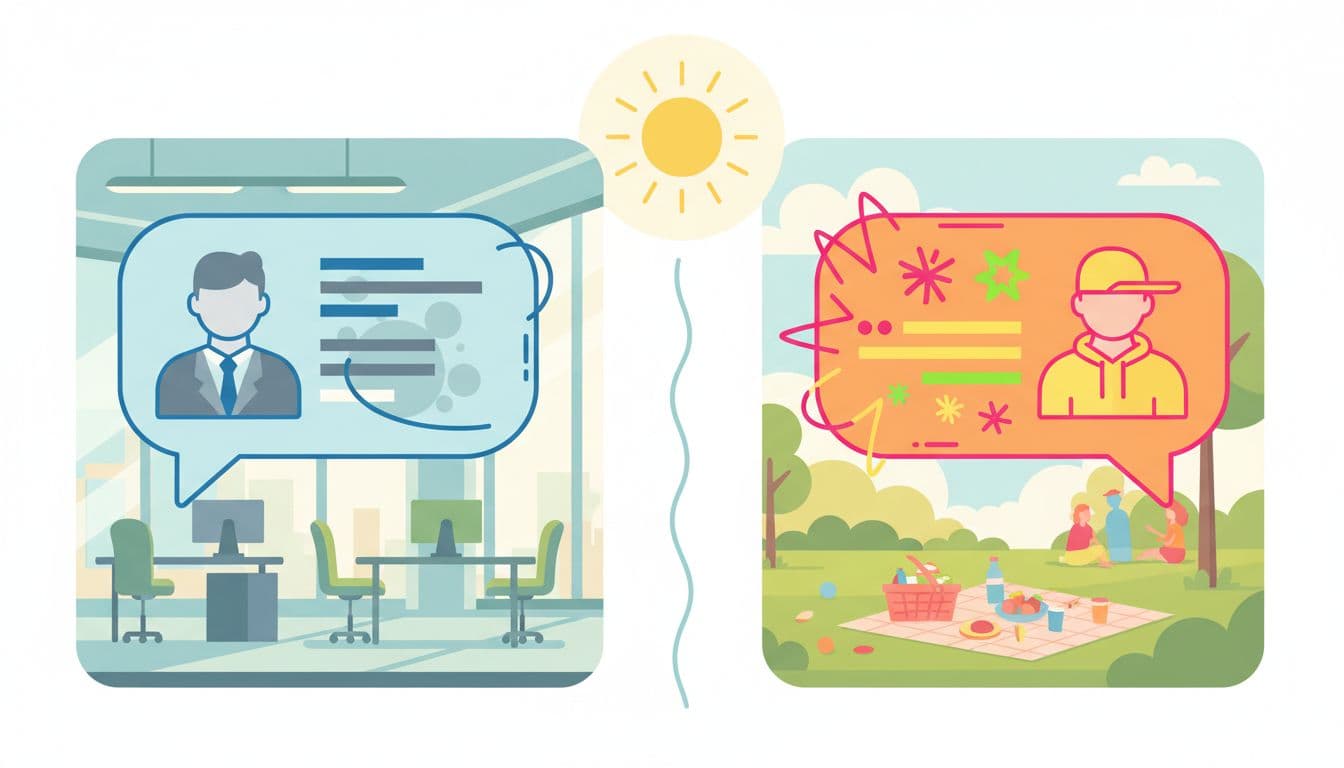
| Situation | More formal | More casual | What to notice |
|---|---|---|---|
| Greeting | Good afternoon, Ms. Lopez. | Hey, Sofia. | Title, full greeting, social distance |
| Asking for help | Could you help me with this report? | Can you help me with this? | Softer verb choice, more detail |
| Invitation | Would you like to join us for dinner? | Want to grab dinner? | Full phrasing versus shortened speech |
| Apology | I apologize for the misunderstanding. | Sorry, I got it wrong. | More distance, less personal warmth |
The takeaway is simple. Formal vs casual speech often changes in length, softness, and social distance, not just vocabulary.
Good apps make that visible. They show the role of each speaker. They label the setting. They let you hear tone, not just read text. Better still, they offer two versions of the same idea, or explain why one line fits a boss and another fits a friend. For more English examples, 2 Ways to Talk (Casual vs Formal) in English is a helpful comparison.
Structured dialogue-based courses can help here, because they give lines a social home. If you’re weighing that kind of app, this in-depth Babbel review pros and cons breaks down how guided lessons handle real-life phrases.
The best habit is simple: never study a sentence alone. Study the relationship around it.
Conclusion
If a phrase feels odd, don’t panic. The words may be right, but the context may be wrong.
A fast check works well: identify the person, setting, goal, and social distance. Then compare how the same idea would sound with a friend, teacher, coworker, customer, or stranger. Do that inside your app for one week, and you’ll stop treating tone like a mystery.