
You open your language app for a “quick” review and suddenly it shows 250 cards due. Your heart sinks. You close the app and do nothing instead.
If that feels familiar, you are not alone. Many learners love spaced repetition at first, then hit a wall when the reviews pile up.
This guide shows you how to use spaced repetition language learning in a way that fits real life. You will set safe limits, handle review spikes, and build short routines that you can keep even with a full-time job or family.
What Spaced Repetition Really Does In Your App

Caption: Visual overview of spaced repetition in a language app, with reviews spread over time. Image created with AI.
Spaced repetition language learning is simple. Your app shows a word right before you are about to forget it. If you tap “easy”, it waits longer next time. If you tap “hard”, it shows it sooner.
Used well, this system gives you strong memory with less total study time. Used badly, it can feel like a never-ending to‑do list that controls your day.
Most apps have two key numbers:
- New items per day
- Maximum reviews per day (or none, which is risky)
If you ignore these, the app will accept every new card you add, then send them back in waves. That is when burnout starts.
Quick setup checklist
- Turn on or find your “new cards per day” setting
- Check whether your app limits daily reviews
- If it does not, decide your own soft cap; for example, “never more than 80 reviews in a day”
- Learn where to pause or reduce new cards
Set Safe Limits For New Cards From Day One
New words feel fun. Reviews feel like work. That trick of the brain is what traps many learners.
A safer rule is to let reviews decide how many new cards you add, not the other way around.
For a typical adult learner:
- If you have 5 to 10 minutes per day, start with 5 new cards per day
- If you have 10 to 20 minutes per day, start with 10 new cards per day
- Go above 15 new cards per day only if you already feel on top of reviews
In apps like Anki or Memrise, that means setting “New cards per day” to 5 or 10, not 20 or 30. In shorter, gamified apps, resist the urge to binge many new lessons in one sitting. Spread them over the week.
Use this rule of thumb: if your reviews for today ever pass 80 and you feel tense, cut your new cards in half for the next week. Your future self will thank you.
New card safety check
- Current daily reviews stay under 60 to 80 most days
- You finish reviews in less than your planned time
- You can say a full example sentence for many words, not just tap the right button
- If any of these fail, reduce new cards by 25 to 50 percent
Build A Sustainable Daily Review Routine
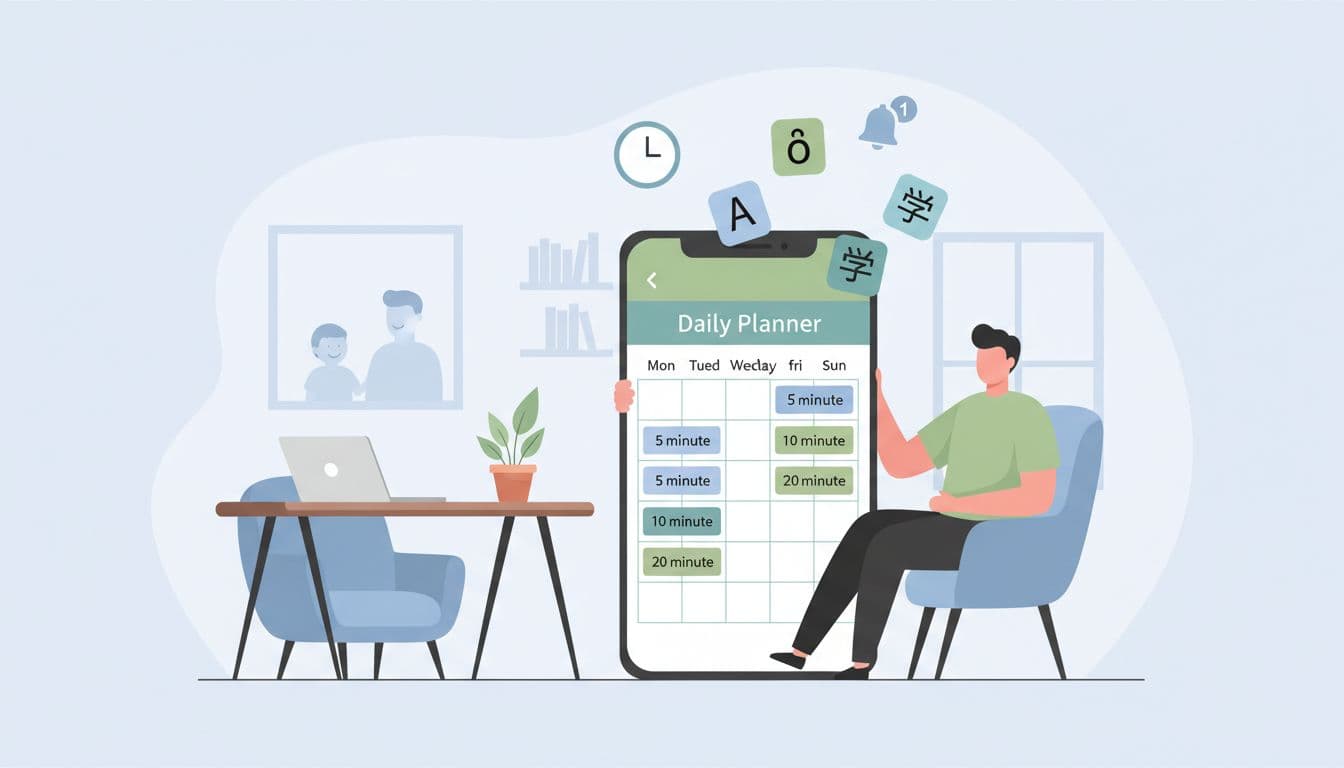
Caption: Short, spaced study sessions built into a busy week. Image created with AI.
Spaced repetition works best with small, steady sessions. Long marathons once a week do not give the same effect.
Here are simple routines you can plug into your day.
5‑minute routine
Perfect for a very busy schedule or for keeping a streak alive on hard days.
- Open your app once, for 5 minutes
- Do only reviews, no new cards
- Stop when the timer ends, even if some cards remain
10‑minute routine
Good for most people on workdays.
- Morning: 5 minutes of reviews during coffee
- Evening: 5 minutes of reviews or a few new cards
- Only add new cards in the evening block
20‑minute routine
Use this when you have more time or on weekends.
- 10 minutes of reviews
- 5 minutes of new cards
- 5 minutes to speak or write with today’s words
A simple table to guide you:
| Daily time | Reviews per day target | New cards per day |
|---|---|---|
| 5 minutes | 20 to 30 | 0 to 3 |
| 10 minutes | 40 to 60 | 5 to 8 |
| 20 minutes | 60 to 100 | 8 to 15 |
Treat these as starting points, not rules. Adjust up or down based on how you feel after a full week, not after a single hard day.
If you are still picking a main app, this detailed Rosetta Stone vs Duolingo comparison can help you match the study style to your routine.
Routine quick-start list
- Pick one time slot you can keep 5 days a week
- Set a phone reminder for that exact time
- Decide in advance: reviews first, new cards only if time remains
- After 7 days, adjust either time or card limits, not both
What To Do When Reviews Explode

Caption: Contrast between overwhelmed reviews and a calmer, reduced schedule. Image created with AI.
At some point your app will show a scary review number. Maybe you missed a weekend or tried too many new words. You do not need to “catch up” in one go.
Use this three‑step reset:
- Pause new cards for 3 to 7 days. In most apps you can set “0 new cards” without losing progress.
- Set a daily review cap. For example, tell yourself you will only clear 80 reviews per day, even if 200 are due.
- Use sprints. Do 10 reviews, then look away from the screen for 30 seconds. Repeat until your time is up.
As long as you come back daily, the backlog will shrink. Some cards will feel harder because they were late, but that is normal. You can again mark them as “hard” or “again” and let the system rebuild their schedule.
If you feel dread every time you see a big number, you can also “bury” or delete a few low‑value cards, such as rare words or phrases you never use. Keeping your deck meaningful is part of staying motivated.
When reviews feel out of control
- Pause all new cards until the backlog feels manageable
- Limit reviews per day to a number that fits your time and mood
- Use short review sprints with tiny breaks
- Drop cards that no longer match your goals
Use App Features To Support You, Not Control You
Many language apps use streaks, badges, and leaderboards. These can help you open the app, but they should not decide how you study.
A few simple rules help you stay in charge:
- Treat streaks as a reminder, not a measure of worth
- Ignore “double or nothing” or “XP rush” style events if you already feel tired
- Turn off some notifications if they cause pressure instead of support
In flashcard-based apps, experiment with features that lower friction, such as:
- Audio auto‑play so you hear pronunciation without extra taps
- Typed answers for a small set of key words only
- Simple tags, for example “travel” or “work”, so you can suspend whole groups if life changes
Your app is a tool. If any feature makes you anxious, change its settings or ignore it. Steady progress with fewer bells and whistles beats a flashy streak that ends in burnout.
Healthy app use checklist
- You choose how many cards to study, not the app
- You can miss a day without feeling like a failure
- You know how to switch off or mute stressful features
- You focus on words you will actually use
Know When To Rest And Reset
You will have days when your brain feels full or life gets messy. Pushing harder on those days often backfires.
Give yourself these options:
- A “reviews only” day with no new cards
- A half session where you stop early on purpose
- One planned day off per week with no guilt
If you pause for more than a week, do not try to clear everything on the first day back. Use the review reset steps again, then move forward with a smaller daily load.
Your goal is not to be perfect. Your goal is to still be learning the language in one year.
Conclusion: Make Spaced Repetition Work For Your Life
Spaced repetition language learning can be a powerful partner if you stay in control of it. Set modest new card limits, build a short daily routine, and treat review spikes as a signal to pause and reset, not as a personal failure.
When you slow down on purpose, you protect your energy and keep the habit alive. That steady, sustainable spaced repetition is what turns an app on your phone into real words in your mouth.
What small change from this guide can you start with today? Pick one, try it for a week, and let your future self enjoy a lighter, calmer review queue.