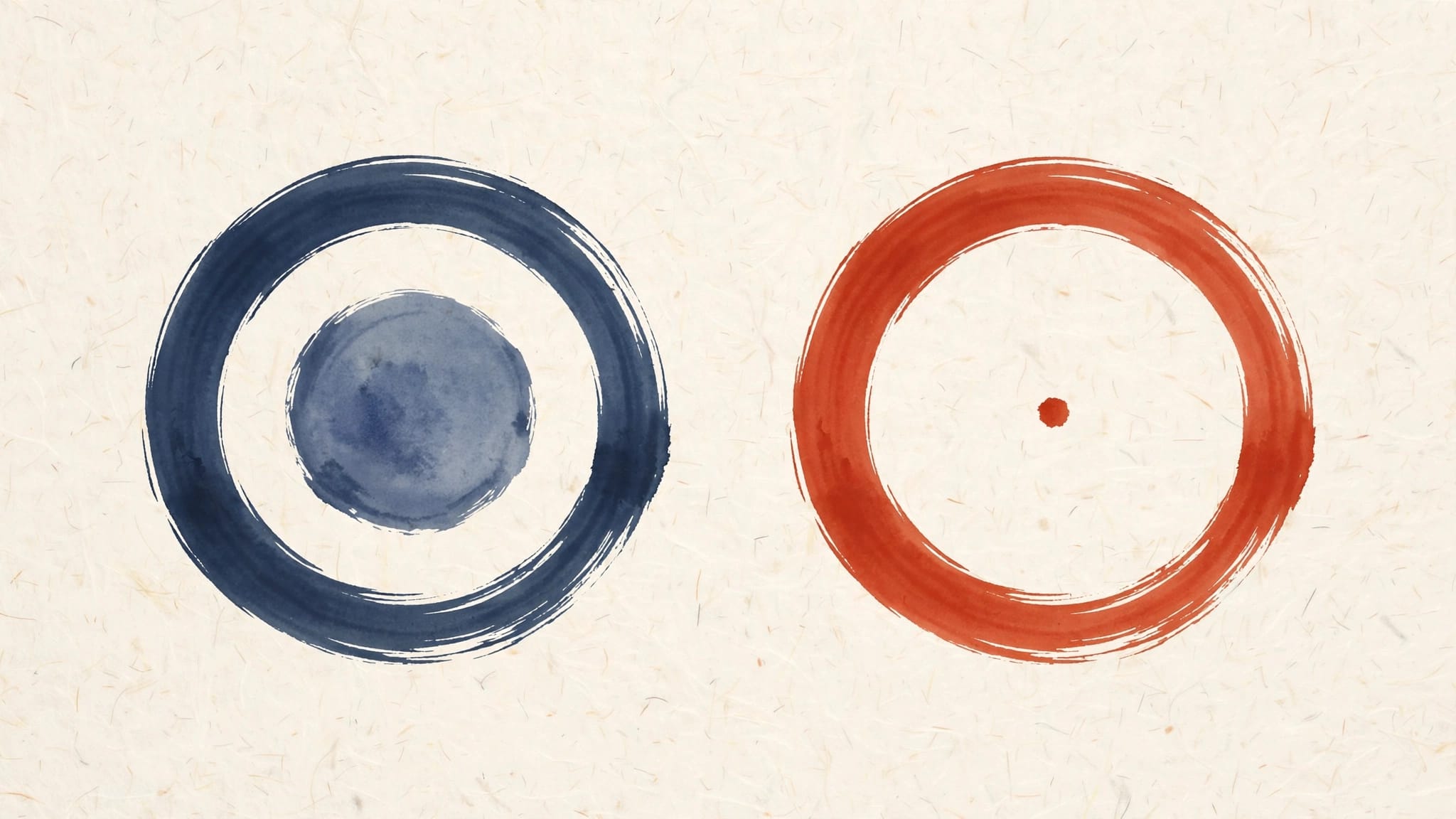
Learners often confuse は and が, two Japanese particles, because English doesn’t consistently distinguish focus from grammatical subject. The starting point for は vs が is simple: は introduces what you’re talking about, while が marks a subject and can identify who’s doing something.
However, choosing between them depends on the surrounding exchange, including what the listener knows and the question being answered. Start with that distinction, then connect each one to the conversation around it.
Key Takeaways
- は, pronounced wa as a particle, sets the discussion’s focus or sets one item against another. It doesn’t simply mean “old information.”
- が, pronounced ga, marks a subject. Depending on the exchange, it introduces something or identifies a particular answer.
- Both particles can produce grammatical sentences with different meanings. Question structure, surrounding sentences, and verb patterns help you choose.
Why は vs が Is Harder Than Two Definitions
A topic isn’t necessarily a subject
McGloin’s definition describes the focus as the word or phrase identifying what a statement is about. That differs from a subject, which has a grammatical relationship with the predicate.
Consider 私は日本語が好きです。, meaning “I like Japanese.”
私は sets “me” as the topic. Within that frame, が is the subject marker for 日本語, the thing that is liked. English translates the sentence with “I” as its subject, but the Japanese structure works differently.
Tofugu’s explanation of the topic marker develops this distinction between establishing that focus and identifying its grammatical role.
English translations conceal the difference
Both 田中さんは来ました and 田中さんが来ました can translate as “Tanaka came.”
However, the first naturally reports something about Tanaka. The second can present Tanaka’s arrival as new information or identify Tanaka as the person who came.
Because English often uses the same translation, memorizing bilingual sentences without the surrounding exchange hides the choice you’re trying to learn. Even a correct translation may leave out the most important distinction.
Paired Examples: Same Person, Different Question
Talking about oranges or choosing oranges
ミカンは美味しいです。
“Mandarin oranges are tasty.”
This naturally answers “What do you think of mandarin oranges?” Oranges set the frame for the description; it supplies the useful information.
ミカンが美味しいと思います。
“I think mandarin oranges are tasty.”
In a discussion about which fruit tastes good, this can answer “What fruit do you think is tasty?” The speaker identifies oranges.
The predicates also differ here, so the question being answered matters more than a direct comparison of the English translations.
Reporting Tanaka’s news or identifying the buyer
田中さんは新しい車を買いました。
“Tanaka bought a new car.”
This fits a conversation where Tanaka is already under discussion. Buying a car is the update.
田中さんが新しい車を買いました。
“Tanaka bought a new car.”
This answers “Who bought a new car?” Tanaka is the identifying information.
Still, が doesn’t always mean “Tanaka, and nobody else.” That interpretation becomes stronger when the conversation asks you to select someone.
Established Topics Don’t Need an Earlier Mention
The shortcut “old information takes は” misses several ways a listener can recognize a topic.
The focus may be explicitly established. After someone mentions Tanaka, you can continue with 田中さんは, “as for Tanaka.” It can also be inferred. Once a house is under discussion, 屋根は赤いです, “The roof is red,” can introduce its roof as an understandable topic.
Shared knowledge also helps. カナダは意外に大きい国です, “Canada is a surprisingly large country,” doesn’t require an earlier mention of Canada.
Likewise, それは彼の自転車です, “That’s his bicycle,” works when the listener can identify what それ, “that,” refers to.
Finally, generic categories readily become subjects of discussion: みかんは美味しいよ, “Mandarin oranges are tasty,” presents a general opinion. Similarly, 人はいつか死にます, “People die someday,” states a general fact.
These uses share recognizability, rather than a requirement that the noun appeared in the previous sentence. Speakers can also deliberately introduce a new conversational focus with は.
Questions Reveal Where the Answer Belongs
Match the question word’s particle
When a question word takes が, its answer normally takes が too.
誰がいる? means “Who’s there?”
先生がいる。 means “The teacher is there.”
Similarly, 何が必要ですか, “What’s necessary?”, invites an answer such as パスポートが必要です, “A passport is necessary.”
Tae Kim’s explanation of は and が connects this identifying function with questions about who or what.
However, other question words retain their own particles. どこに行きますか, “Where are you going?”, can receive 学校に行きます, “I’m going to school.” 何を食べますか, “What will you eat?”, can receive パンを食べます, “I’ll eat bread.”
The relevant particle follows the question word. An answer doesn’t automatically require が.
Use attention as a guide, not a law
McGloin’s attention heuristic is useful: は generally directs attention toward what follows; identifying が directs attention toward what precedes.
The arithmetic mnemonic いち たす いち は に, “One plus one is two,” supplies the answer after は.
Its paired version, いち たす いち が に, roughly “One plus one makes two,” treats “one plus one” as the answer to what makes two.
These are common interrogative patterns, not templates for every answer. が also appears in neutral descriptions without strong emphasis.
Contrast and Description Can Change the Nuance
Neutral description often introduces a subject with が: 猫がいます, “There’s a cat.” Once the cat is established, 猫は寝ています, “The cat is sleeping,” reports something about it. This is a tendency, not a rule.
However, は can set one feature against another.
目がきれいです。
“Their eyes are beautiful.”
目はきれいです。
“Their eyes are beautiful,” with a possible implication about other features.
The second sentence may sound like limited praise. It doesn’t automatically mean the rest of the person’s face is unattractive, but context can encourage that inference.
A similar distinction appears with self-identification:
私は学生です。 means “I’m a student,” as an ordinary statement about yourself.
私が学生です。 can mean “I’m the student,” identifying yourself as the relevant person.
Therefore, が isn’t the default particle for introducing yourself.
A yes or no question often uses は because it already has a definite topic: 田中さんは学生ですか, “Is Tanaka a student?” However, 田中さんが学生ですか, “Is Tanaka the student?”, can ask for confirmation of an identification.
Sentence Structure Sometimes Matters More Than Emphasis
が inside a subordinate clause
Consider this example:
マイケルがケーキを作ったので、私はお皿とフォークを持ってきました。
“Since Michael made the cake, I brought plates and forks.”
マイケルが identifies the subject inside the subordinate clause ending in ので, “because” or “since.” Meanwhile, 私は establishes who brought the utensils.
Without 私は, Japanese leaves the main clause’s subject unspoken. Listeners might infer Michael or someone else from context. Adding 私は resolves that uncertainty.
Using が inside subordinate clauses is common, though は can appear when an appropriate topic or contrast extends into the clause.
を and potential forms follow different patterns
In ordinary expressions, を marks a direct object: テニスをします, “I play tennis,” and ビールを飲みます, “I drink beer.”
Potential expressions often use が:
テニスができます。
“I can play tennis.”
ビールが飲めます。
“I can drink beer.”
These express ability, not a conditional meaning. Potential verbs can also take を in many contexts, so “potential always replaces を with が” is too absolute. Tae Kim’s Japanese grammar guide covers these potential-form patterns.
Existence follows another structure: 猫がいます means “There’s a cat.” The cat is the subject, not an object, so を doesn’t belong there. は can topicalize some objects, but it doesn’t turn が into a general-purpose replacement for を.
Practice With Exchanges, Not Isolated Sentences
When unsure, first identify what the conversation is about. Then locate what the speaker is adding or selecting. Finally, check whether a verb or clause pattern explains the particle.
When saving examples, keep the preceding question or sentence. A flashcard containing “Who bought a car?” followed by the Tanaka answer teaches more than the answer alone.
Jisho can help identify vocabulary, but a dictionary translation rarely explains an entire topic relationship. Search the complete phrase and compare examples with clear contexts.
For listening practice, keep the surrounding exchange too. Intonation can support an interpretation, but louder pronunciation alone doesn’t explain why a speaker chose が.
Frequently Asked Questions
Can both は and が be correct?
Yes. 雨が降っています, “It’s raining,” naturally reports an observation. 雨は降っています, “It is raining,” can contrast rain with another condition, such as whether the wind is blowing. The second needs a suitable context.
Does は always imply contrast?
No. は commonly establishes a neutral topic. That reading becomes more noticeable when the speaker separates one item, person, or feature from relevant alternatives. Tofugu’s account of は includes both topic-setting and contrast.
Should I avoid が for familiar people?
No. Familiarity doesn’t prevent が. 誰が来ましたか, “Who came?”, can receive 田中さんが来ました, “Tanaka came,” even when everyone knows Tanaka. Here, the sentence identifies the answer rather than introducing an unfamiliar person.
Choose the Particle That Fits the Conversation
The most useful distinction is topic versus subject, supported by the question your sentence answers. は establishes what you’re discussing or contrasting; が marks a subject and can identify the relevant person or thing.
Keep the surrounding conversation when you study examples. The choice becomes clearer when you understand what the listener already recognizes and what your sentence contributes.
Ready to Take Your Language Learning Further?
Your favorite language-learning app is a great place to start. Rocket Languages can help you go further with interactive audio lessons, pronunciation practice, real-world conversations, and structured learning.
Explore Rocket Languages →Affiliate disclosure: We may earn a commission if you purchase through this link, at no additional cost to you.