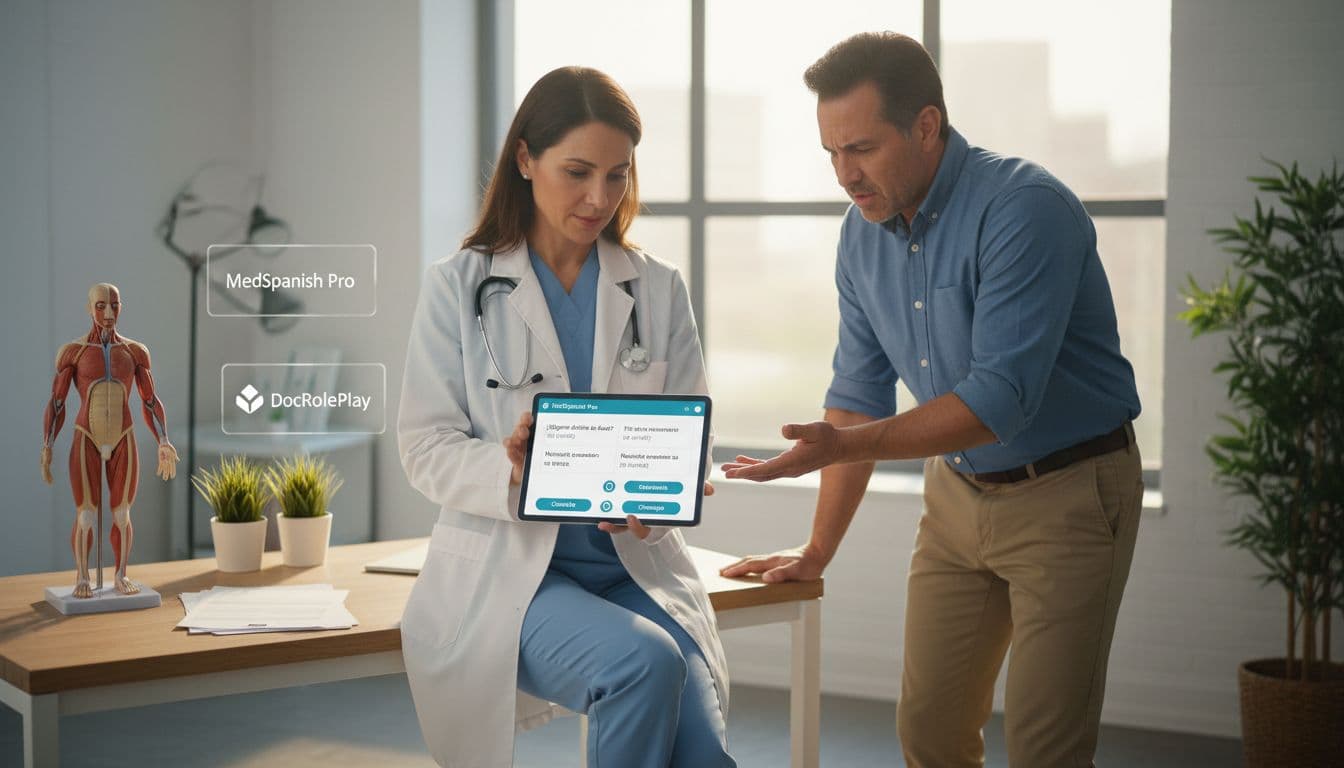
The first time you try to take a history in Spanish, it can feel like walking into a room with the lights off. You know what you want to ask, but the words don’t come out fast enough, and the patient’s answer lands like a blur.
The good news is that a few medical Spanish apps now put patient-style dialogues front and center, so you can practice how real conversations sound in triage, clinic, and discharge. Below are the strongest options for interactive scenarios, speaking practice, and clinical vocabulary (as of January 2026), plus how to choose the right one for your level.
What makes an app good for patient interaction scenarios?
Many general Spanish apps teach travel phrases or grammar. That’s fine, but it doesn’t prepare you for, “When did it start?” followed by a long answer with time clues, symptoms, and worry.
When you’re comparing medical Spanish apps, prioritize features that match clinical reality:
- Scenario-based flows: history-taking, ROS, consent, discharge, follow-up plans.
- Audio-first practice: you need to hear patient answers and clinician prompts.
- Speaking practice and feedback: even basic speech scoring helps you improve faster.
- Offline access: critical for hospitals with weak signal (or elevator dead zones).
- Dialect clarity: at minimum, clear audio and consistent phrasing (ideally accent options).
If you want a broader list of tools beyond apps, Georgetown maintains a helpful directory of medical Spanish resources, including apps and podcasts: https://guides.dml.georgetown.edu/medspanish/apps
Best apps for medical Spanish with realistic patient scenarios
Canopy Medical Spanish (strongest for structured role-play)
Canopy is built for clinicians who want both phrase access and guided learning. It stands out because it supports role-play style practice alongside high-utility clinical phrases.
Scenario types: common complaint interviews, symptom questions and ROS-style phrasing, consent and procedure explanations, discharge instructions, and specialty-focused language (varies by module).
Skill focus: listening and speaking first, with reading support for fast scanning.
Feedback method: guided lessons and activities, plus repetition and modeled audio (feedback depth depends on the course format you’re using).
Offline access: some content may be available offline depending on how the app packages lessons, confirm in-app for your device.
Pricing model: free access to limited content, paid subscription for full library (current rates are listed in the app store).
Platform: iOS and Android.
Best for: clinicians who want a training path (not just a phrasebook), especially if you need discharge, consent, and complaint-based questioning in one place.
Dialect notes: Spanish audio is provided, check the app settings or lesson notes for accent details.
Care to Translate (fast, clinical, accent-aware audio)
Care to Translate is designed for point-of-care communication, but it can also work as a practice tool because phrases are organized by clinical contexts and paired with clean audio.
Scenario types: intake questions, ROS-style symptom checks, consent-related prompts, maternity and mental health topics, and discharge-oriented phrases organized by use case.
Skill focus: listening and speaking (repeat-after-audio practice works well), with quick reading support.
Feedback method: audio modeling and self-check (it’s not a graded speaking coach, but it’s excellent for accurate phrasing).
Offline access: offline support depends on plan and downloads, confirm inside the app before relying on it.
Pricing model: free trial, then monthly or annual subscription (pricing varies by region and plan).
Platform: iOS and Android.
Best for: busy ED, urgent care, inpatient teams, and EMTs who need fast, reliable phrasing organized by clinical intent.
Dialect notes: includes Latin American and European Spanish audio options for many phrases, which helps if your patient population is mixed.
MediBabble (best free option for core patient Q&A)
MediBabble is a long-time favorite because it’s free, practical, and designed around clinical questioning. It’s less “course” and more “ready-to-say” patient communication.
Scenario types: focused history questions, key ROS-style symptom questions, consent-related lines, and discharge basics organized for rapid use.
Skill focus: listening and speaking through repetition, with quick reference reading.
Feedback method: no formal scoring, but the audio lets you shadow and correct yourself.
Offline access: strong offline use once content is available on your device (a major plus in clinical settings).
Pricing model: free.
Platform: iOS and Android.
Best for: students, trainees, and clinicians who need a no-cost tool for safe, standard questions and instructions.
Dialect notes: audio is clear, but dialect labeling may be limited, treat it as general clinical Spanish and adjust phrasing to local norms.
Bonus practice resource: Doc Molly (interactive audio drills)
If you want extra listening reps that feel like clinical exchanges, Doc Molly offers interactive audio lessons organized by specialty and visit type: https://docmolly.com/
It’s a useful supplement when you want to train your ear for patient-friendly phrasing, even if your main workflow app is one of the options above.
Quick comparison table (patient-scenario fit)
| App | Best scenario coverage | Skill emphasis | Feedback style | Offline use | Pricing model | Platforms |
|---|---|---|---|---|---|---|
| Canopy Medical Spanish | Role-play lessons, history, ROS, consent, discharge | Listening, speaking | Guided activities and modeled audio | Varies by content | Free tier, paid subscription | iOS, Android |
| Care to Translate | Point-of-care categories (incl. psych, maternity, discharge) | Listening, speaking | Modeled audio (self-check) | Varies by plan | Trial then subscription | iOS, Android |
| MediBabble | Core history and common instructions | Listening, speaking | Modeled audio (no scoring) | Strong | Free | iOS, Android |
Recommendations by proficiency level (what to use first)
Beginner (new to clinical Spanish)
Start with MediBabble for predictable, high-frequency questions. Pair it with Care to Translate when you need better topic organization and accent options.
At this level, your goal is simple: ask safe questions, confirm pain, timing, allergies, meds, and red flags.
Intermediate (you can get through a basic history)
Use Canopy as your main skill builder, because structured role-play helps you stop translating in your head. Keep Care to Translate as a quick-reference tool for phrasing consent and discharge steps.
If you also want a general Spanish base, compare popular mainstream apps and decide what fits your study style: https://languavibe.com/rosetta-stone-vs-duolingo-which-app-is-best-for-you/
Advanced (you work in Spanish sometimes, but want consistency)
Go heavier on Canopy modules that match your setting (ED, outpatient, inpatient). Use Care to Translate for fast, patient-friendly alternatives and accent flexibility. Add focused listening drills (like Doc Molly) to sharpen comprehension when patients speak fast, use idioms, or mix in English.
If you’re curious about AI conversation practice for general Spanish fluency, this roundup gives context on what current tools can and can’t do well: https://languatalk.com/blog/spanish/how-to-learn-spanish-with-ai/
Dialect and region notes (what matters in real encounters)
In most US clinical settings, Latin American Spanish is the common default, but patients may be from many countries, and word choice can shift (for example, “cold” and “congestion” language varies).
- Pick apps that provide clear audio and, when possible, accent options (Care to Translate is strong here).
- Use plain, patient-friendly terms over textbook words.
- When in doubt, ask the patient what term they use, then mirror it.
Safety disclaimer: when to use a certified medical interpreter
These apps are practice tools and supports, not a replacement for professional language access. Use a certified medical interpreter for complex, high-risk, or legally sensitive communication, including informed consent for procedures, end-of-life discussions, capacity concerns, and situations with potential misunderstanding.
For a broader view of safe ways to build medical Spanish skills at work, this overview is a helpful starting point: https://www.babbelforbusiness.com/us/blog/the-best-ways-to-learn-medical-spanish/
Conclusion
The best medical Spanish apps for patient interaction scenarios are the ones that make you speak, listen, and respond like you’re in the room. Canopy is the top pick for structured role-play, Care to Translate shines for quick clinical categories and accent options, and MediBabble is the strongest free option for core patient Q&A. Pick one primary app, practice out loud, and keep an interpreter workflow ready when the stakes are high.
Ready to Take Your Language Learning Further?
Your favorite language-learning app is a great place to start. Rocket Languages can help you go further with interactive audio lessons, pronunciation practice, real-world conversations, and structured learning.
Explore Rocket Languages →Affiliate disclosure: We may earn a commission if you purchase through this link, at no additional cost to you.