Arabic becomes readable when your eyes stop treating each word as a puzzle of separate symbols. The best Arabic reading apps help you recognize letters in connected forms, hear their sounds, and use short-vowel marks before you face unvowelled text.
Many general courses teach phrases before they teach decoding. That can work for travel, but it leaves beginners dependent on transliteration. A reading-first app should make Arabic script the default from the start.
Key Takeaways
- Choose an app that teaches the Arabic alphabet in isolated, initial, medial, and final forms, not only as an alphabet chart.
- Practice words with harakat first. FatHa, damma, kasra, sukun, and shadda show how a word is pronounced.
- AlifBee offers a structured course with free access to part of its content. Mango is more useful for choosing a regional course, but its verified strengths are course variety and dialogue practice, not script drills.
- ReadArabic is available on Google Play and the Apple App Store, although you should check its current reading tools before subscribing.
- Use one core course, one dictionary or reference tool, and short reading sessions with vowelled texts. Multiple overlapping subscriptions rarely improve results.
How Arabic Reading Apps Should Teach Script
Arabic has 28 letters, yet many change shape according to their place in a word. Knowing the Arabic alphabet is different from reading connected text. Good instruction moves from letter recognition to syllables, common word patterns, and short sentences.
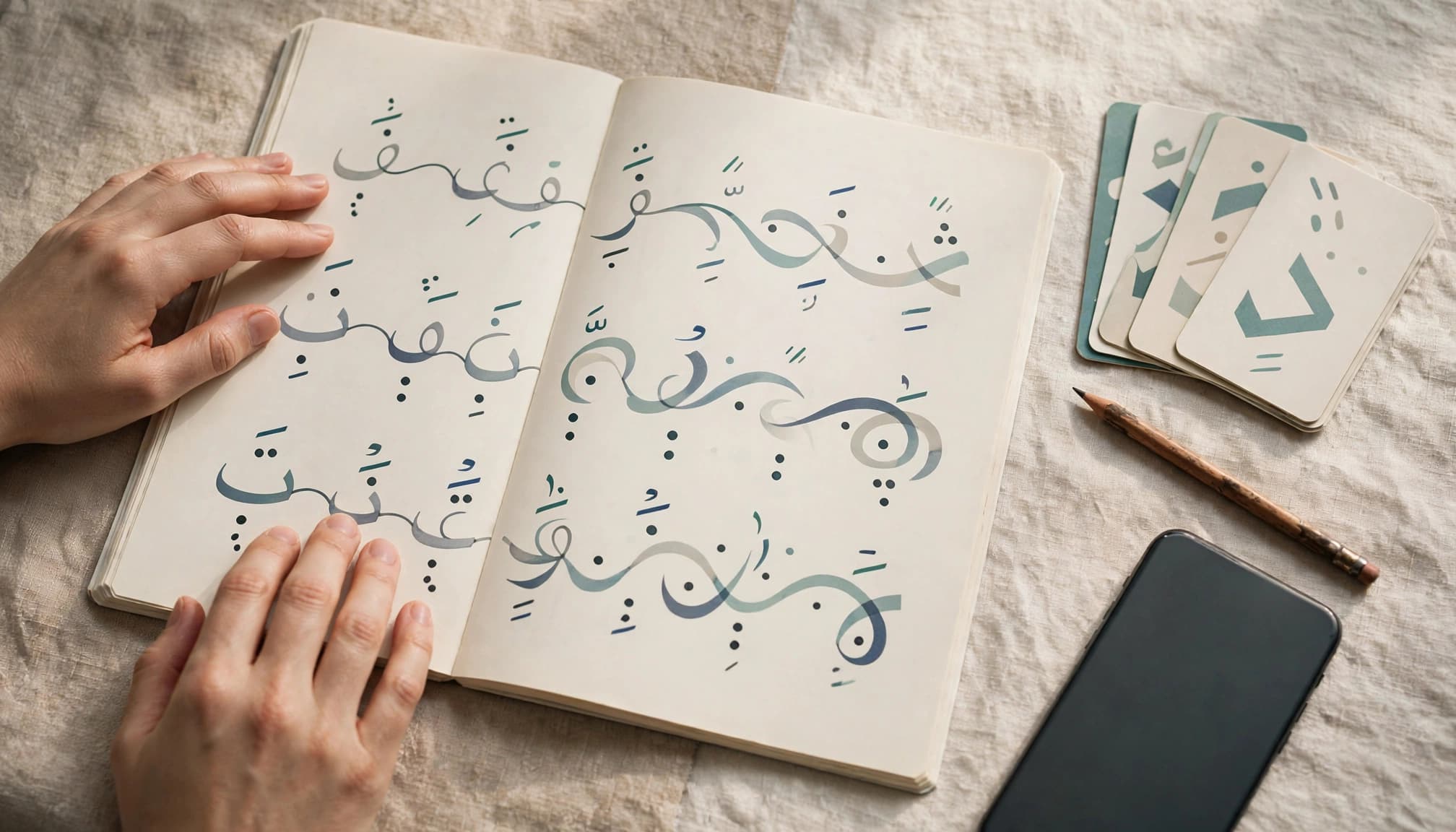
Connected forms matter more than alphabet order
Look for exercises that contrast a letter at the beginning, middle, and end of a word. The app should also point out the six letters that do not connect to the following letter: ا, د, ذ, ر, ز, and و.
Writing practice can reinforce recognition, especially when you confuse similar shapes such as ب, ت, and ث. Still, tracing letters alone won’t build reading speed. You need timed recognition of familiar words, followed by repeated exposure to short phrases.
Avoid courses that keep Latin-letter spellings on screen after the first lessons. Use Arabic script versus romanization as a useful test: if you can answer every exercise by reading English letters, the app isn’t training Arabic reading.
Harakat should support reading, then fade
Harakat vowels provide short-vowel information, while related marks offer other reading cues. Beginners need them because the same consonantal outline can represent different words or grammatical forms. Read aloud with the marks visible, then revisit the same line with fewer supports.
However, everyday Arabic news, messages, and books often omit short vowels. A useful progression starts with fully vowelled words, moves to partially marked sentences, and finally includes plain text with audio or a translation available after your first attempt.
Vowel marks are training wheels for accurate decoding, but learners must also practice reading the consonantal patterns that appear in normal Arabic print.
Arabic Reading Apps Worth Testing
No single app covers every part of literacy. The right choice depends on whether you need a structured Modern Standard Arabic course, a reading-oriented tool, or a course tied to a spoken variety.
AlifBee app for a structured course
AlifBee presents itself as a course for learning to read and write Arabic alongside listening and speaking. Its free mode includes about 20% of the content, including 20 lessons in the first level and two lessons in later levels.
That limited access can serve as a free trial before you pay. Work through the early script lessons and check whether you can read a new vowelled word without seeing transliteration. If the course helps you decode rather than guess from pictures or translations, it may suit your beginner study plan.
ReadArabic for a reading-focused option
ReadArabic on Google Play is also listed in the Apple App Store. Apple describes it as free with in-app purchases, so you can inspect the basic experience before committing.
Its name makes it relevant for learners whose priority is reading, but don’t assume it includes every tool you need. Before upgrading, test how it handles connected letters, vowel marks, audio, definitions, and longer passages. The available sources do not verify those mechanics, so your own trial matters.
Mango for dialect choice
Mango Languages offers Arabic courses for Egyptian, Iraqi, Levantine, and Modern Standard Arabic. That breadth is valuable if you have a family, travel, or work reason to focus on one variety.
Mango lists an Individual subscription at $13.99 per month and a Family plan at $19.99 per month, although app-store prices can differ by country and plan. You can try the first three lessons of each course free, and some libraries or schools provide access. Treat it as a dialogue-centered course with audio lessons, not a dedicated script-drilling tool, and assess its script support before making it your main literacy course.
Use Vocabulary and Audio Apps as Supplements
Broad language learning apps often offer flashcards, picture vocabulary, and audio recall, but script-focused tools teach a different skill. These supplements can help you remember Arabic vocabulary, while a flashcard app may reinforce words. Pimsleur-style audio lessons support listening and spoken recall, building broader language skills without replacing Arabic script instruction.
A handwriting-focused app can also help you recall letter shapes. Test a supplement during its free trial only if it addresses a specific weakness. Pair it with reading practice so handwriting doesn’t become copying isolated characters without meaning.
For a wider view of course options and their trade-offs, compare these choices with best Arabic learning apps. The useful question isn’t which app has the most activities. It’s whether its next exercise trains the weakness you have today.
Modern Standard Arabic and Dialects Need Different Plans
Modern Standard Arabic, often called MSA or fusHa, is the written form used in formal news, books, education, and much public communication. It is a practical starting point for formal reading, though other varieties remain useful for conversation.
Arabic dialects matter for conversation and conversational fluency. Egyptian Arabic, Iraqi, Gulf, and Maghrebi varieties differ in pronunciation and vocabulary, while their writing may range from informal dialect spelling to standard Arabic. A dialect course can build listening and speaking confidence, yet it should not replace MSA script work for most independent readers.
If you need Syrian, Palestinian, or Jordanian speech, these Levantine Arabic learning apps can help you compare regional choices. Language exchange can provide practice with speakers, but it shouldn’t replace structured Arabic-script reading. Keep your reading practice in Arabic script even when a dialect course introduces transliteration.
Compare Free Access Before You Subscribe
App subscriptions change often, and their subscription model can affect pricing and locked content. Check current device-specific pricing and access before starting. More importantly, judge the paid version by the work it replaces. Paying for three apps that all drill single-word vocabulary creates expense without a stronger reading habit.
Test the free material as a diagnostic
Use free lessons as a self-assessment test. When available, a free trial should let you answer a few practical questions:
- Can you identify letters when they connect in unfamiliar words?
- Does audio match the text clearly enough to repeat aloud?
- Can you hide or reduce transliteration?
- Are vowelled sentences followed by less-supported reading?
- Does the app use spaced repetition to bring earlier words back in full sentences?
- Does progress tracking show completed work without proving reading ability?
AlifBee’s free access gives you enough material to make that decision. Mango Languages’ first three lessons per course can help you assess its teaching style and dialect fit, though library or school access may vary. Compare what remains available after the free trial ends, not just what appears during the introductory access period.
Consider children separately
Children need large print, short sessions, clear audio, and frequent repetition. AlifBee sells an AlifBee Kids product or bundle, but parents should still inspect the current material for age fit, reading direction, and script depth.
A child who can tap the right picture may not yet read the word. Ask them to point to a letter, sound out a vowelled word, and recognize it again in a new sentence.
Can You Learn the Alphabet With an App Alone?
An app can teach the Arabic alphabet effectively when you use it actively. Read each word aloud, cover the answer before tapping, and write a few letters from memory. Ten focused minutes every day beats an occasional hour of passive swiping.
Still, apps don’t reliably detect every hesitation, rhythm problem, or mistaken vowel. For pronunciation practice, record yourself reading a two-line dialogue, then compare it with native audio. Online tutors, native speakers, or a language exchange partner can catch recurring issues that automated feedback misses.
Use the transliteration fade-out test after a few weeks. If you still look first at Roman letters, reduce them rather than adding more vocabulary drills.
Build a Reading Routine Beyond the App
Reading improves reading comprehension when words appear in connected meaning, not as isolated answer choices. Once you can decode short vowelled sentences, add graded readers, interactive stories, or simple dialogue with audio lessons. Use audio to support reading, not replace looking at the script. Read once without translation, then check unknown words afterward.

Keep daily practice short and repeatable
A 20-minute session can include five minutes of letter or vowel review, ten minutes in your main app, and five minutes rereading yesterday’s passage aloud. Use spaced repetition to revisit a small number of useful words and sentences. If possible, read short passages aloud with a language exchange partner or another speaker.
Save only a few useful words from each passage. Full sentences are better flashcards than isolated translations because they preserve word order, vowels, and context.
Move toward authentic text in stages
At an intermediate level, start reading headlines, short news summaries, social posts from reputable outlets, and simple nonfiction. Use a tap-to-translate dictionary after your first pass rather than translating every word immediately.
Tools such as LingQ can become more useful once you can tolerate longer passages and build your own reading routine. However, authentic material contains omitted vowels, dense vocabulary, and varied sentence patterns. Keep structured grammar lessons nearby, or work with online tutors, when the text exposes a gap.
Frequently Asked Questions
Which app is best for learning Arabic letters and short vowels?
AlifBee is a strong option to test when you want a structured course that includes reading and writing. Its free lessons let you evaluate the script path before paying. Choose it only if its exercises make you decode connected, vowelled words without relying on Roman letters.
Do Arabic reading apps teach dialects as well as MSA?
Most reading goals point toward MSA because it dominates formal written material. Spoken-course choices vary across Arabic dialects by region. Mango Languages offers Egyptian, Iraqi, Levantine, and MSA courses, which can help learners seeking conversational fluency alongside script practice. Keep dialect listening separate from your core reading work, since a dialect course won’t automatically build formal reading ability.
What should advanced learners read after beginner app lessons?
Use graded stories first, then move to articles, interviews, and fiction with audio when possible. A current comparison of Arabic learning apps can help you find broader course options, but longer real texts will do more for reading stamina than another beginner word game.
Read Arabic as Written Language, Not Transliterated Sound
The best Arabic reading apps make the script visible early, give vowel marks enough time to teach pronunciation, and gradually remove supports. A structured course can build the base, but repeated reading turns that knowledge into speed.
Choose one app that teaches the letters honestly, then return to short Arabic texts every day. Recognition becomes reading when you can meet the same patterns in new words without waiting for a hint.
Ready to Take Your Language Learning Further?
Your favorite language-learning app is a great place to start. Rocket Languages can help you go further with interactive audio lessons, pronunciation practice, real-world conversations, and structured learning.
Explore Rocket Languages →Affiliate disclosure: We may earn a commission if you purchase through this link, at no additional cost to you.