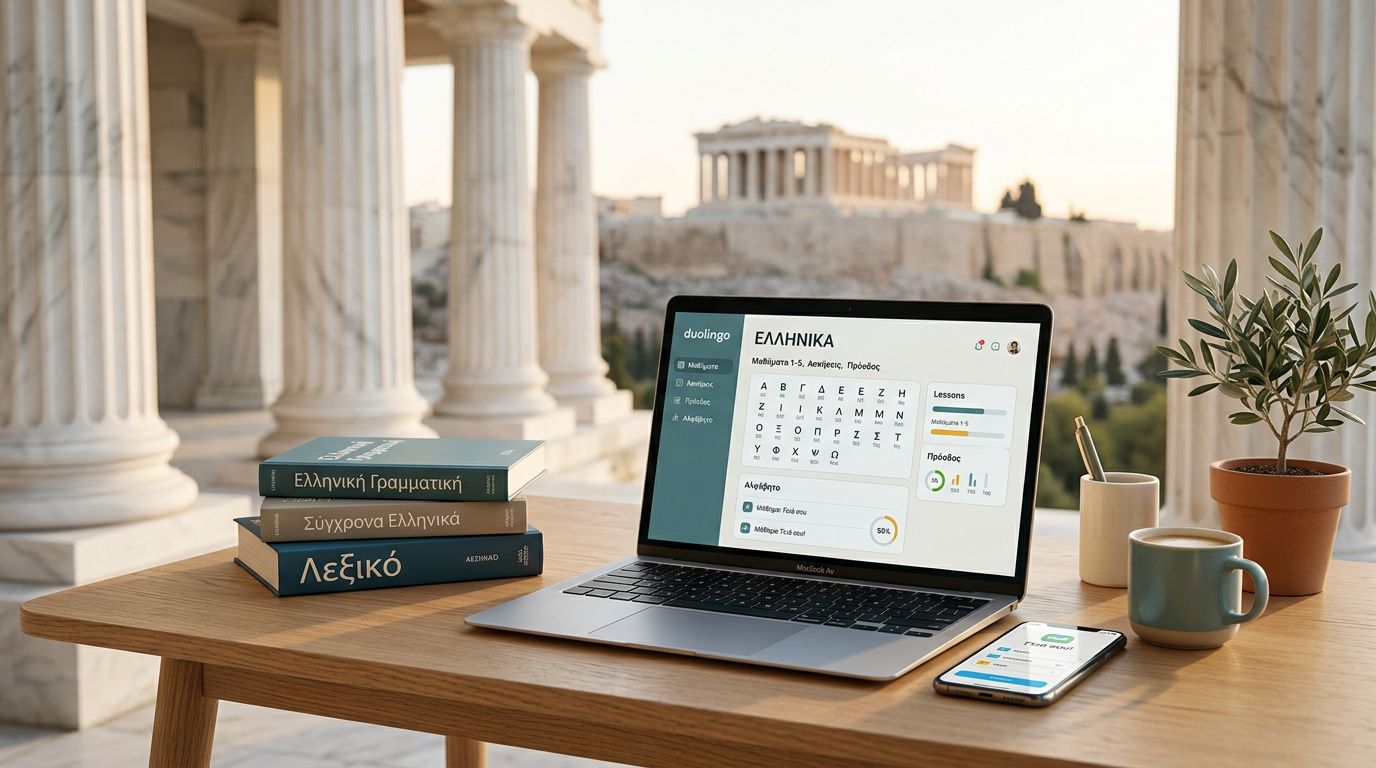
Modern Greek is easy to start and hard to outgrow. A flashy app can get you through greetings, but it won’t carry you through articles, verb forms, or real conversation. If you want the best Greek learning apps for serious progress in 2026, you need tools that help you read, listen, recall, and speak, not just tap through pretty screens.
That means choosing by job, not by hype. One app can handle sentence practice, another can feed you real Greek, and a tutor can fix what self-study misses. The list below keeps that split in mind.
Quick comparison of the best Greek learning apps
Here is the fast version.
| App | Best for | Strengths | Weaknesses | Pricing model | Serious long-term study? |
|---|---|---|---|---|---|
| Taalhammer | Sentence-based grammar and recall | Full-sentence practice, spaced review, word-order training | Less playful, smaller brand presence | Paid subscription | Yes, as a core app |
| LingQ | Reading and listening with real Greek | Large input, transcripts, vocab tracking | Open-ended, less hand-holding | Freemium, paid tiers | Yes, if you self-direct |
| GreekPod101 | Audio lessons and explanations | Structured lessons, grammar help, listening practice | Can become passive | Subscription, free samples | Yes, as a support layer |
| Preply | Live speaking practice | Native feedback, custom lessons, conversation | Cost varies, no built-in course path | Pay per lesson | Yes, essential for speech |
| Babbel | Structured beginner-to-lower-intermediate course | Clear path, adult-friendly pacing | Limited advanced depth | Subscription | Good foundation, not enough alone |
| Mango Languages | Daily review and basic conversation | Short lessons, simple interface | Not deep enough for advanced work | Subscription, sometimes library access | Limited, best as support |
| Duolingo | Habit building and very early practice | Easy entry, quick daily sessions | Too shallow for serious study | Free + paid plan | Weak as a main tool |
| Drops and Memrise | Vocabulary and phrase review | Fast word practice, short sessions | Little grammar or speaking depth | Freemium, paid upgrades | Only as support |
The split is clear. Taalhammer, LingQ, GreekPod101, and Preply can anchor a real study plan. Babbel and Mango help you build structure. Duolingo, Drops, and Memrise can keep Greek in your day, but they cannot carry the load by themselves.
What serious Greek learners should look for
Before paying for any app, ask what it makes you do. A serious Greek tool should push you toward full sentences, not just word labels. It should also give you clear audio, useful review, and enough grammar support to explain why forms change.
If you compare this list with Langoly’s Greek app guide, you will notice a common pattern. Many roundups still reward the easiest app to start. That matters for beginners, but serious learners need something that still helps after the first month.
A good filter is simple. Read recent reviews, look for complaints about audio, billing, or progress sync, and ignore polished app-store blurbs. The method in vetting language app quality is useful here because it focuses on the problems that affect real study, not just star ratings.
If an app stops being useful after a few weeks, it is a practice tool, not a study system.
Match the app to the job
Serious Greek study works better when each tool has one job. Structured courses help you build habits and basic grammar. Immersion apps help you read and listen for longer stretches. Tutoring forces output. Vocabulary apps fill gaps, but they do not teach a language on their own.
A simple map helps:
- Structured course: Babbel, Mango Languages, and GreekPod101
- Immersion: LingQ
- Tutoring: Preply
- Sentence memory and grammar patterns: Taalhammer
- Vocabulary support: Drops and Memrise
- Habit building: Duolingo
That said, no app should stay in one box forever. A beginner may start with Mango, move into Taalhammer or LingQ, then add Preply. A stronger learner may use Babbel for review and switch the main time to real Greek input. Broad lists like BullishLang’s Greek app roundup still rank easy starters high, and that makes sense. The problem starts when easy starts are treated as a full plan.
The apps that earn a place in a real Greek study plan
The apps below are strongest when you use them for the right task. None of them is magic. Each one solves a specific problem, and each one leaves something out.
Taalhammer
Taalhammer is the strongest choice if you want Greek to stick. It centers full sentences, active recall, and spaced review, so you practice how the language actually behaves. That matters in Greek, where endings, articles, and word order carry more weight than many apps admit.
Its big strength is retention. Instead of collecting vocabulary like souvenirs, you keep meeting words inside patterns. That helps with grammar, too, because the forms stop feeling random after a while. For a serious learner, that is a real advantage.
The downside is that it feels less playful than gamified apps. It also asks for patience, which casual learners often dislike. Pricing is usually on a paid subscription model, so it is not the cheapest route.
Taalhammer works best for committed beginners, lower-intermediate learners, and self-studiers who want a core system. Pair it with audio input or a tutor, because sentence practice alone will not give you enough listening or speaking pressure.
LingQ
LingQ is one of the best Greek learning apps for reading and listening with real content. It gives you articles, audio, transcripts, and vocabulary tracking, so you learn through material that feels alive. That is a big deal once you move past textbook lines.
The app shines when you already enjoy self-study. You can import or browse content, save words, and keep returning to the same text until it starts to feel natural. In other words, it trains you to spend time with Greek, which is where durable progress comes from.
The weakness is the learning curve. LingQ can feel open-ended, and some learners get lost without a plan. It also works better as an input engine than as a full course. Pricing is freemium with paid tiers.
LingQ is strongest for intermediate learners and motivated beginners who do not mind uncertainty. Pair it with a grammar-focused app or course, because LingQ will not explain every form for you. If you want deeper context on sentence-level word work, Clozemaster’s 2026 Greek app review is a useful comparison point.
GreekPod101
GreekPod101 is the best fit for learners who want guided audio lessons. It offers structured episodes, listening practice, and grammar explanations, so it feels closer to a mini-course than a game. That makes it useful when you want support without losing pace.
The main strength is clarity. Lessons usually give you a clear target, and that helps when Greek grammar starts to feel slippery. It is also useful for commuters or anyone who likes to study by listening. For many adults, that format is easier to keep than pure reading drills.
Its weakness is passivity. If you only listen, you can feel productive without producing much. The app also works better when you take notes or repeat lessons, not when you treat it like background audio. Pricing is subscription-based, with free samples and paid access to deeper content.
GreekPod101 is a good fit for beginner through advanced learners, depending on the lesson level you choose. It works well as a grammar and listening companion, but it should sit next to a more active app or a speaking outlet.
Preply
Preply is not a course app in the usual sense, but it may be the most important tool on this list for speaking. It connects you with tutors, so you can get live correction, real conversation, and custom help with the exact problems you keep missing. That kind of feedback is hard to replace.
Its strength is obvious once you start talking. A tutor hears what your app never notices, especially pronunciation, sentence rhythm, and gaps in your active vocabulary. For serious learners, that feedback can save months of guessing.
The tradeoff is cost. You pay per lesson, so the price depends on how often you book and which tutor you choose. Tutor quality also varies, which means you need to sample carefully. If you want the strongest use of your budget, fewer good lessons beat many random ones.
Preply works for all levels, but it becomes especially valuable after the first few weeks of self-study. Pair it with a structured app like Taalhammer or Babbel, because tutoring works best when you arrive with material to discuss.
Babbel
Babbel is one of the cleanest structured-course options for adults. It gives you guided lessons, practical grammar, and a steady pace that does not feel childish. That makes it attractive if you want order without a school workbook.
The strongest case for Babbel is consistency. It helps you build a habit, and its lesson design usually suits serious beginners and lower-intermediate learners. For many adults, that balance is easier to maintain than a fully open platform. The full Babbel review for language students goes deeper into where it helps and where it stops.
Its limit is depth. Babbel can build a base, but it is not enough for advanced Greek on its own. Once you need freer listening, wider reading, or more natural conversation, you will want another source. Pricing is subscription-based.
Babbel is best for learners who want a structured start and a clean path. It is useful long-term only if you treat it as one layer in a larger plan.
Mango Languages
Mango Languages is a good support app for short daily lessons. It covers useful phrases, basic grammar, and some pronunciation work, so it can help you keep Greek in view even on busy days. The lessons are simple, and that is part of the appeal.
Its strength is low friction. You can do a little each day without much setup, which is useful for students with tight schedules. Mango also suits people who want a lighter, calmer interface than the streak-heavy apps.
The drawback is depth. Mango can help you get started, but it will not take you very far by itself. Serious learners usually outgrow it once they need more reading, more listening, or more grammar detail. Pricing is usually subscription-based, and some users may access it through libraries or institutions.
Mango works best for beginners and busy adults who want a second app for review. Pair it with LingQ, Taalhammer, or a tutor if you want real progress beyond the basics.
Duolingo, Drops, and Memrise
These three belong in the support category, not the core category. Duolingo is useful for habit-building and very early exposure, but its Greek course does not go deep enough for serious long-term study. Drops is better for quick vocabulary review, while Memrise helps with words and phrases through short clips and repetition. Mondly sits close to this group too, useful for basics but not enough on its own.
Their strength is convenience. You can use them in spare minutes, and that makes them good for keeping Greek in your daily rotation. They also help some learners overcome the fear of starting. That matters more than many people admit.
The weakness is depth. Duolingo, Drops, and Memrise do not give you enough grammar, reading, or speaking pressure to carry a whole plan. They can also create a false sense of progress if you rely on streaks alone. Pricing is freemium, with paid upgrades for more features.
Use these apps for light reinforcement, not for your main study. If you want a serious path, keep them in the background and make sure your core work happens elsewhere.
Building a Greek study stack that lasts
Most serious learners do better with a stack than with a single app. One tool builds structure, another gives you input, and a third forces speech. That is enough to cover most weak points without drowning in options.

A balanced setup can look like this:
- Taalhammer plus Preply for learners who want sentence control and live correction.
- LingQ plus GreekPod101 for readers and listeners who want more input.
- Babbel or Mango plus a tutor for adults who want a gentle start.
The best stack is the one you will keep using after the first burst of enthusiasm. If one app gets boring, that is fine. Greek study is not a sprint, and boredom is easier to handle than confusion. Choose the tool that removes friction, then add the tool that fills the gap.
Conclusion
Modern Greek rewards patience more than novelty. The best Greek learning apps are the ones that make you read, listen, recall, and speak in the right order. For most serious learners, that means one core app like Taalhammer or LingQ, one structure app like GreekPod101 or Babbel, and one speaking outlet like Preply.
If you keep one rule in mind, make it this: use each app for the job it does best, then cover the missing piece elsewhere. That mix is far more useful than chasing a single perfect app.
Ready to Take Your Language Learning Further?
Your favorite language-learning app is a great place to start. Rocket Languages can help you go further with interactive audio lessons, pronunciation practice, real-world conversations, and structured learning.
Explore Rocket Languages →Affiliate disclosure: We may earn a commission if you purchase through this link, at no additional cost to you.