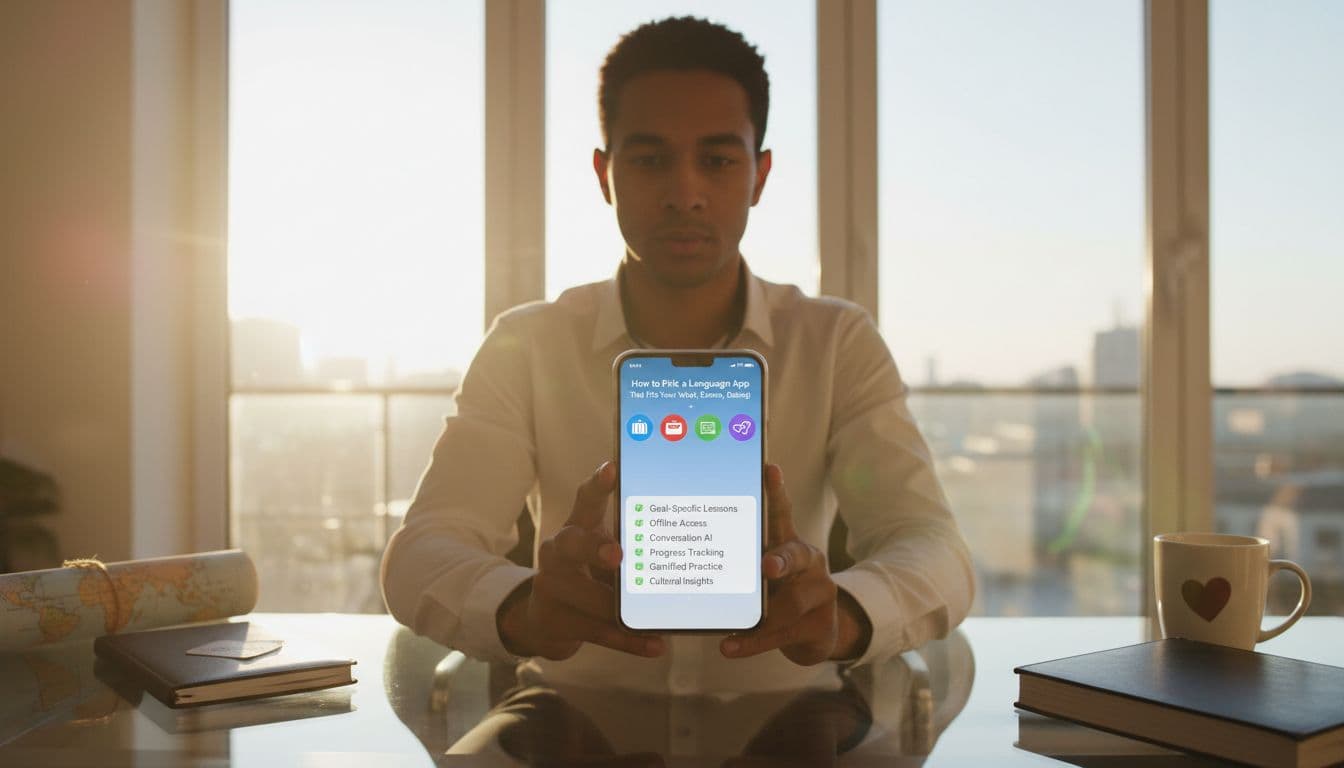
Choosing a language learning app can feel like buying shoes online. Most look good in photos, but only a few fit your feet and your day-to-day life.
The fastest way to avoid wasting time (and subscriptions) is to start with your outcome, then match features to that outcome. A traveler needs different tools than someone writing client emails, preparing for a CEFR exam, or trying to sound natural on a first date.
Start with the outcome, not the app
Before you compare apps, write one sentence that describes success. Keep it concrete.
- Travel: “I want to order food, ask for directions, and handle check-in without panic.”
- Work: “I want to lead meetings, write clear emails, and understand my team.”
- Exams: “I want a B2 score with strong listening and writing under time pressure.”
- Dating/social: “I want playful, natural chats, and I don’t want to sound rude.”
That sentence tells you what to demand from an app. If the app can’t practice your real situations, it’s entertainment, not training.
Match your goal to the right feature set
If your goal is travel, pick speed and offline reliability
Travel learning is about short bursts and high usefulness. You’re not studying literature, you’re trying to function.
Look for:
- Offline mode that includes audio, not just text. Airports and subways don’t care about your signal.
- Travel phrase coverage that goes beyond greetings, including doctors, pharmacy, transport, allergies, and payment.
- Strong speech recognition for quick pronunciation fixes (especially for names, numbers, and common requests).
- Scenario practice: checking into a hotel, ordering with substitutions, handling refunds.
A good travel-first app feels like a pocket coach. You practice “two tickets to…” and “I’m allergic to…” until they come out fast.
If your goal is work, prioritize writing feedback and role-specific language
Work fluency is not only speaking. It’s tone, clarity, and accuracy when stakes are real.
Look for:
- Workplace vocabulary tracks (your field if possible: sales, healthcare, tech, hospitality).
- Writing practice with corrections for emails, reports, and chat messages, including tone (formal, neutral, friendly).
- Meeting and call roleplays (interrupting politely, clarifying, summarizing, disagreeing).
- CEFR alignment or level mapping, because employers often recognize CEFR.
If you’re comparing mainstream platforms, it helps to see how different teaching styles affect structure and speaking practice. This Rosetta Stone vs Duolingo: detailed comparison is a useful example of what to look at when you’re choosing between “immersive and structured” and “quick and gamified.”
If your goal is exams, demand timed tasks and measurable alignment
Exam prep needs pressure testing. If an app never forces you to answer under time limits, it’s not preparing you for exam day.
Look for:
- Timed mock tests for reading and listening.
- Writing tasks graded with clear rubrics (task response, organization, grammar range).
- Speaking prompts that match exam formats, with recordings you can review.
- Strong CEFR alignment (or the exam’s own level system), so you can track readiness.
For some learners, AI tools can help with repetition and instant corrections, but treat them as practice partners, not final judges. Human grading still matters most for high-stakes writing.
If your goal is dating or social life, choose natural conversation practice
Dating language is emotional and fast. Textbook lines can sound stiff, even if they’re correct.
Look for:
- AI conversation roleplays that let you flirt lightly, tell stories, and recover from mistakes.
- Feedback on register (too formal, too blunt, too intense).
- Cultural notes for texting and humor (what feels friendly in one culture can feel strange in another).
- Voice-note style practice, because real chats are rarely perfect sentences.
A good dating-focused app teaches you how to sound like a person, not a phrasebook.
The 2025 features that actually change results (and what to watch for)
In late 2025, many apps push AI tutors, speech scoring, and personalization. Some of it is useful, some is marketing. Here’s how to judge it.
AI conversation tutors: The best ones handle free-form talk and give corrections that make sense. They should explain errors in plain language and help you try again, not just show a “correct version.” If you want context on how AI tutoring is being used in language study, LanguaTalk’s overview is a solid starting point: https://languatalk.com/blog/whats-the-best-ai-for-language-learning/
Speech recognition quality: Don’t trust a demo video. Test it in your real environment (street noise, cheap earbuds). Say the same sentence three times. If the score swings wildly, it won’t train your pronunciation well.
SRS and spaced repetition: Vocabulary sticks when an app brings words back at the right time, inside sentences, with audio. If SRS is only isolated flashcards, you may remember meanings but freeze when speaking.
CEFR alignment: This matters for work and exams, and it also helps travelers avoid random lesson order. The app should show what “A2 listening” or “B1 speaking” means in practice.
Human tutoring or community: AI can give volume, humans give judgment. If your goal is serious (job interview, exam, relocation), choose an app that offers easy upgrades to live sessions or feedback.
Privacy and data sharing: Many apps collect voice recordings and chat logs. Read the privacy settings and look for opt-outs, data deletion options, and clear language about model training.
For a broad view of how apps package these features in 2025, this roundup can help you build a shortlist: https://makesyoufluent.com/ai-language-learning-apps/
Pricing and platform support: the hidden deal-breakers
Pricing is not just “monthly vs yearly.” In 2025, many plans are feature-gated.
Check for:
- Limits on AI tutor time (minutes per day or per month).
- Extra fees for mock tests, certificates, or writing corrections.
- Offline access restrictions (some apps only allow downloads on premium tiers).
- Device support (iOS/Android, web app, tablets), plus sync reliability across devices.
If you’re deciding between two apps that feel similar, pick the one you’ll actually open daily. A slightly worse course that you use beats a perfect course you avoid.
Quick feature checklist (test these in 10 minutes)
| Feature to check | Why it matters | Quick test |
|---|---|---|
| AI conversation roleplay | Builds speaking under real conditions | Try a 3-minute roleplay and ask for corrections |
| Speech recognition feedback | Fixes pronunciation early | Repeat one sentence 3 times in a noisy room |
| Offline mode with audio | Saves you while traveling | Download a lesson, then turn on airplane mode |
| SRS (spaced repetition) | Helps recall when speaking | See if words reappear days later in sentences |
| CEFR or level mapping | Makes progress measurable | Look for a placement test and level labels |
| Writing feedback | Essential for work and exams | Submit a short email or paragraph for correction |
| Human tutoring/community | Adds real accountability | Check if booking a session is easy and transparent |
| Privacy controls | Protects voice and chat data | Find opt-out and delete-data options in settings |
3-step action plan to choose and validate an app in 7 days
- Day 1: Write your “success sentence” and pick 2 real scenarios. Example: “Hotel check-in” and “restaurant problem,” or “weekly status update” and “client email.”
- Days 2 to 6: Run a daily 15-minute test routine. Do one speaking task, one review (SRS), and one goal-specific task (mock test, email rewrite, or dating roleplay). Track what feels easier by Day 6.
- Day 7: Decide using evidence, not vibes. Keep the app that improved speed, confidence, and accuracy in your scenarios. Cancel the rest.
Conclusion
The best language learning app is the one that rehearses your real life, then corrects you in a way you can use tomorrow. Start with your goal, test the features that match it, and give yourself one focused week to prove what works. When your practice matches your target moments, progress stops feeling mysterious and starts feeling repeatable.
Ready to Take Your Language Learning Further?
Your favorite language-learning app is a great place to start. Rocket Languages can help you go further with interactive audio lessons, pronunciation practice, real-world conversations, and structured learning.
Explore Rocket Languages →Affiliate disclosure: We may earn a commission if you purchase through this link, at no additional cost to you.