Yes, you can learn Cornish online through free audio courses, beginner videos, written lessons, and tutor-supported study. You don’t need several subscriptions to begin, but you do need a small, repeatable routine that includes speaking aloud.
The main difficulty is choosing resources that work together rather than collecting disconnected phrases. Start with one learning path, add replayable audio, and use your first month to build foundations rather than chase fluency.
Key Takeaways
- SaySomethinginCornish offers a free audio course, while Cornish with Clive provides free beginner video lessons.
- KDL offers tutor-supported correspondence study, and Go Cornish provides structured beginner materials.
- Commercial phrase apps can supplement a course, but they shouldn’t carry your entire study plan.
- A useful first-month goal is understanding familiar phrases and producing short replies without reading every answer.
Where to Learn Cornish Online
Free starting points
The Learn Cornish beginner guide is a free, five-minute introduction that doesn’t require an account. It points learners toward audio, an app, a dictionary, and opportunities to practise with others.
For ongoing lessons, Cornish with Clive offers free structured beginner videos. Video suits learners who want to hear explanations while following written examples.
Go Cornish also provides beginner material. Its Grade 1 course covers greetings, questions and answers, numbers, and simple language. Separately, GoCornish WJEC Entry Level video materials combine worksheets and activities with roughly 10 to 12 hours of study.
These are different routes, so choose one sequence rather than starting them all.
Tutor-supported and written courses
KDL, short for Kernewek Dre Lyther, offers correspondence learning with a designated tutor. It runs from beginner to advanced study and aligns with Kesva grades 1 to 4.
That structure suits independent learners who want someone to review their work. A tutor can also help explain a recurring error that repeated exercises haven’t resolved.
For a written alternative, Quick Cornish, or Kernowek Qwyck, contains 15 grammar-based PDF lessons. It suits learners who like explicit explanations, although written work still needs listening and spoken practice.
We recommend choosing according to how you’ll study regularly: video for explanation, correspondence for feedback, or written lessons for deliberate grammar work.
Choose Supporting Tools Without Duplicating Your Course
Apps and dictionaries have different jobs
uTalk offers Cornish words and practical phrases through a commercial learning product. Treat it as supplementary vocabulary and phrase practice rather than assuming it supplies a complete grammar curriculum.
There’s no need to add a paid app immediately. Free beginner lessons and audio already provide a workable starting combination.
The Akademi Kernewek Gerlyver is an online dictionary recommended by Learn Cornish. Use it to understand words you meet in lessons, then save the whole example sentence when possible.
A dictionary answers a particular question. Your main course should still decide what you study next.
Keep spelling and audio consistent
Cornish resources can use different written conventions and pronunciation models. The Standard Written Form is one convention you’ll encounter, while some courses follow other approaches.
For example, the beginner Late Cornish course associated with Desky Kernowek provides 24 downloadable MP3 lessons. It offers a particular learning route rather than interchangeable recordings for every textbook.
During your first month, keep your main written lessons and pronunciation model together. If another resource shows a different spelling, note its source instead of immediately treating either version as an error.
Make Cornish Audio an Active Exercise
SaySomethinginCornish’s free audio course is an accessible option for learners who want to practise through listening and speaking. Go Cornish describes it as an audio-only course produced in partnership with MAGA.
However, familiarity with a recording doesn’t automatically mean you can answer someone. Give yourself opportunities to retrieve language before hearing the model.
Use this short practice sequence:
- Listen to a manageable section and establish its meaning.
- Replay it, pausing to produce a familiar response before the recording supplies it.
- Repeat a difficult sentence, then record your own version separately.
- Compare one feature, such as vowel quality, rhythm, or a missing sound.
If a transcript accompanies your chosen material, listen once before reading it. Then use the text to resolve what you missed.
Keep a brief pronunciation note rather than trying to fix everything simultaneously. One clear target makes the next repetition more useful.
Background listening can supplement this work. For focused sessions, however, choose a quiet place where you can pause and speak. Several attentive repetitions of a short exchange are more useful than finishing a long recording without attempting any replies.
Your First-Month Plan: Weeks 1 and 2
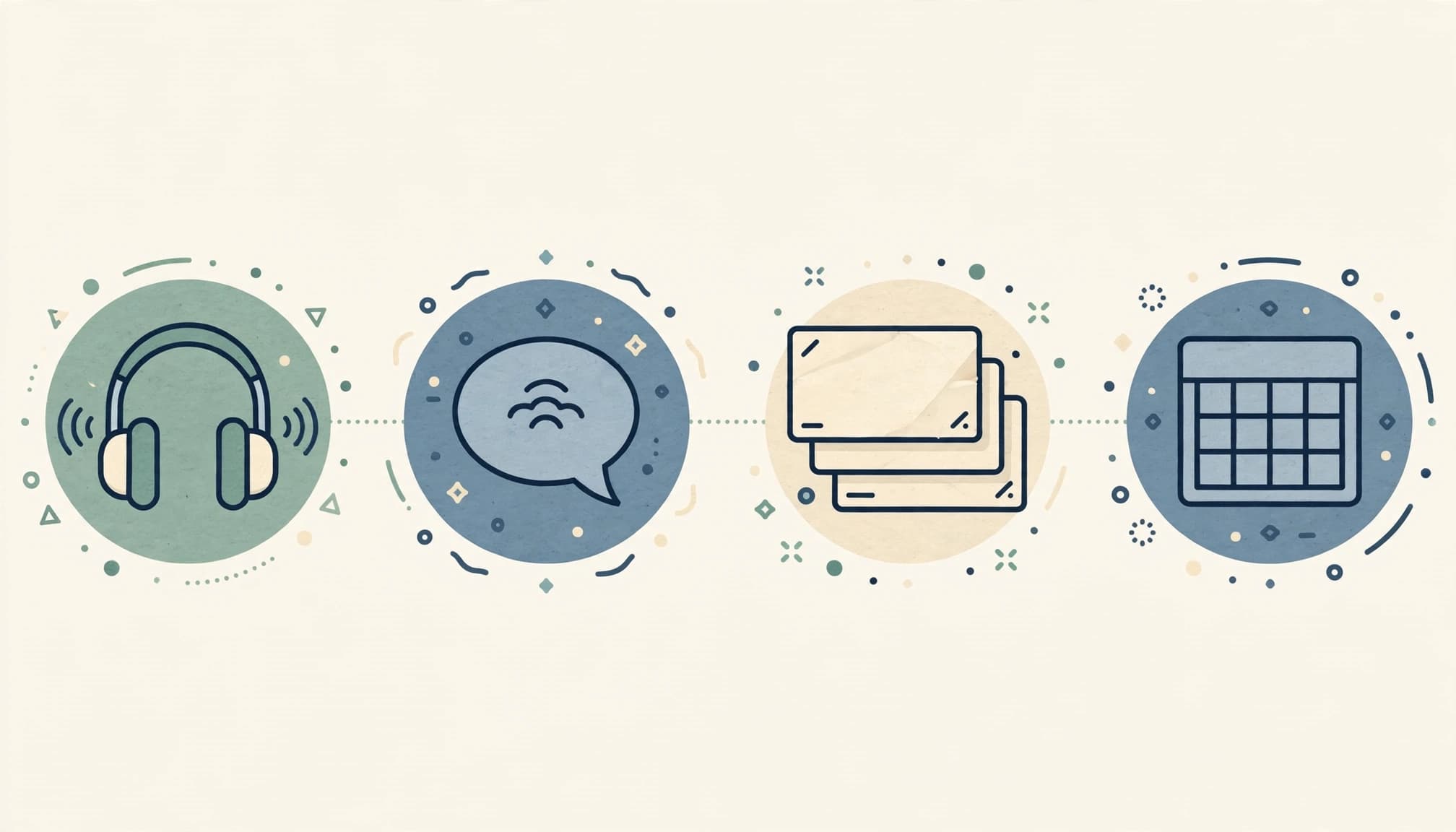
Aim for about 20 minutes on five days each week. This is a suggested routine, not a provider’s timetable. Shorten it when necessary so returning tomorrow remains manageable.
Week 1: Settle into one course
Choose your main course and work through its opening material in order. Spend roughly ten minutes on a lesson, five replaying audio, and five recalling familiar phrases.
Concentrate on the functions your course introduces, such as greeting someone, giving your name, or understanding a simple question. Avoid adding unrelated vocabulary lists.
At the end of the week, record a brief introduction using only language you’ve learned. Notes are fine for preparation, but make one attempt without reading them.
Keep this recording. It gives you a concrete starting point for comparison later.
Week 2: Retrieve before you review
Begin each session by trying yesterday’s language before opening the lesson. Then revisit the parts you couldn’t recall.
Keep a small collection of useful sentences rather than isolated translations. If you make flashcards, take examples from your course and retain enough context to understand their use.
Also, give one session to a grammar point you’ve already encountered. Reuse its model sentences before attempting a new pattern.
If attention or consistency makes study difficult, our guide to ADHD-friendly language study tools discusses approaches to manageable sessions. A routine should be easy to restart after a missed day.
Weeks 3 and 4: Turn Practice Into Short Exchanges
Week 3: Produce language without the model
Continue your course, but reserve part of each session for spoken recall. Hide the written answer and respond to a familiar prompt.
Next, change one detail in a sentence using vocabulary you’ve already learned. This might mean substituting a name or number when your course has taught that pattern.
Twice this week, record a short spoken attempt. Compare it with course audio and choose one pronunciation feature to revisit.
Don’t measure success by speed. A slower answer produced independently is a useful step beyond repeating immediately after a recording.
Week 4: Add feedback and consolidate
Look for a beginner class or conversation opportunity alongside your independent study. Cornwall Council’s Cornish learning page directs learners toward classes and other learning resources.
Learn Cornish also recommends Yeth an Werin conversation circles. These provide a community connection, although a beginner class offers more explicit teaching.
Prepare a few familiar sentences before joining an exchange. Ask for help with one recurring difficulty rather than expecting corrections on everything.
Finally, repeat your first-week introduction. Compare how much support you need, where you hesitate, and which phrases now come more readily. Spend your remaining sessions repairing those gaps instead of rushing into another course.
What Progress Should Look Like After a Month
A month can establish beginner habits and a small usable foundation. It can’t promise conversational fluency, and completing lessons alone doesn’t show what you can retain.
Use a few practical tasks to judge progress.
Can you understand a familiar greeting without seeing its translation? Can you give a short introduction without reading? Can you recognise words inside a course recording rather than only on flashcards?
Also notice where your skills differ. You might read a sentence comfortably but struggle to recognise it by ear. In that case, repeat familiar audio before adding more written material.
Keep a simple weekly record of what you can understand and say. That gives you a better basis for the next month’s study than lesson totals alone.
Frequently Asked Questions
Can I learn Cornish online for free?
Yes. SaySomethinginCornish provides free audio learning, Cornish with Clive offers free beginner videos, and Learn Cornish has a free introductory guide. These give you a starting point without buying a subscription. Personal tuition and commercial apps are separate options.
Do I need a tutor immediately?
You can begin independently. A tutor becomes particularly useful when you need corrections, explanations, or help maintaining a study sequence. KDL provides a designated tutor within its correspondence route, while classes add scheduled contact with a teacher.
Which is better for beginners, audio or written lessons?
They support different skills. Audio develops listening and spoken rehearsal, while written lessons make spelling and grammar easier to examine. Choose one main course and add the missing element rather than expecting either format to do everything.
Build a Routine You Can Continue
Learning Cornish online is a realistic starting point when your resources have clear roles. Choose one course, practise its audio actively, and seek feedback as you begin producing your own replies.
Your first month’s strongest result is a repeatable study habit supported by language you can remember and use. Build on that foundation before adding more tools.
Ready to Take Your Language Learning Further?
Your favorite language-learning app is a great place to start. Rocket Languages can help you go further with interactive audio lessons, pronunciation practice, real-world conversations, and structured learning.
Explore Rocket Languages →Affiliate disclosure: We may earn a commission if you purchase through this link, at no additional cost to you.
