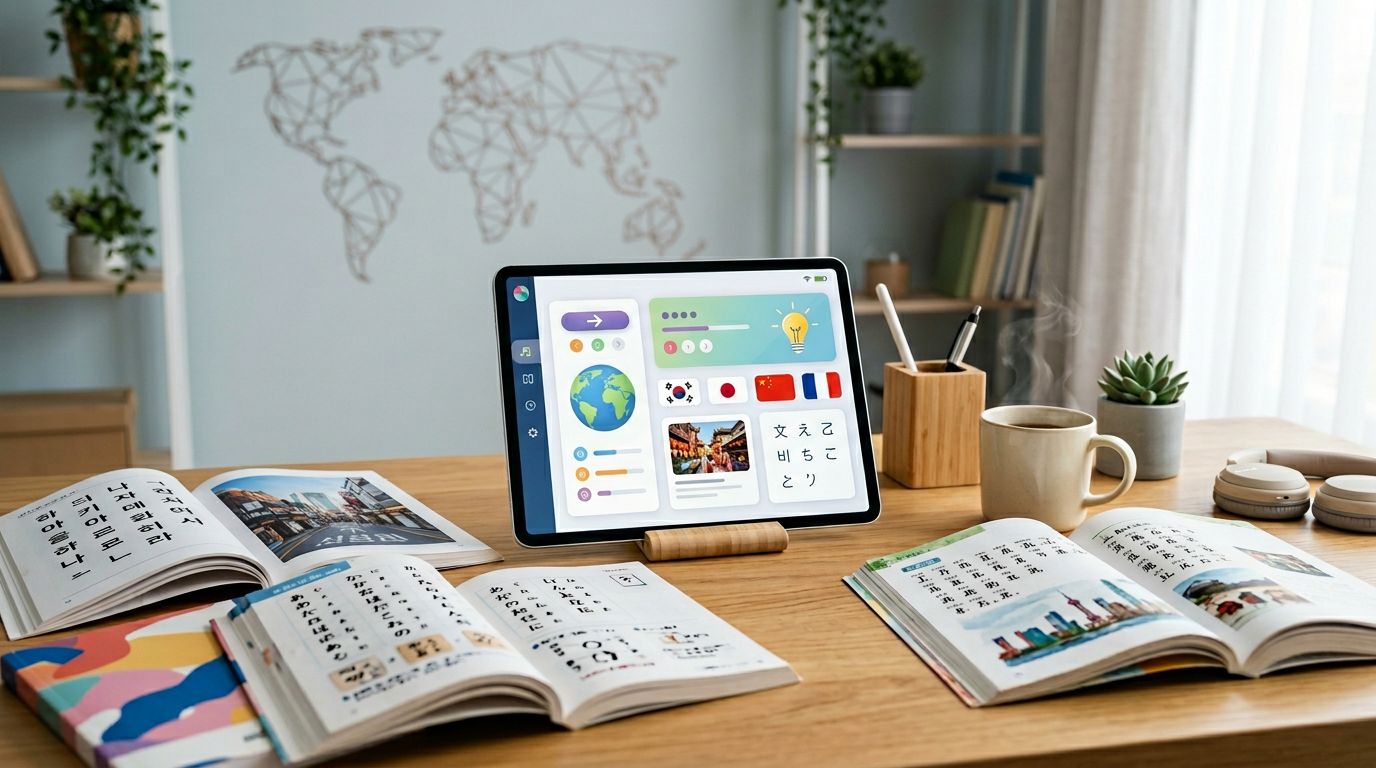
Many language apps help you tap the right answer and feel busy. Fewer help you build a base that can survive outside the app.
This LingoDeer review matters because the app sits in a useful middle ground. It is more structured than Duolingo, but less heavy than piecing together a textbook, flashcards, and grammar notes. For serious self-studiers in 2026, that balance can help, or it can cap your progress.
After looking at current features, pricing, and how the courses compare with rivals, the verdict is fairly simple. LingoDeer is strong for serious beginners, best in Asian languages, and weaker once you need open-ended speaking.
Where LingoDeer still feels stronger than most apps
LingoDeer still works best as a course, not a game. Lessons build in order, grammar shows up early, and you often create sentences instead of guessing from context. That alone makes it more useful than many streak-first apps.
Current 2026 listings and reviews also point to the same edge: LingoDeer handles Asian languages unusually well. Japanese, Korean, and Chinese learners get script training, slow introductions to new writing systems, and grammar that feels designed for the language instead of copied from a Spanish template. That matches what reviewers found in a 2026 Japanese-focused review and a Chinese review comparing it with Duolingo.

For European languages, the picture changes a bit. Spanish, French, German, and Portuguese courses are solid, but they are not as distinctive. You still get clear sequencing, audio by native speakers, review tools, and offline downloads. However, once the alphabet is familiar, LingoDeer’s special advantage shrinks.
Realistic progress depends on time and expectations. With four or five sessions a week, many learners can build a solid A1 or A2 base. Stronger courses can move you toward B1 in controlled reading and listening. That is good progress. Still, it is progress inside a guided system, not proof of real-world fluency.
If your target language uses a new script, LingoDeer gives you a better runway than most generalist apps.
Where LingoDeer falls short for long-term study
Speaking is the main limit. LingoDeer has pronunciation work and some voice recognition, but that is still guided practice. It does not create the pressure of a real conversation where you must listen, react, and repair mistakes on the spot.
Listening also stays clean. Audio quality is good, yet it rarely feels messy or fast in the way real speech does. Writing practice is useful at the start, especially for scripts, but it does not grow into long-form output.
That means serious learners should be careful about what “effective” means here. If you study daily for three months, LingoDeer can help you read basic sentences, recognize grammar patterns, and understand controlled audio. It probably will not prepare you for an unscripted call, tutoring session, or fast dinner conversation without outside help.
For lower-intermediate users, the review system can also feel a bit static over time. It reinforces weak points, but it is not deep enough to replace a dedicated spaced-repetition tool or live correction. Past the beginner stage, the app works better as one part of a study plan than as the whole plan.
How LingoDeer compares with Duolingo, Babbel, and Busuu
The quickest way to place LingoDeer is to compare what each app does best.
| App | Strongest use | Main limit |
|---|---|---|
| LingoDeer | Structured beginner courses, Asian scripts | Limited speaking depth |
| Duolingo | Free habit-building | Weaker grammar explanation |
| Babbel | Adult-focused European language courses | Less impressive for Asian languages |
| Busuu | Guided output and CEFR-style paths | Smaller catalog, feedback varies |
Compared with Duolingo, LingoDeer is less addictive but more serious. It explains more, asks for better sentence work, and wastes less time on streak mechanics. Compared with Babbel, it is stronger for Japanese, Korean, and Chinese, while Babbel often feels better tuned for major European languages. If Babbel is on your shortlist, this Babbel review 2026 adds more detail, and this LingoDeer vs Babbel comparison lands in a similar place.
Busuu is closer. Both feel more course-like than Duolingo. Still, Busuu pushes output a bit harder and maps progress more clearly, while LingoDeer wins on scripts and lesson clarity for Asian languages. For more on that trade-off, see this Busuu review 2026.
If your main goal is speaking, a more serious next step is outside the app category. Platforms like italki or Lingoda make you produce language with a person, and that matters once you move beyond beginner work.
Is LingoDeer worth paying for in 2026?
Public 2026 pricing snapshots put LingoDeer at about $14.99 monthly, $39.99 quarterly, $95.99 yearly, and around $199.99 for a discounted lifetime plan. The lifetime offer looks better than the monthly plan if you know you will stick with it.
Value depends on your use case. For Japanese, Korean, or Chinese, the paid version is easier to justify because the script tools and course design are better than what most rivals offer. For beginner Spanish or French, the value is less obvious because Babbel and Busuu are strong alternatives, and Duolingo still covers basic habit-building for free. Before paying, it is smart to run a quick 15-minute paywall honesty check because promo prices and renewal terms can vary by store and region.
Best for
Serious beginners, returning learners, and self-studiers who want grammar, structure, and strong support for Asian languages.
Not ideal for
Upper-intermediate learners, speaking-first learners, and anyone hoping one app will carry them to confident conversation alone.
Bottom line
LingoDeer is good enough to be a primary tool at the start, especially for Asian languages. After that, it works better as a supplement. The app teaches foundations well. It does not replace conversation practice, tougher listening, or broader reading.
If you want an app that feels like real study and not only a streak, LingoDeer still earns a place in 2026. If you need the language to live outside the app, you will outgrow it, and that is the honest limit.
Ready to Take Your Language Learning Further?
Your favorite language-learning app is a great place to start. Rocket Languages can help you go further with interactive audio lessons, pronunciation practice, real-world conversations, and structured learning.
Explore Rocket Languages →Affiliate disclosure: We may earn a commission if you purchase through this link, at no additional cost to you.