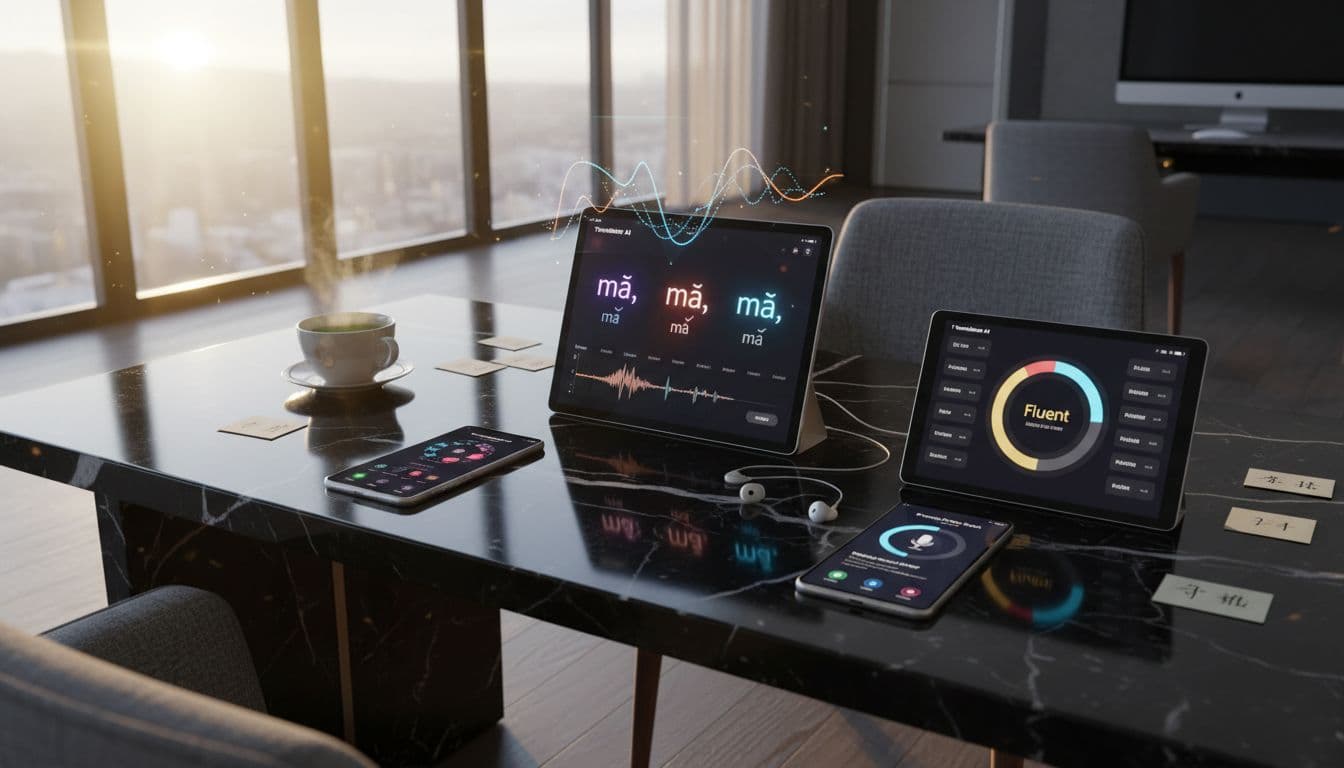
Mandarin tones can feel like singing a melody while juggling vocabulary. You might know the right word, then one pitch change turns it into a different word. That’s why the best mandarin tone apps don’t just teach meaning, they train your ear and your voice.
In January 2026, tone practice has gotten easier to fit into real life. You can do quick tone-pair drills on the train, record yourself between meetings, and get instant feedback. Still, the app you pick matters because not all feedback is equally helpful.
What to look for in mandarin tone apps (so you don’t waste time)
A good tone app does two jobs: it helps you hear tone differences and it helps you produce them. Most learners need both.
Look for these features:
- Tone pair practice (like 2-3, 3-3, 4-4), because tones change fastest in combination.
- Minimal pairs (shi vs xi), since consonants and tones often get mixed up together.
- Clear feedback, ideally with a model audio you can copy, not just a pass or fail.
- Dictation or listening checks, to build tone recognition under speed.
- A plan you’ll actually follow, because tones improve through repetition, not one big study day.
The best language apps for mastering Mandarin tones in 2026
HelloChinese (best all-in-one course with tone feedback)
Platforms: iOS, Android
Pricing/free trial: Free (ads), Premium $9.99/month or $59.99/year, 7-day free trial (pricing can change)
Tone training: In-app speaking checks, pronunciation exercises, and tone-focused pinyin learning with visual cues; feedback is fast but not perfect.
Ideal level: Beginner to intermediate
Pros/cons: Strong structure and lessons, but tone-pair depth is limited compared with specialist tools.
Recommendation: Choose HelloChinese if you want tones built into a full beginner path, not a standalone drill app. Official listing: https://apps.apple.com/us/app/hellochinese-learn-chinese/id1001507516?l=zh
Ka Chinese Tones (best for fast, addictive tone drills)
Platforms: Web app (works well on mobile and desktop browsers)
Pricing/free trial: Free to use (as stated on the app’s site)
Tone training: Ear training, quick recognition rounds, and speaking exercises that flag mispronounced tones; great for minimal-pair style confusion.
Ideal level: Beginner to intermediate (also useful as a daily warmup later)
Pros/cons: Very focused and time-efficient, but it won’t teach you broader Chinese skills.
Recommendation: Use Ka as your 5 to 10-minute daily tone gym, alongside a course app. https://chinesetones.app/
Speechling (best for serious speaking practice and feedback quality)
Platforms: iOS, Android, web
Pricing/free trial: Free limited plan; Unlimited $19.99/month; includes a limited monthly feedback allowance on the free tier (details can change)
Tone training: Record-and-repeat sentences, model audio, and a mix of AI and human-style coaching workflows; better for whole-sentence tone flow than single-syllable drills.
Ideal level: Beginner to advanced
Pros/cons: Feedback quality is strong, but it can feel slower if you rely on reviewed submissions.
Recommendation: Pick Speechling if you want tones to sound natural inside real sentences, not just isolated syllables.
Pleco (best for tone accuracy through listening and spaced repetition)
Platforms: iOS, Android
Pricing/free trial: Core dictionary is free; add-ons are one-time purchases (often $9.99 to $29.99); no trial needed for the free base
Tone training: High-quality native audio models and customizable flashcards; you can build tone-pair decks and review with spaced repetition, but there’s no live tone scoring.
Ideal level: All levels (shines at upper-beginner and beyond)
Pros/cons: Amazing as a daily “truth source” for pronunciation, but you must self-check your own tones.
Recommendation: Use Pleco as your reference and review engine, then pair it with an app that grades speaking.
Talkpal (best for tone practice in live conversation)
Platforms: Mobile apps plus web access (availability can vary by region)
Pricing/free trial: Free tier; Premium plans from about $4.99/month; trial availability varies
Tone training: AI voice chats that push you to speak more; useful for volume and confidence, with instant pronunciation prompts.
Ideal level: Lower-intermediate and up (beginners can use it, but may feel overwhelmed)
Pros/cons: Great for getting words out fast, but tone scoring can be inconsistent, and there are no detailed pitch graphs.
Recommendation: Use Talkpal to turn tone work into real dialogue practice, then validate tricky words with native audio elsewhere. Context and overview: https://talkpal.ai/master-chinese-tone-practice-app-for-perfect-pronunciation/
Duolingo Chinese (best free option for habit and exposure)
Platforms: iOS, Android, web
Pricing/free trial: Free with ads; Super subscription pricing varies by region (the free path is still usable)
Tone training: Lots of listening and repetition, plus speaking prompts; good for exposure, weaker for precise tone correction.
Ideal level: Beginner
Pros/cons: Easy to stick with, but feedback can be forgiving, so tone errors may slip through.
Recommendation: Use it for daily momentum, but add a tone-focused tool if tones are your main goal.
Hanziway Tone Trainer (best browser-based tone pair and pattern training)
Platforms: Web (desktop and mobile browser)
Pricing/free trial: No pricing shown on the Tone Trainer page (it runs in the browser)
Tone training: Tone single, pair, triple, and quadruple drills with adjustable task counts; great for recognition and quick pattern reps.
Ideal level: Beginner to intermediate
Pros/cons: Clean drill format, but it’s not a full learning system, and it doesn’t coach your speaking in depth.
Recommendation: Keep this as a “tone pairs first” trainer when your biggest problem is tone combos. https://hanziway.com/en/tonetrainer
Quick comparison table (features that matter for tones)
| Feature | HelloChinese | Ka Chinese Tones | Speechling | Pleco | Talkpal | Duolingo Chinese | Hanziway Tone Trainer |
|---|---|---|---|---|---|---|---|
| Pitch contour visuals | Some | No | Pitch comparison style | No | No | No | No |
| Tone-pair drills | Limited | Some | In sentences | DIY via decks | In conversation | Limited | Strong |
| Minimal pairs / contrast | Some | Strong | Medium | DIY | Medium | Limited | Medium |
| Dictation/listening checks | Some | Strong | Medium | Medium | Medium | Medium | Strong |
| Live speaking feedback | Yes (AI) | Yes (basic scoring) | Yes (AI plus coaching flow) | No | Yes (AI) | Yes (basic) | No |
| Full course content | Yes | No | No | No | No | Yes | No |
Best picks by goal (so you can choose fast)
- I want the most efficient daily tone training: Ka Chinese Tones
- I want tones inside a structured beginner course: HelloChinese
- I want the best speaking correction loop: Speechling
- I want to practice tones while chatting: Talkpal
- I want accurate audio models and review power: Pleco
- I need a free habit-builder: Duolingo Chinese
- I want tone-pair drills without installing anything: Hanziway Tone Trainer
For more broad app options beyond tone specialists, this updated roundup can help you compare tools: https://www.alllanguageresources.com/best-apps-learn-chinese/
A reality check on AI tone scoring (and how to use it well)
AI feedback is helpful, but it’s not a judge at a speech contest. It can miss subtle contour issues, especially with tone sandhi, fast speech, background noise, or certain accents. Some apps also “pass” a tone if your rhythm sounds close enough.
A simple fix: treat AI scores as a filter. If it flags something, repeat it. If it passes something but you still feel unsure, compare to native audio and record yourself again.
A simple weekly practice plan (20 minutes, 5 days)
Day 1 (listening): 10 minutes minimal pairs, 10 minutes tone pairs.
Day 2 (speaking): Copy 15 short syllables, then 10 short words, record yourself.
Day 3 (tone pairs): Focus on 3-3, 2-3, 4-4 combos, slow first, then faster.
Day 4 (sentences): Shadow 8 to 12 sentences (Speechling style), match the pitch and pace.
Day 5 (real use): 10 minutes AI chat or speaking prompts, then correct 5 “problem words” with native audio.
Keep weekends light. Consistency beats marathon sessions for tones.
Conclusion
Tones don’t improve from one perfect explanation, they improve from hundreds of small corrections. The best mandarin tone apps in 2026 make those corrections quick and repeatable. Start with one tone specialist (Ka or Hanziway), pair it with a structured path (HelloChinese or Duolingo), then add higher-quality speaking feedback when you’re ready (Speechling). Pick your stack, follow the weekly plan for four weeks, and your tones will start to feel less like guesswork and more like muscle memory.