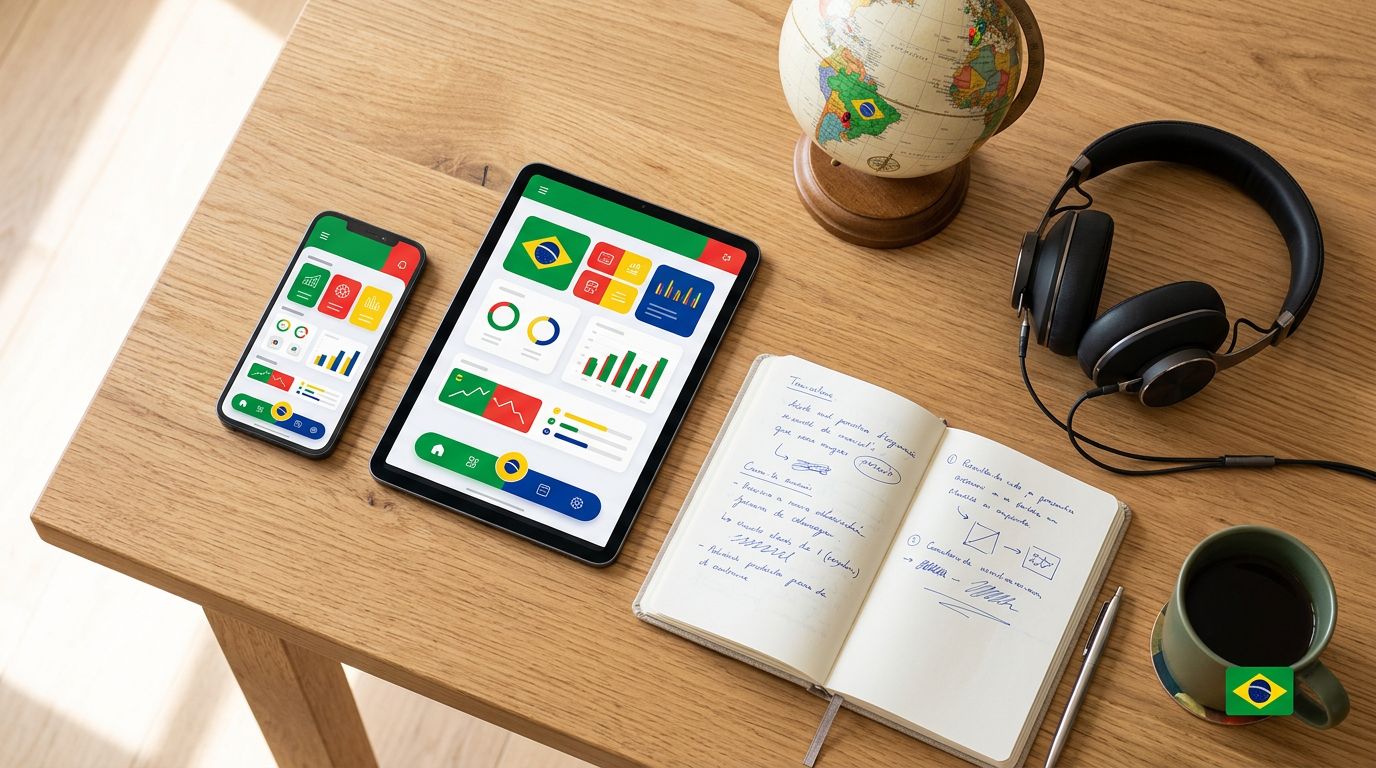
Most Portuguese learning apps are built for streaks. Serious learners need something that can carry them past day seven.
If you want to speak with confidence, understand fast audio, and keep grammar in order, the bar is higher. To learn Portuguese effectively in 2026, you need a course path, spaced review, real listening, and a clear choice between Brazilian and European Portuguese. Recent 2026 roundups such as Mynago’s 2026 Portuguese app comparison keep pointing in the same direction; the best language learning apps teach habits, not taps.
This guide focuses on apps that can support months of work, not quick bursts of motivation.
Key Takeaways
- Serious Portuguese learners need apps with a clear syllabus to B1/B2, native audio, pronunciation feedback, grammar explanations, spaced repetition, offline downloads, and Brazilian/European dialect options—avoid streak toys like Duolingo.
- Pimsleur tops for speaking confidence with hands-on listening and repetition; PortuguesePod101 wins for all-around depth with massive lessons covering both dialects; Rocket Portuguese excels as a one-time Brazilian course buy.
- Busuu adds native feedback and structure; LingoDeer gives beginners clean grammar and offline study—pair any with Anki for review or italki for live talk to build real skills.
- Depth beats gamification: these apps support months of study, not quick bursts, for fluency that sticks.
What serious learners should demand from a Portuguese app
Before you pay, check whether the app can do more than show vocabulary and smile for the camera. It should guide you through a real path to learn Portuguese, explain grammar, test your listening, and push you to speak. If it also tracks CEFR levels, offers offline downloads, and lets you choose Brazilian Portuguese or European Portuguese, that is a strong sign.
A serious app should also help you review old material. Without review, you will keep learning the same words and forgetting them. That gets old fast. Apps like babbel and duolingo are popular for habit building, but serious students who want to learn Portuguese need a full study system with more depth.
If an app hides grammar, skips listening, and never checks your pronunciation, it is a practice toy, not a study plan.
Here is the checklist that matters most:
- A clear syllabus with grammar lessons and a vocabulary builder that reaches at least B1 or B2.
- Native audio, not stiff text-to-speech.
- Pronunciation practice with feedback or voice recognition.
- Grammar explanations that make the lesson click.
- A built-in spaced repetition system.
- Downloadable lessons if you study offline.
- Separate Brazilian Portuguese and European Portuguese tracks if you need them.
Best Portuguese learning apps at a glance
This quick table helps you sort the strongest options fast.
| App | Best for | BR / EU support | Price note | Main limitation |
|---|---|---|---|---|
| Pimsleur | Speaking and pronunciation | Separate BR and EU courses | About $20.95/month or $150 lifetime | Light on grammar and reading |
| PortuguesePod101 | Full self-study and listening depth | BR and EU | Free tier, premium about $8 to $47/month | Large catalog needs direction |
| Rocket Portuguese | One-time course for Brazil | BR only | About $99 to $150 one-time | No European Portuguese track |
| Busuu | Grammar plus native feedback | BR and EU | About $9.99/month | Less deep than full courses |
| LingoDeer | Beginner structure and offline study | BR only | About $11.99/month | Tops out around B1 |
| italki / Preply | Live correction and conversation | BR and EU tutors | About $8 to $40/hour | No built-in curriculum |
| Anki | Spaced review | BR and EU via your decks | Free, iOS $25 one-time | You build everything yourself |
| MosaLingua | Efficient recall | BR and EU | About $8.99/month | Light on grammar and speaking |
| Glossika | Sentence rhythm and speed | BR only | About $16.99/month | Thin grammar explanation |
The pattern is clear. In the competitive landscape of language learning apps, these Portuguese learning apps are top-tier, excelling as full courses, serious review tools, or live practice platforms. Others like Mondly, Memrise, and Rosetta Stone often focus more on casual users. The weakest ones try to be everything and end up shallow.
Pimsleur is still the best first buy for speaking
Pimsleur is the strongest app if speaking is your biggest hurdle when you learn Portuguese. The whole course is built around listening comprehension, repeating, and pronunciation practice out loud, so your mouth gets training from day one. In 2026, the added AI voice checks make the feedback loop tighter, but the core idea stays simple. You hear, repeat, and speak before you overthink.
That simplicity is the point. Pimsleur gives you real practice in short sessions, which helps if Portuguese still feels hard to say aloud. It also comes in separate Brazilian and European Portuguese courses, so you are not locked into the wrong accent. The course sits roughly in the A1 to B2 range, which is broad enough for early progress and useful speaking work.
The tradeoff is just as clear. You will not get deep grammar lessons or much reading practice here. Still, if you freeze when native audio speeds up, pimsleur does more for confidence than most apps. At about $20.95 a month, it is not cheap. The lifetime option makes more sense if you know you will use it often.

Pimsleur is best for learners who want to achieve conversational fluency fast without sounding hesitant. Pair it with a review tool, and it becomes much stronger.
PortuguesePod101 is the best all-around study library
PortuguesePod101 is the best base app for learners who want depth to learn Portuguese. It offers thousands of audio and video lessons featuring native speakers on conversation, grammar, culture, and listening. It also covers both Brazilian and European Portuguese, which matters a lot when you want one app to support you for the long haul.
Its biggest strength is range. The curriculum takes learners from beginner to advanced, so you do not outgrow it after a few weeks. In 2026, the app also adds AI quiz generation from lessons, creating interactive lessons that are handy when you want quick review without building everything by hand. That makes it especially useful for learners who like a steady routine.
The weak spot is the size of the catalog. A huge lesson library is a gift, but it can also feel messy. You still need to choose a path and stick with it. Premium pricing runs from the low single digits to the upper end of the monthly range, depending on access, so the value depends on how often you use the platform. If you study several times a week, it starts to look much better.
For most serious learners, PortuguesePod101 is the safest core choice because it balances structure, breadth, and dialect support.
Rocket Portuguese is a strong one-time purchase
Rocket Portuguese makes sense if you want a full course without another monthly bill. It combines immersive learning through interactive audio, grammar notes, cultural tips, voice recognition, and an AI conversation partner for real-world conversation. The rocket portuguese course is built for Brazilian Portuguese, highlighting specific benefits for the Brazilian dialect while covering roughly A1 to B2 and beyond. This develops comprehensive language skills, which gives it a clear runway for self-study.
That one-time pricing model is the main reason people like it. At about $99 to $150, it can be good value if you prefer ownership over subscriptions. It also feels more coherent than a lot of app-based courses, because the lessons are tied to one path instead of a giant content library.
The limitation is easy to see. Rocket Portuguese does not offer European Portuguese, so it is a poor fit if your target is Portugal. It is also less expansive than a library like PortuguesePod101. Still, if you want Brazilian Portuguese and you like a tidy curriculum, this is one of the stronger paid choices in 2026.
Busuu gives you structure with real feedback
Busuu sits in a useful middle ground. It offers CEFR-aligned lessons from A1 to B2, and it supports both Brazilian and European Portuguese. For committed learners, the value is in the feedback layer. You can submit writing and speaking work for peer feedback from native speakers, which gives busuu a language exchange feel and makes the app less isolated than a solo course.
Busuu also adds AI speech practice in 2026, so you can rehearse before you talk to real people. That is useful if you want extra reps without booking a tutor every time. The app does a good job of making progress visible, which matters when you want steady study habits with its daily lessons that are manageable and effective.
Its weakness is depth. Busuu is solid, but it does not go as far as a full course library, and it does not train speaking as hard as Pimsleur. At about $9.99 a month, the value is fair if you use the corrections and keep moving. For many learners, it is one of the easiest apps to stick with past the beginner stage.
LingoDeer is best for beginners who want order
LingoDeer is the cleanest beginner app if you want grammar in order and fewer distractions. It’s ideal for those who want to learn Portuguese with structure and native audio throughout. The Portuguese course is well sequenced and includes powerful review tools like flashcards, which act as a vocabulary builder for new students. Additional flashcards help reinforce key terms over time. It also offers downloadable lessons, which makes it easier to study offline when your connection is bad or your schedule is packed.
The catch is dialect support. LingoDeer focuses solely on Brazilian Portuguese, so it may not suit beginners who want to learn Portuguese from Lisbon or Porto. Its range also tops out around A1 to B1.
Frequently Asked Questions
Which app is best for building speaking confidence fast?
Pimsleur stands out with its audio-focused lessons that train listening, repetition, and pronunciation from day one, including AI feedback in 2026. It covers A1 to B2 in separate Brazilian and European tracks but skips deep grammar. Pair it with a review tool for stronger results.
What’s the top choice for comprehensive Portuguese study?
PortuguesePod101 offers the deepest library of audio/video lessons on grammar, conversation, and culture for both dialects, from beginner to advanced. AI quizzes add quick reviews, though the vast catalog needs a steady path. Premium tiers start cheap and scale with use.
Is there a good one-time purchase for Brazilian Portuguese?
Rocket Portuguese delivers a full immersive course with audio, grammar, voice recognition, and AI chat for about $99–$150. It builds A1–B2+ skills coherently without subscriptions but lacks European support. Ideal if you want ownership over endless billing.
Which apps support both Brazilian and European Portuguese?
PortuguesePod101, Busuu, Pimsleur, and Anki (via decks) handle both dialects well. Busuu adds CEFR lessons and native feedback; others focus on core skills like speaking or review. Pick based on your priority: depth, structure, or practice.
Should beginners start with LingoDeer?
Yes, if you want structured grammar, native audio, flashcards, and offline Brazilian lessons without distractions—it shines A1–B1. It lacks European support and advanced depth, so graduate to PortuguesePod101 or tutors later. Great for building order early.