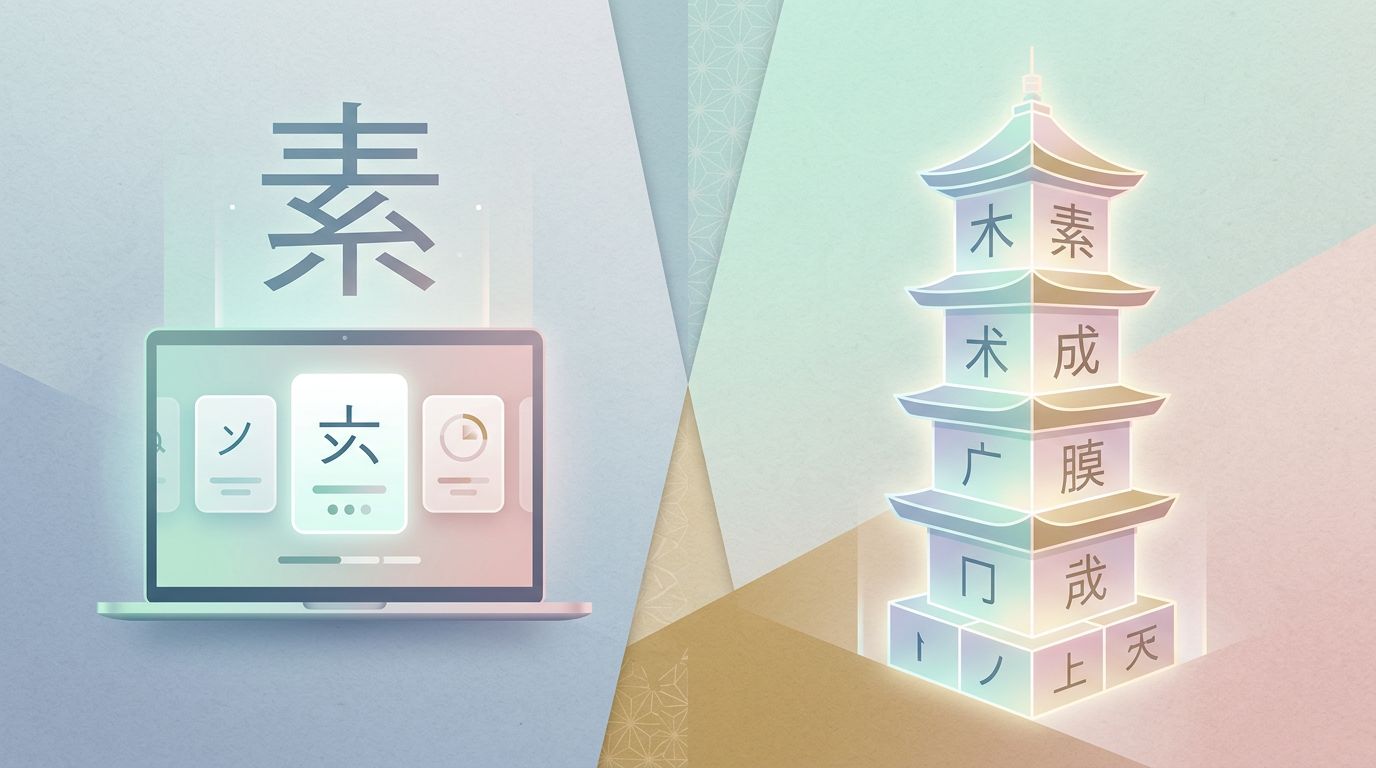
Kanji retention falls apart when the review system becomes harder than the kanji. In 2026, WaniKani vs Anki is still a choice between a guided path and a custom build. One app removes decisions and keeps the pace steady. The other lets you shape every card, but asks more from you in return.
If you keep dropping old characters, the right tool matters less than how well it fits your routine. The best choice is the one you can use on ordinary days, not only when motivation is high.
WaniKani and Anki solve different retention problems
WaniKani is a fixed kanji course. It starts with radicals, then kanji, then vocabulary, so the order is built for recognition and reading. Anki is a general flashcard app. You can make it handle kanji meanings, readings, handwriting, vocabulary, or all of them at once.
That difference shows up fast in day-to-day study. WaniKani gives you built-in mnemonics, a set sequence, and a review flow you do not need to design. Anki gives you complete control, which is great if you already know what you want and how you want to test it. If you want a deeper look at WaniKani’s pacing and limits, the 2026 WaniKani review goes into the details.
A quick side-by-side view makes the tradeoff easier to see.
| Area | WaniKani | Anki |
|---|---|---|
| Learning path | Fixed order | Fully custom |
| Setup | Minimal | You build or import cards |
| Mnemonics | Built in | You create them or add them |
| Review style | App-led | User-controlled |
| Leech handling | Automatic | Manual or semi-manual |
| Best fit | Structure seekers | Self-directed learners |
The pattern is simple. WaniKani reduces friction. Anki reduces limits. For kanji retention, that difference matters more than feature lists.
That same split comes up often in WaniKani community pros and cons discussions, where users praise the structure but point to the fixed path and subscription cost as tradeoffs.
WaniKani gives you fewer decisions. Anki gives you more control, and more chances to stall.
What daily retention feels like in real study
Retention is not a theory. It is what your brain does after a long workday, when your queue still waits for you.
WaniKani tends to feel smoother at first because it handles the sequencing. You learn small parts, then kanji, then words that reinforce them. That helps beginners see patterns sooner. When you miss an item, the app drops it back down the ladder. The system is strict, but it is also clear.

Anki can do the same job, but only after you build the workflow. A good deck can focus on recognition, reading, meaning, or production. A bad deck can ask too much at once. If every card is crowded with extra facts, your review time grows and your accuracy drops.
By 2026, many serious Anki users rely on FSRS scheduling and custom templates. That helps a lot, but it does not fix poor cards. Clean prompts still matter. Honest grading still matters. If you want the app to carry less of the load, you need to design the cards well.
Leech management is another real difference. In WaniKani, cards you keep missing return more often. The system handles that for you. In Anki, you can tag leeches, suspend them, or move them into filtered decks, but you must decide when and how. That extra control helps power users. It also gives busy learners one more thing to manage.
A common warning in Learn Japanese discussions about first-step study is easy to understand. If you only review cards and never read real Japanese, you can spin your wheels. That applies to both apps. Retention grows when review and reading support each other.
Review burden is where many learners feel the real cost. WaniKani often builds a predictable queue that can become heavy as you advance. Anki can be light or brutal, depending on deck size, card design, and interval settings. A small deck stays friendly. A bloated deck turns into a second job.
Who should choose WaniKani or Anki
The better choice depends on your habits more than your goals.
- Beginners: WaniKani is usually easier if you freeze when too many choices pile up. The fixed path reduces setup time and helps you build a routine fast.
- Intermediate learners: Anki makes more sense if you already know which kanji, words, or readings keep slipping. You can build a deck around your own weak spots.
- Busy adults: WaniKani often wins when consistency is the main problem. Open it, do the reviews, close it, and move on.
- Power users: Anki fits better if you want one system for kanji, vocabulary, sentence cards, audio, and custom testing. It scales with your own workflow.
If you want a wider view of the market, the best Japanese kanji learning apps roundup puts these tools in a broader context.
The biggest difference for retention is how much mental energy the app steals before study even starts. WaniKani asks less of you. Anki asks more, but gives more back if you know how to steer it.
Recognition and recall matter here too. For most learners, recognition should come first. You want to see a kanji and know what it means or how to read it. Strong recall, like writing it from memory, is useful later, but it is a different skill. If you force every card to test everything, reviews get slow and messy.
That is why WaniKani feels safe for beginners. It keeps the task narrow. Anki can do the same, but only if you keep your card design narrow too.
A practical 2026 choice framework
Use WaniKani if you want a guided start, built-in mnemonics, and less setup. It is especially strong when your main problem is starting and staying consistent. It gives you a lane, and that lane keeps moving.
Use Anki if you want control over content, order, and testing style. It works well when you already know your weak spots and want a deck shaped around them. It also fits learners who want kanji inside a larger study system, not as a separate island.
Use both if you want WaniKani for the front end and Anki for the messy parts. Many learners do exactly that. WaniKani can push new kanji into memory. Anki can hold vocabulary, exceptions, or cards drawn from your own reading.
For kanji retention, the winning setup is rarely the fanciest one. It is the one that keeps review load sustainable and leech cards under control without draining your attention.
Conclusion
Kanji retention improves when your study tool matches your daily life. WaniKani wins on structure and ease of use. Anki wins on control and flexibility.
If you want a system that tells you what to do next, WaniKani is the cleaner fit. If you want to build your own memory machine, Anki gives you the room to do it.
The real test is simple. Will you still open the app on a tired night after work? The tool that survives that moment is the one that keeps your kanji alive.
Ready to Take Your Language Learning Further?
Your favorite language-learning app is a great place to start. Rocket Languages can help you go further with interactive audio lessons, pronunciation practice, real-world conversations, and structured learning.
Explore Rocket Languages →Affiliate disclosure: We may earn a commission if you purchase through this link, at no additional cost to you.