
Babbel and Rosetta Stone are still around in 2026 because they solve different problems. For serious learners, that difference matters more than brand familiarity.
Babbel gives you structure, grammar support, and practical dialogue. Rosetta Stone leans on immersion, repetition, and visual clues. If you study often, the better app is the one that matches how you stay engaged after the first few days.
The quickest way to see the gap is to compare how each app teaches.
The cleanest answer for most adult learners
For most serious adult learners, Babbel is the stronger first choice. It is easier to use for steady progress, and it explains more along the way.
Rosetta Stone still has a place. It suits learners who want an immersion-heavy routine and do not mind slower, less explicit instruction.
Before you look at the table, keep one thing in mind. Pricing, trials, and feature bundles change often, so current offers matter more than old screenshots.
| Area | Babbel | Rosetta Stone | Better fit |
|---|---|---|---|
| Core teaching style | Short, structured lessons with grammar in context | Immersion through images, audio, and repetition | Babbel for clarity, Rosetta Stone for immersion |
| Speaking support | Guided pronunciation and Babbel Speak AI practice | Speech recognition and repeat-after-me practice | Babbel for role-play, Rosetta Stone for drilling |
| Grammar help | Frequent and direct | Light and mostly implicit | Babbel |
| Lesson feel | Fast, practical, conversational | Slower, more repetitive, more visual | Depends on patience |
| Progress experience | Easy to see what you are working on | More gradual, less rule-based | Babbel for visible progress |
| Best use case | Serious learners who want usable language sooner | Learners who prefer low-translation immersion | Depends on style |
The table points to the real divide. Babbel gives you a map. Rosetta Stone gives you a path and asks you to figure out more on your own.
How Babbel and Rosetta Stone teach
Babbel starts with usable language
Babbel’s current setup in 2026 is built around short lessons, interactive dialogues, speech recognition, grammar tips, spaced review, and Babbel Speak. It also includes podcast-style and culture content in some courses, which helps when you want a break from pure drills.
That mix matters because Babbel feels built for adults with limited time. You can finish a lesson, repeat weak points, and move on with a clear sense of what changed. The app usually shows you the pattern, then asks you to use it in context. That is Babbel’s core strength.
It also explains grammar more directly than Rosetta Stone. For many serious learners, that saves time. You do not have to guess why a sentence works. You see the rule, then you practice it.
Rosetta Stone builds through immersion
Rosetta Stone still follows an immersion-first method. It uses pictures, audio, and repeated examples so you connect meaning directly to the language. Translation stays in the background. That can feel elegant when it works.
Its lesson flow is slower and more repetitive than Babbel’s. You see, hear, and match the same patterns many times. That repetition can help memory, especially if you like learning by association.
The downside is clear too. If you want quick explanations, Rosetta Stone can feel vague. When grammar gets tricky, the app gives you fewer direct answers. Some learners enjoy that challenge. Others get tired of it fast.
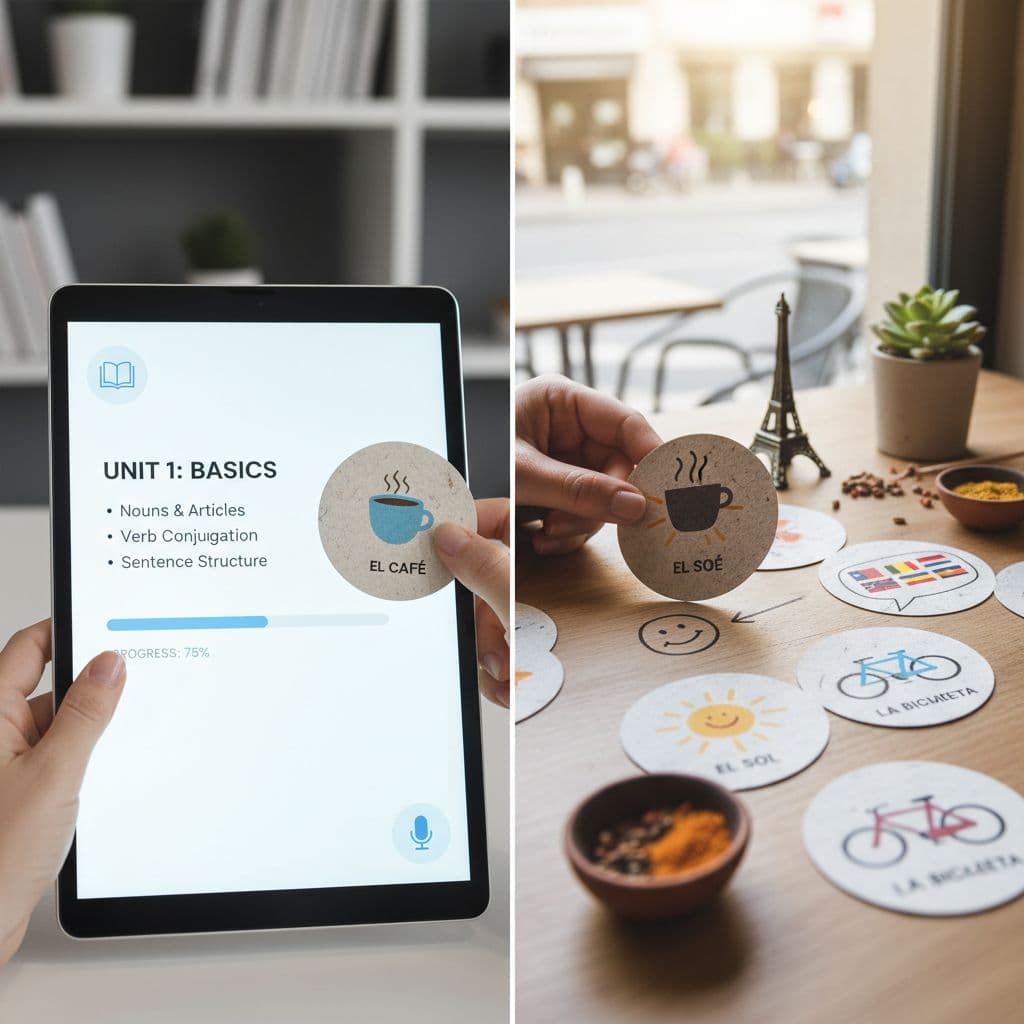
Babbel reduces friction. Rosetta Stone adds it on purpose, so the language stays front and center.
That design choice is the heart of the comparison. Babbel tries to make the path obvious. Rosetta Stone tries to make the target language feel unavoidable.
Speaking practice and pronunciation feedback
Speaking practice is where many learners care the most, and the two apps handle it differently.
Babbel Speak is the newer, more practical feature. It gives you AI conversation practice in common situations, such as ordering food or checking in at a hotel. That makes it useful for people who want to rehearse real exchanges before using the language with a human.
Babbel’s speech work is also more guided. You repeat phrases, get feedback, and move through short exchanges. That helps if you want confidence before travel or work use.
Rosetta Stone uses speech recognition too, and it has long done this well. It listens for pronunciation, then pushes you to refine how you say words and phrases. The feedback is useful for sound accuracy and pattern practice.
Still, Rosetta Stone’s speaking practice is less like a conversation and more like controlled repetition. That makes it good for sound training, but less direct for spontaneous speech.
Neither app replaces real conversation. Serious learners usually need both app practice and live speaking. If you want the app to do more of the first step, Babbel is better. If you want a calmer pronunciation drill, Rosetta Stone holds up well.
Grammar, structure, and long-term progress
Babbel has the edge when grammar matters. It explains forms, word order, and sentence patterns in a way that helps adult learners build logic, not just memory.
That matters in languages where endings, gender, or verb placement can get confusing fast. When you understand the rule, you waste less time guessing. Babbel’s structure also makes review easier because the lesson path feels cumulative.
Rosetta Stone is less direct. It expects you to infer grammar through repeated exposure. Some learners like that because it feels natural. Others feel stuck because the app says too little.
For serious study, explicit grammar support usually wins. You do not need a lecture in every lesson, but you do need enough explanation to understand why your answer was wrong. Babbel gives you more of that.
Rosetta Stone can still work well if you are patient and comfortable with uncertainty. The issue is not quality. It is pace. If you want to move faster through the early stages, Babbel is usually kinder to your time.
Daily use, motivation, and routine fit
A language app only matters if you keep using it. That is where lesson length and routine design become important.
Babbel is easier to fit into a busy day. Its short lessons make it simple to study before work, during a break, or after dinner. The progress tracking also helps because you can see what you finished and what still needs attention.
Rosetta Stone can feel steadier and more meditative. Some learners like that calm, repetitive rhythm. It creates a strong habit if you enjoy the same kind of practice day after day.

Babbel’s extra content, such as podcasts and culture pieces, also gives serious learners a way to vary their study without leaving the app. Rosetta Stone keeps things more uniform. That can help focus, but it can also feel narrow over time.
Both apps offer some offline use on certain plans or features, though the details change by subscription. That is another reason to check the current offer before you buy.
Pricing and value in 2026
Price is where many buyers make the wrong call. They compare headline numbers, then ignore what they actually need.
Babbel is often the easier budget choice, especially if you want practical lessons and grammar support without paying for a slower immersive model. Rosetta Stone often asks for more commitment, which can be fine if you really want its style.
The safest move is to check current pricing, trial terms, and refund rules in your region. Those details change often. A plan that looked fair last year may not be the best buy now.
Babbel’s own comparison page shows how it positions itself against Rosetta Stone and other major apps. That is useful for current feature awareness, but it is still smart to compare the live offer with your own learning needs.
A recent Babbel vs Rosetta Stone comparison reaches a similar bottom line for many adult learners. The reasoning is simple: Babbel tends to feel more direct, while Rosetta Stone appeals more to immersion-first learners.
Value is not just about price. It is about how much real study you get for the money. If an app keeps you moving, it is worth more than a cheaper plan you ignore.
Which app fits different learner profiles
Babbel fits learners who want clear progress
Babbel is the better match if you want visible structure, quick lessons, grammar help, and practical speaking practice. It suits adults who like knowing what they are doing and why.
It also works well if you are returning to language study after a long break. The lesson design lowers friction. You can restart without feeling lost.
If you want a broader frame for choosing among apps, the how to choose the right language app guide is a useful next stop. It helps you compare options by goal, budget, and lesson style.
Rosetta Stone fits learners who like immersion and repetition
Rosetta Stone is better if you want a low-translation method and do not mind learning by exposure. It suits people who like visual memory, pattern repetition, and a slower build.
That said, it asks for patience. You need to be comfortable with less explanation early on. If that feels frustrating, you may drop off before the method pays off.
If Babbel feels close but you want to compare another structured platform, the Babbel vs Busuu deep dive gives you a useful third point of reference.
A practical way to choose
Use this quick test before you subscribe.
- If you want faster practical speech and clearer grammar, pick Babbel.
- If you want immersion with minimal translation, pick Rosetta Stone.
- If you care most about value, compare the current price, trial length, and offline access before you pay.
That simple check keeps the decision grounded. It also stops you from buying the app with the prettier marketing.
Conclusion
For most serious learners in 2026, Babbel is the better fit. It explains more, moves faster, and works better for people who want useful language in less time.
Rosetta Stone still has a real audience. If you like immersion, repetition, and a slower path, it can still be a solid choice.
The real answer comes down to one thing: choose the app that matches how you stay consistent. For most adults, consistency beats novelty every time.
Ready to Take Your Language Learning Further?
Your favorite language-learning app is a great place to start. Rocket Languages can help you go further with interactive audio lessons, pronunciation practice, real-world conversations, and structured learning.
Explore Rocket Languages →Affiliate disclosure: We may earn a commission if you purchase through this link, at no additional cost to you.