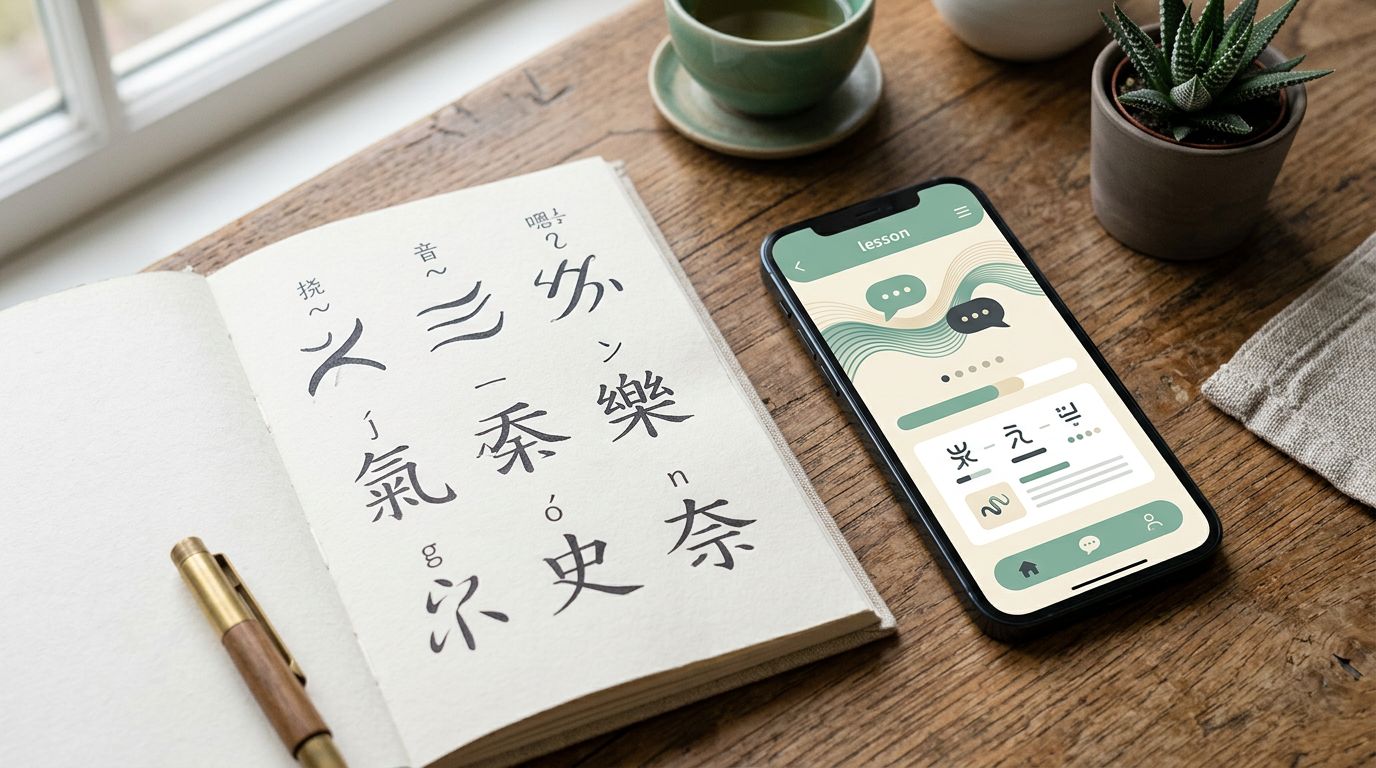
Cantonese learning apps often teach useful phrases without showing how Cantonese sounds connect to written Chinese. When you learn Cantonese, romanized words may still be unreadable in messages or subtitles. This sound-to-script gap often grows more noticeable with intermediate Cantonese.
The strongest combination of tools is usually a focused set of apps. Pleco is the strongest choice for Jyutping, Traditional Chinese character lookup, audio, and flashcards. A structured listening course adds guided practice, while Learn Cantonese Jyutping offers a narrower study option for Android users. Start by matching the tool to the skill you need most.
What Cantonese learners should check before downloading an app
Cantonese needs more than a Chinese vocabulary list. A suitable language learning app should explicitly identify Cantonese, provide Cantonese audio, and show the relevant script.
Jyutping romanization places a tone number after each syllable. For example, si1 and si6 have different tones and can represent different words. Cantonese has six commonly taught tone categories, so an app showing only Pinyin for Mandarin Chinese won’t provide reliable Cantonese pronunciation practice.
Script support matters just as much. Hong Kong Cantonese uses traditional characters, and everyday written Cantonese includes forms such as 係, 唔, 冇, 喺, and 咗. These often differ from formal written Chinese or Mandarin examples found in general Chinese courses.
Mandarin Pinyin support is not Cantonese support. Check the language label, audio model, romanization system, and script before building your study routine.
Look for these features:
- Search by Jyutping, English, and Chinese characters.
- Native speaker audio for clear Cantonese pronunciation.
- Handwriting recognition or optical character recognition.
- Traditional script display and stroke order.
- Flashcards with spaced repetition, tone practice, and pronunciation review.
- Short dialogues that support listening comprehension and speaking practice, while showing how words work in real sentences.
If you’re comparing several platforms, these checks matter even more for intermediate Cantonese, when basic phrase study is no longer enough. LanguaVibe’s guide to Cantonese learning apps provides a wider look at courses, tutors, and daily practice tools.
Best Cantonese learning apps for Jyutping and character reading
Pleco is the best dictionary companion
The Pleco dictionary is the most useful single app for learners who care about both Jyutping and character reading. It’s available for iOS and Android, and the free version provides a strong Chinese dictionary foundation.
Pleco supports searches in Jyutping and Yale romanization, as well as English and Chinese characters. The Google Play listing reports about 22,000 entries for its optional Cantonese-English dictionary, though the count may change. Cantonese audio add-ons may also be available, depending on the current listing and platform, for learners who need spoken pronunciation rather than Mandarin readings.
The character tools are where Pleco earns a place on almost every Cantonese learner’s phone. You can draw an unfamiliar character, scan text with OCR, view stroke order diagrams, and save words to flashcards. Its flashcards can support regular review. The document reader can also help you work through longer Chinese content, although some file and tap-lookup features depend on paid upgrades.

Pleco isn’t a complete beginner course. It won’t guide you through grammar or provide structured speaking practice, so it won’t build conversational skills in a fixed sequence. Instead, use it beside your main lessons.
For intermediate Cantonese learners, enable Cantonese search, select Jyutping as your phonetic system, and turn on Cantonese support for pop-up definitions or OCR. When you meet a new character, check its Cantonese pronunciation, listen to the audio, read the example sentence, and save the word only if it fits your current goals.
CantoneseClass101 works best for guided listening
CantoneseClass101 is a lesson platform built around podcast-style audio lessons. It suits beginners who want a clear path through everyday phrases and regular recordings from native speakers.
Its main advantage is lesson structure. Instead of opening a dictionary and choosing random words, you can follow a sequence of dialogues and explanations. That makes it easier to develop listening comprehension before natural Cantonese starts sounding too fast.
Use CantoneseClass101 as your structured course and audio source, then use Pleco to confirm Jyutping, traditional characters, pronunciation, and example sentences. The course should not replace Pleco for character lookup. Check each lesson’s materials before relying on them for reading, since audio-focused content may not provide the same depth of character tools as a dictionary.
A learner who wants to speak Hong Kong Cantonese should listen beyond isolated vocabulary. Pay attention to reductions, sentence-final particles, and the difference between careful lesson audio and spontaneous conversation.
Learn Cantonese Jyutping offers focused Android practice
As of August 2026, Google Play lists an app called Learn Cantonese Jyutping. Its clearest point of difference is its explicit focus on Jyutping, which makes it relevant for learners who want repeated romanization practice.
This is a narrow tool, so use it as a supplement rather than a complete introductory program. It can help you become comfortable reading syllables and tone numbers, but you still need a dictionary with character tools and a source of connected audio.
The verified listing is on Google Play, so availability is platform-specific. Before committing to it, check the current listing, screenshots, audio samples, and update history on your device. Android learners may find it useful for short drills, while iOS users shouldn’t assume that an identically named app offers the same content.
Apps with limited or unclear Cantonese coverage
Duolingo does not currently offer a standard English-to-Cantonese course. Its Mandarin-focused Chinese content teaches Mandarin, so its pronunciation and Pinyin can’t substitute for Cantonese audio or Jyutping. You can use Duolingo for general language-learning habits, but it won’t solve Cantonese pronunciation or character-reading needs.
The Drops app and Mango Languages appear in many Cantonese app roundups. Each may be useful as a vocabulary builder for words or practical phrases when Cantonese content is available in your region, but neither replaces structured instruction. For intermediate Cantonese, isolated word practice isn’t enough, especially for pronunciation, tones, and reading.
Check the current in-app catalog before paying. Look elsewhere if a listing doesn’t clearly label Cantonese or display Traditional script and its romanization. Check that its audio matches the listed Jyutping, then review the update history and regional availability. A polished app can still be the wrong choice for a learner whose target is Hong Kong Cantonese.
Community lists can help you discover smaller resources. A language exchange may reveal real usage or learner recommendations, but it doesn’t confirm an app’s Cantonese coverage. Verify each resource before downloading; this Cantonese learning resource list includes tools that may suit different levels and study styles.
How to practice tones and character reading together
Tone practice works best when you connect three things: the sound, the Jyutping spelling, and the character. Studying tone numbers without hearing the syllable can create false confidence.
Use this routine several times each week:
- Listen to one word or short phrase in a structured lesson. Repeat it without looking at the English translation.
- Check the Jyutping in Pleco and notice the tone number attached to each syllable.
- Say the phrase again while looking at the traditional characters.
- Record your voice and compare your pitch movement with the model audio. This turns passive recognition into measurable speaking practice.
- Review the item later with spaced repetition, but save only words you can place in a useful sentence.
Together, these steps build listening comprehension while connecting pronunciation, Jyutping, and reading.
Don’t try to force every Cantonese tone into an exaggerated musical pattern. Tone 4, tone 5, and tone 6 can be difficult to separate at first, especially when a sentence is spoken quickly. Your goal is to hear contrasts inside real words, not to produce six isolated pitches perfectly.
Character reading should begin early, even if your first lessons use romanization. When you learn a word, store its character and Jyutping together. This creates a useful visual association and helps prevent a common intermediate problem: understanding spoken Cantonese while remaining unable to read familiar words.
At the intermediate Cantonese stage, formal written Chinese creates another challenge. A learner may recognize Mandarin-style written sentences but still struggle with colloquial Cantonese online. Short messages, subtitles, and social posts often use Cantonese-specific grammar and characters. Search unfamiliar items in Pleco, then save recurring words rather than trying to memorize every character in one sitting.
For graded material that combines dialogue, Jyutping, characters, and English, see this Cantonese study account. Resources with all three layers make it easier to move from pronunciation drills into reading.
A simple app combination for each learning goal
The right choice depends on the skill that currently blocks your progress. Start with structured study, then add native input as you move toward intermediate Cantonese.
| Your main goal | Best fit | What it does well | Main limitation |
|---|---|---|---|
| Search characters and Jyutping | Pleco | Dictionary, OCR, handwriting, audio, flashcards | Doesn’t provide a full course |
| Follow guided audio lessons | CantoneseClass101 | Podcast-style audio lessons and listening practice | Character support may be less central |
| Drill Jyutping on Android | Learn Cantonese Jyutping | Focused Jyutping study | Narrower scope and platform availability |
| Build native-media comprehension | Pleco plus Cantonese media | Builds listening comprehension by looking up recurring words and saving them | Requires independent material selection |
After beginner lessons feel familiar, use short clips as practical immersion methods from Cantonese YouTube channels, interviews, dramas, or podcasts. Choose material with subtitles when possible, and use the asbplayer tool to replay subtitle segments if helpful. Replay a few seconds, identify one phrase, check it in Pleco, and listen again at normal speed.
Native media will expose gaps that no vocabulary app can predict. Speakers shorten phrases, leave subjects unstated, and use particles whose meaning depends on tone and context. Use that discomfort as a reason for speaking practice with iTalki tutors or through a language exchange. Keep clips short enough to study rather than letting them become background noise, save a few recurring phrases for spaced repetition, and make review a daily habit.
Frequently Asked Questions
What is the best app for learning Cantonese Jyutping?
Pleco is the strongest choice for searching Jyutping, hearing Cantonese audio, and connecting pronunciation with Traditional Chinese characters. Use a structured course alongside it for guided lessons and speaking practice.
Can I use a Mandarin learning app to study Cantonese?
Usually not, because Mandarin apps generally teach Pinyin, Mandarin pronunciation, and simplified or formal written Chinese. Check that an app clearly labels Cantonese, provides Cantonese audio, and supports Jyutping before relying on it.
Is Pleco a complete Cantonese course?
No, Pleco is primarily a dictionary and study companion rather than a structured beginner course. It is most useful beside guided lessons, where you can use its audio, OCR, handwriting lookup, and flashcards to review new words.
Should Cantonese learners study characters as well as Jyutping?
Yes, connect the sound, Jyutping, and character from the beginning of your study routine. This helps you move beyond romanized phrases and recognize colloquial Cantonese in messages, subtitles, and social media.
Conclusion
Pleco remains the strongest foundation for Cantonese Jyutping and Traditional Chinese character reading. CantoneseClass101 offers a more orderly audio path, while Learn Cantonese Jyutping may suit Android users seeking focused romanization drills.
Use Mandarin-focused apps with care, and verify Cantonese coverage before relying on any general Chinese platform. The most reliable routine connects native audio, Jyutping, characters, repeated reading, and speaking practice, then tests all five against real Cantonese media.
Ready to Take Your Language Learning Further?
Your favorite language-learning app is a great place to start. Rocket Languages can help you go further with interactive audio lessons, pronunciation practice, real-world conversations, and structured learning.
Explore Rocket Languages →Affiliate disclosure: We may earn a commission if you purchase through this link, at no additional cost to you.