
To practice foreign language phone calls, rehearse one useful situation, listen without a transcript, and answer aloud without reading. Then repeat the exchange with someone who changes the questions.
You don’t need perfect grammar to book a room or arrange an appointment. You need reliable ways to recover when you miss something, plus a habit of confirming important details.
Start with a small, complete conversation rather than a long vocabulary list.
Key Takeaways
- Practice likely replies as well as your opening request.
- Learn phrases for repetition, slower speech, and spelling before making real calls.
- Confirm names, numbers, dates, and agreements aloud, then request written confirmation when appropriate.
Why Phone Conversations Feel Harder
On the phone, you lose facial expressions, gestures, and visible context. Meanwhile, unfamiliar accents and reduced audio quality can make familiar words harder to recognize.
This difficulty doesn’t mean your studying has failed. Our guide to understanding native speakers explains why natural speech can sound different from lesson recordings.
Language barriers are also common. In 2023, over 68 million U.S. residents spoke another language at home, and 25.9 million had limited English proficiency. The Census Bureau’s language-use questions distinguish home language from self-reported English ability.
Prepare a Small Call Sheet
Write your goal and essential details
Choose one outcome: reserve a table, change an appointment, or ask about a repair. Write your opening request in the local language, but leave space for unexpected answers.
Before a medical appointment call, write down symptoms and questions. For an office or clinic, learn the department name and extension number.
Also prepare your name, account or booking number, dates, and callback number. Practice saying these aloud. Reading digits silently won’t prepare you to recognize them at conversational speed.
Learn phrases that keep the conversation moving
Translate these phrases into your target language and rehearse them with reliable audio:
“Could you repeat that, please?” “Could you please speak slower?” “How do you spell that?”
Add a brief introduction: “I’m learning the language. Please speak slowly.” For a wrong department, prepare: “Could you transfer me to reservations?”
Keep the sheet short enough to scan quickly. A full script becomes difficult to follow when someone answers differently. However, a few familiar phrases give you several ways to continue.
Build a Foreign Language Phone Calls Practice Routine

Connect listening, imitation, and spoken recall
Use one short dialogue about booking, appointments, or customer service. Choose audio you mostly understand, then spend about 15 minutes on this sequence:
- Listen without reading and identify the request, response, and outcome.
- Open the transcript, resolve unclear phrases, and replay those sections.
- Repeat two useful lines, then record yourself saying them.
- Close the text and answer a related prompt using different details.
For example, after hearing someone arrange a meeting, propose your own time or explain why you need another day.
Imitating a recording practices pronunciation. Answering without the model practices retrieval. Give both tasks time rather than assuming repetition alone prepares you for conversation.
Add unpredictable replies and audio-only practice
Ask a tutor or exchange partner to role-play the same situation with cameras off. Let them change the question order or offer an unavailable appointment time.
Practice hearing prices and writing numbers, too. Ask your partner to read several dates or booking references, then repeat each back.
HelloTalk and Tandem voice notes offer a gentler starting point because you can replay messages. However, move toward live exchanges once familiar replies feel manageable. Our guide to choosing language-learning tools can help you match practice to your weakest skill.
Keep a Real Call Moving
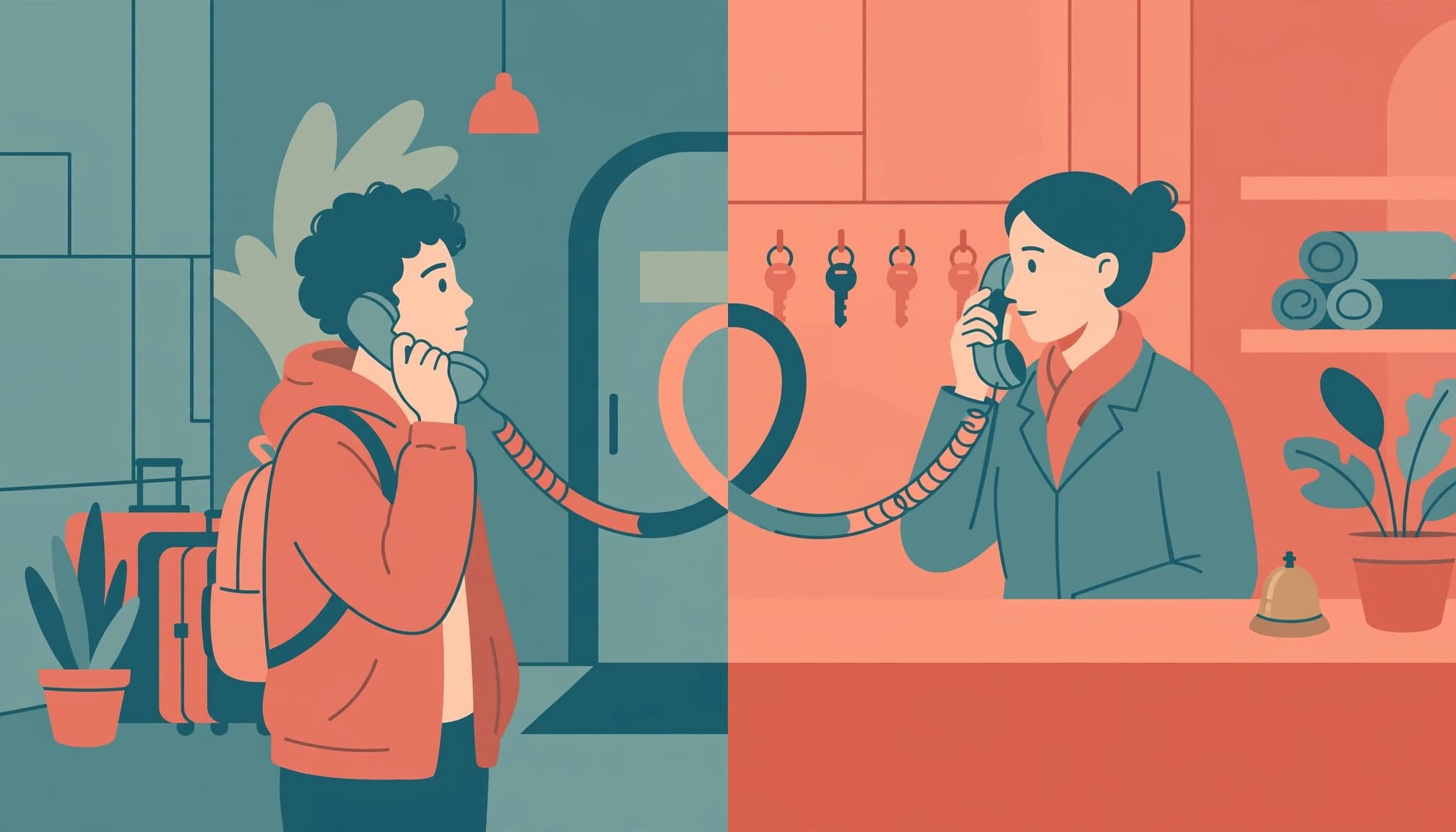
Recover when you miss something
Ask for the missing piece rather than restarting everything: “I understood Tuesday. What time did you say?”
If you start speaking too fast, excuse yourself: “One moment, please.” Set the phone aside briefly, take a deep breath, then continue more slowly.
When using a translator, explain that at the beginning: “I’m using a translation service. Please pause after each sentence.” Short turns reduce overlapping speech and give both people time to respond.
Confirm details before saying goodbye
Take notes as you hear names, dates, addresses, and amounts, then read them back aloud. Say, “To confirm, that’s Tuesday the fourteenth at three in the afternoon.”
For account numbers, read digits individually. For names, ask the speaker to spell them and repeat the spelling back.
A successful opening doesn’t guarantee a successful booking. Confirm the final date, time, price, and reference number before ending the call.
Summarize the conversation, then ask for an email or text to confirm the details. After landlord or housing calls, follow up in writing to create a record of requests and commitments that spoken conversation alone doesn’t provide.
Choose Translation Help When Practice Isn’t Enough
Many Italian restaurants and small hotels take reservations by phone, sometimes as their only booking channel. A phone call translator app can provide real-time translation when you need an answer before your speaking skills catch up. Features and performance vary.
Interpreter services and other options differ in cost, availability, and privacy.
| Method | Typical cost | Main tradeoff |
|---|---|---|
| Friend or exchange partner | Often free | Availability and privacy concerns |
| Call-translation app | Credits billed per minute | Recognition errors and translation delays |
| Professional phone interpreter | Often $1 to $3 per minute | Booking may be necessary |
| Covered public-service interpretation | Free to the eligible caller | Availability depends on the service |
Credit-based translation call apps display per-minute charges before dialing; some offer a free trial call. Services that connect to ordinary telephone numbers can reach mobile and landline numbers without requiring the recipient to install an app. Before relying on a translated phone call, check that the service supports the number type and language you need, especially for customer service.
Professional interpreter appointments often require scheduling, although some services offer on-demand connections. For medical, legal, or financial discussions, qualified human interpretation is the safer choice.
When calling a U.S. federal agency or government office, request free interpretation in your first sentence. Coverage depends on the agency and program; a blanket promise for every federal call is too broad. HHS explains that covered health programs must provide language assistance at no cost.
Dial International Numbers Correctly
When making phone calls abroad, format international calls with + followed by the country code. Common codes include Japan +81, China +86, France +33, Germany +49, South Korea +82, Italy +39, and Thailand +66.
Usually, drop the domestic leading zero. A Tokyo number beginning 03 becomes +81 3. However, Italy retains the leading zero in geographic landline numbers.
Without a local SIM, you can use your home carrier’s roaming service or an internet-based calling service that reaches regular telephone numbers. Wi-Fi alone doesn’t give every messaging app that ability.
If a bank or hotel requests an extension, open the in-call keypad and enter it. Internet access or Wi-Fi calling doesn’t automatically make an international call free.
Protect Privacy and Prepare for Emergencies
Before recording or transcribing, notify everyone and obtain any recording consent required by local law. EU and UK privacy obligations depend on context, while certain U.S. states require all-party consent. There isn’t one universal recording rule.
For business processing, the UK’s right to be informed covers transparency about collecting personal data. Translation software may also send audio to an external service.
Know your destination’s emergency number before you need it, and keep these numbers accessible: 112 across EU countries; 119 for fire or ambulance and 110 for police in Japan; 999 in the UK; 911 in the USA, Canada, and Mexico; and 000 in Australia. The U.S. State Department publishes an emergency-number reference for travelers.
Dial local emergency numbers directly, without adding a country code. State your location and the emergency first, then request language assistance. Never use emergency lines for practice.
Review Each Call Before Adding More Vocabulary
After a practice exchange or real call, note what blocked communication. Separate a listening problem from a missing word or an unfinished sentence, because each needs different practice.
If you couldn’t understand a price, rehearse numbers with new recordings. If you knew the words but froze, practice answering the same question without notes.
Ask a tutor to correct one or two recurring problems. Save the corrected phrase with its meaning and, with permission, a spoken version.
Then repeat the task with a changed detail or unfamiliar voice. Following one memorized dialogue perfectly doesn’t prove you’ll understand a new speaker.
Measure progress by completed tasks and recovery. Booking successfully after requesting repetition is meaningful progress, even when the exchange feels slow.
Frequently Asked Questions
Can I practice without a conversation partner?
Yes. Listen to a short exchange, pause before each answer, and supply your own response. Record a 30-second message using two useful phrases. However, add live practice when possible because recordings can’t react to your choices.
Can a translator call a Japanese hotel without English-speaking staff?
A service that translates calls to ordinary numbers can help, even if the hotel has no app or internet connection. Still, background noise, names, and dates can cause errors. Keep turns short and request written booking confirmation.
What’s the cheapest way to call internationally?
App-to-app audio calls over existing Wi-Fi usually avoid international telephone charges when both people use the same service. Calling an ordinary business number may require paid internet-calling credit or a carrier plan. Changing your phone’s display language doesn’t translate calls.
Make Your Next Call a Small, Repeatable Task
Confidence grows through complete exchanges: making a request, understanding the reply, recovering from confusion, and confirming the result.
Choose one low-stakes call to rehearse this week. Practice it without reading, introduce an unexpected reply, and carry a short phrase sheet into the real conversation. You can complete a useful call while still needing help.
Ready to Take Your Language Learning Further?
Your favorite language-learning app is a great place to start. Rocket Languages can help you go further with interactive audio lessons, pronunciation practice, real-world conversations, and structured learning.
Explore Rocket Languages →Affiliate disclosure: We may earn a commission if you purchase through this link, at no additional cost to you.