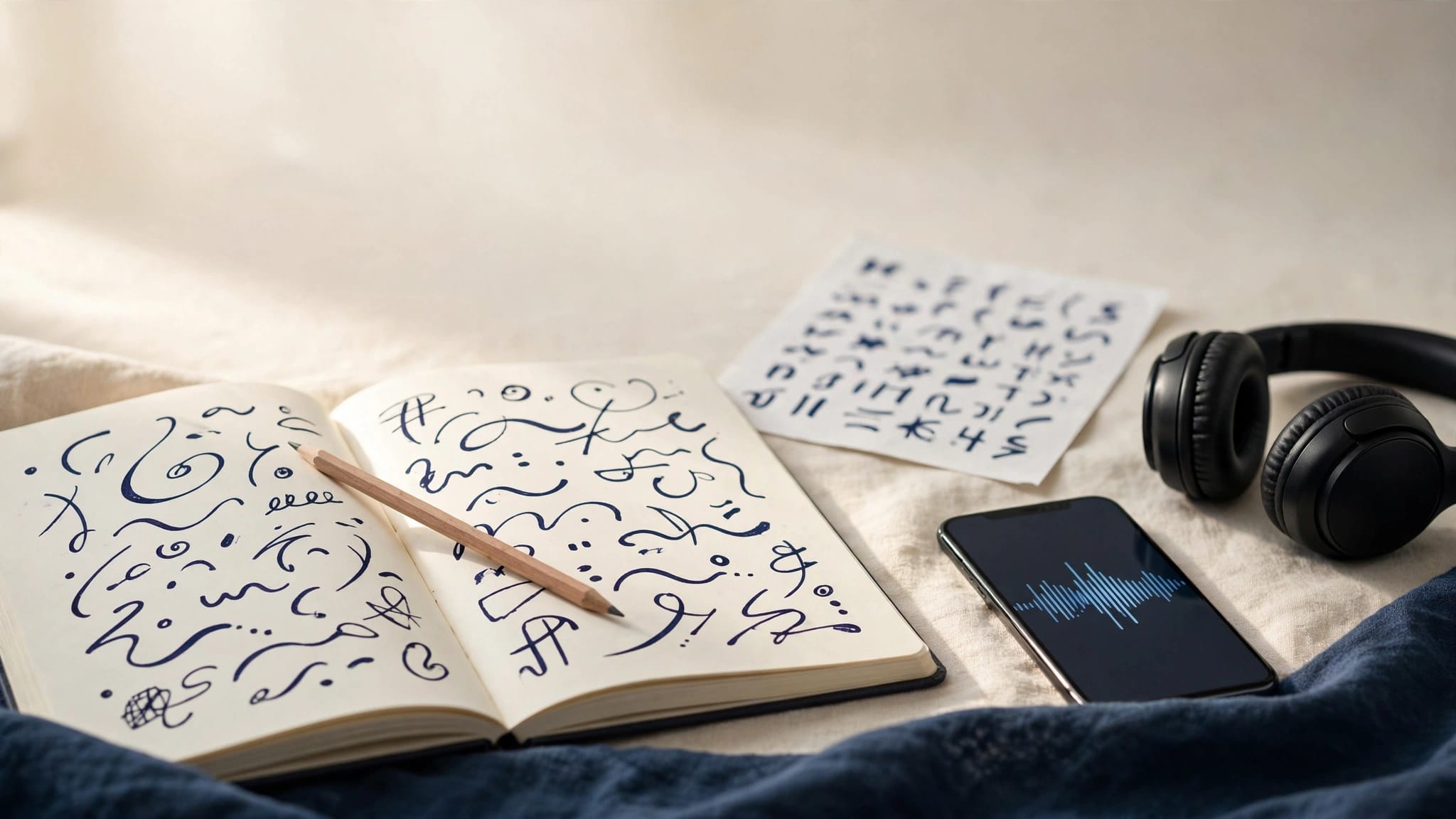
To learn Tigrinya, study small groups of Fidel characters alongside short recordings, then practice understanding and answering without looking. Reading and listening support each other, but each needs its own practice.
A familiar written word may still be difficult to recognize in speech, especially when English pronunciation spellings have become your main guide. Aim for independent comprehension, so you can recognize words without a chart and understand familiar speech without a transcript.
Start by making the script manageable, then connect it to language you can use.
Key Takeaways
- Learn one Fidel character family at a time instead of memorizing the whole chart before starting audio.
- Pair written words with recordings, meanings, and spoken repetition.
- Test reading and listening separately because recognizing a spelling doesn’t prove you understand it in conversation.
- Keep your setup small: one main learning sequence, a script reference, and replayable audio.
Learn Tigrinya Script in Small Character Families
Tigrinya uses a Ge’ez-derived writing system, also called Ethiopic. You’ll often hear its characters called Fidel.
The system is an abugida: characters generally combine a consonant with a vowel value. That gives you a useful pattern to learn, rather than hundreds of unrelated shapes.

Recognize the family before memorizing every form
Most basic consonant families have seven standard orders. For example, this family follows the familiar seven-position sequence:
ሰ ሱ ሲ ሳ ሴ ስ ሶ
First, notice what stays similar and what changes. Then hear each form in a Tigrinya recording while looking at the corresponding character.
You don’t need to master the entire chart before learning words. Start with one family, revisit it across several sessions, and add another when you can recognize the earlier forms out of order. Otherwise, you may remember the sequence without recognizing individual characters.
Treat vowel labels as guides, not English equivalents
The seven Fidel vowel orders help organize the characters. However, English letters such as “a” or “e” don’t provide exact pronunciation instructions.
Use your recording as the sound model. Listen, point to the character, repeat, and then hear it again.
Copy a few forms while saying them, but also practice recognition without writing. Compare similar shapes side by side when they cause confusion. Filling a page with copies is less useful if you still can’t identify the character in a word.
Pair Fidel With Useful Everyday Vocabulary
Character practice becomes more meaningful when the forms appear in words you understand. Choose a small vocabulary set connected to daily life rather than collecting long lists.
Start with a few concrete words
These words give you manageable starting points for connecting print, meaning, and sound.
| Tigrinya | Meaning | Practice focus |
|---|---|---|
| ሰላም | Hello; peace | Recognize it in a greeting. |
| ማይ | Water | Connect the written word with its recording. |
| ቡን | Coffee | Say it after hearing a clear model. |
Use these as word-reading practice, then learn complete requests and responses from your main material. Knowing the word for water doesn’t yet give you the grammar for asking for it.
When a lesson introduces a question, save its answer too. A short exchange gives you more useful speaking practice than two disconnected vocabulary entries.
Reduce transliteration gradually
Latin-letter spellings can help you locate a word initially. However, they can also encourage you to pronounce Tigrinya through English spelling habits.
Keep the Fidel spelling visible beside the recording. After several reviews, cover the Latin version and try reading the original.
If recognition fails, reveal the support briefly and retry. You don’t need to remove every aid immediately. Instead, make the original script your main written reference, with transliteration as temporary support.
Train Listening Separately From Reading
To learn Tigrinya for conversation, you need practice recognizing speech before written clues supply the answer. Start with a brief exchange whose meaning you can establish, not a long recording full of unfamiliar language.

Listen for meaning before opening the text
Play a short exchange without reading. Identify the situation, familiar words, or the response someone gives.
Next, read the accompanying text and resolve the unclear parts. Replay one difficult line rather than restarting a whole lesson repeatedly.
Finally, hide the transcript and listen again. Try answering the speaker or explaining the exchange’s meaning. This last pass reveals whether the recording has become understandable without visual support.
If you understand a recording only while reading its transcript, keep practicing that passage without text before adding harder material.
Repeat pronunciation without copying English sound habits
After understanding a line, listen closely to its sounds and rhythm. Pause, repeat it, and compare your version with the model.
Record yourself occasionally, focusing on one difference at a time. For example, notice whether you added an extra vowel or broke the phrase into unnatural pauses.
Don’t force every unfamiliar consonant into its nearest English equivalent. A teacher or proficient speaker can help with sounds you can’t yet distinguish.
Slower playback may clarify a difficult section, but return to normal speed afterward. Recognizing isolated sounds and following connected speech are related tasks, not identical achievements.
Choose a Small Set of Tigrinya Study Tools
Give each resource a clear job. Your main learning sequence should introduce language in a sensible order, while a script reference helps with unfamiliar forms.
For targeted reading work, Tigrinlish’s Tigrinya reading and pronunciation tips offer a supplementary tutorial. Keep such videos tied to a specific difficulty rather than replacing steady practice with browsing.
For beginner audio, prioritize short human recordings with understandable meanings and matching written support. Individual word recordings help establish pronunciation; short exchanges also let you hear phrasing and responses.
A keyboard, dictionary, or character chart won’t automatically provide those listening opportunities. Likewise, an audio collection doesn’t necessarily explain how sentences work.
On a phone, clear script display matters. Our guide to testing script support in apps covers display issues that can interfere with unfamiliar-script study. Missing characters or clipped forms make recognition practice harder than it needs to be.
Flash cards can handle review, but they shouldn’t replace listening. Our AnkiMobile and AnkiDroid comparison explains the app options if you want that approach.
Build cards around material you’ve studied. Some should ask you to recognize a written word; others should ask you to understand audio or recall a spoken answer. Those tasks expose different weaknesses.
Build a 25-Minute Script-and-Audio Routine
A short session works well when every part has a distinct purpose. Keep new material modest so review and speaking don’t disappear.
Use this schedule as a starting point.
| Time | Activity | What you’re practicing |
|---|---|---|
| 5 minutes | Recognize and write recently studied Fidel forms in words. | Reading and character recall |
| 10 minutes | Listen to one short exchange, use its text, then replay without it. | Listening comprehension |
| 5 minutes | Review older words and phrases without transliteration. | Retrieval and retention |
| 5 minutes | Answer prompts aloud or record a familiar exchange. | Spoken recall |
The session should end with something you can attempt independently, not another screen of completed exercises.
For script review, mix the order of familiar characters. For speaking, pause before a recorded answer and supply your own response. If you’re copying every answer immediately, introduce a short delay before repeating.
Across the week, return to older material as well as yesterday’s lesson. Keep a simple record of tasks you can perform: reading a familiar word, understanding a greeting, or answering an introduction.
When one skill falls behind, adjust the balance. If you can read a phrase but miss it in audio, spend more time listening without text. If you understand it but can’t respond, add spoken recall.
Progress means needing fewer prompts for a useful task. Finishing more lessons matters less than remembering and using their language.
Frequently Asked Questions
Should I learn all the Fidel characters before speaking?
No. Begin listening and speaking while learning the script in small groups. Waiting for complete chart mastery delays useful practice connecting sounds with meaning.
You can rehearse a greeting before reading every character it contains. Then study its spelling alongside the recording. This gives the written forms a familiar spoken context.
Can I learn Tigrinya using only transliteration?
Transliteration can support an early start, but it leaves your reading dependent on Latin-letter representations. It may also hide sound distinctions or suggest misleading English pronunciations.
Use it alongside Fidel and audio, then reduce it as recognition improves. Learning the original script also lets you use written material without needing someone to transliterate every word first.
Why can I read a word but miss it in audio?
Reading lets you inspect a word at your own pace. Speech continues, and the word arrives within a phrase rather than alone on a flash card.
Practice the word in a short sentence whose meaning you understand. Then replay that sentence without reading. If it remains unclear, shorten the passage and rebuild toward the complete exchange.
Connect the Script With Speech You Understand
Learning Fidel and understanding spoken Tigrinya require connected but separate practice. Small character groups make reading manageable, while short recordings give those forms a sound and a useful context.
Keep independent understanding as your measure: recognize familiar words without transliteration, follow a brief exchange without its transcript, and answer without copying. A modest set of material practiced this way gives you a stronger foundation than a large collection you can only recognize on screen.
Ready to Take Your Language Learning Further?
Your favorite language-learning app is a great place to start. Rocket Languages can help you go further with interactive audio lessons, pronunciation practice, real-world conversations, and structured learning.
Explore Rocket Languages →Affiliate disclosure: We may earn a commission if you purchase through this link, at no additional cost to you.