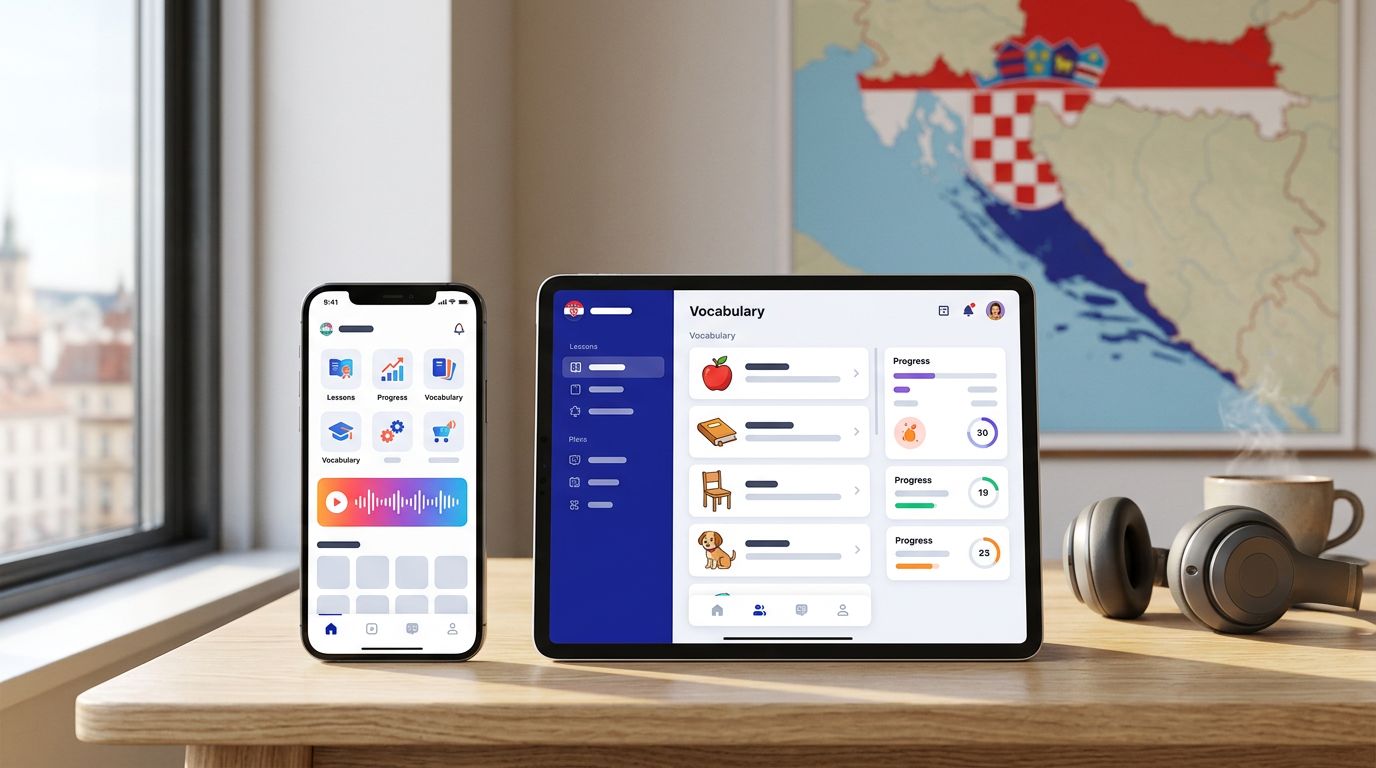
If you want Croatian to stick, you need more than flashcards and a streak counter. You need an app that gives you usable words, clear audio, and a path you can repeat without losing momentum.
That is where most Croatian apps split apart. Some are good for speaking, some for vocabulary, and some only help you get started before the training wheels come off.
Quick comparison of the strongest Croatian options
These four apps cover different jobs, so the right choice depends on what you need most.
| App | Best for | Strengths | Weaknesses | Price model | Platforms |
|---|---|---|---|---|---|
| Mondly | A balanced Croatian starter | Short lessons, speech practice, progress tracking, active Croatian support | Light grammar, phrase-heavy, not enough for advanced output | Free tier, subscription, occasional lifetime deals | iOS, Android, web |
| Pimsleur | Speaking and listening | Audio-first repetition, pronunciation training, strong recall | Little visual support, limited reading help, check Croatian availability | Paid subscription, sometimes course purchase | iOS, Android, web |
| Memrise | Vocabulary and native audio | Spaced review, native-speaker clips, flashcard-style memory work | Weak grammar, less structure, Croatian catalog can vary | Free tier, subscription | iOS, Android, web |
| Duolingo | A free starter habit | Easy daily practice, gamified review, low barrier to entry | Shallow Croatian depth, weak speaking, availability can vary | Free tier, paid plans | iOS, Android, web |
A recent Croatian app roundup from Clozemaster reaches the same basic conclusion. Croatian tools exist, but each one covers only part of the job.
The pattern is clear. Mondly is the best all-round starter, Pimsleur is the best speaking tool, Memrise is the strongest memory aid, and Duolingo is the easiest free entry point.
What serious Croatian learners need from an app
Croatian punishes vague study. Noun endings change, verbs shift form, and pronunciation matters earlier than many beginners expect. An app that only teaches tourist phrases will stall fast.
Look for clear audio, sentence-level drills, spaced review, and some explanation of how forms change. If the app also gives you level markers or progress gates, that helps, because it keeps the path visible.
A good Croatian app gives you audio, repetition, and some structure. Without those, progress gets shaky fast.
That is also why CEFR-style structure matters. It gives you a sense of what comes next, instead of a pile of random lessons. The Busuu app review for serious students and Babbel review for adult learners are useful benchmarks for that kind of design, even though Croatian coverage is a separate question.
None of the apps in this roundup gives Croatian a truly polished CEFR ladder. Mondly comes closest to a level-like path, but it still feels lighter than a full adult course. That is fine if you know its limits.
Mondly: the most balanced Croatian starter
Mondly is the easiest app here to recommend as a first Croatian home base. Its Croatian course is still listed on the Apple App Store and Google Play, which is a good sign for 2026.
The app works best when you want short sessions that feel manageable. Lessons are themed, so you can move through practical language without staring at a wall of grammar. You get pronunciation help, verb conjugation practice, and progress tracking that makes daily study easier to maintain.
Mondly also feels adult-friendly. It does not talk down to you, and it does not bury you under huge explanations. That matters when you are trying to fit Croatian into a real schedule.
Its weakness is depth. Mondly teaches useful language, but it does not push far into grammar or spontaneous conversation. If you want to explain why a case ending changed, you will need a book, notes, or a tutor. Its drills can also feel phrase-heavy after a while.
Even so, Mondly is the best overall choice in this group for many serious learners. It is active, easy to use, and broad enough to stay useful after the first week.
Best for: beginners, early returners, expats, and anyone who wants a dependable daily Croatian app without a steep setup cost.
Pimsleur: the strongest app for speaking out loud
Pimsleur is built for speaking. You hear a prompt, answer out loud, and repeat until the pattern sticks. For Croatian, that matters because confidence with sound comes before confidence with grammar.
Croatian availability should still be checked before paying, because course catalogs change. When the language is available, the method is one of the strongest ways to train your ear and mouth at the same time.
The big strength here is active recall. You are not only recognizing Croatian, you are producing it under light pressure. That is exactly the kind of practice many learners skip. It also works well during commutes, walks, or chores, since the core method is audio-first.
Pimsleur does have limits. It is the least visual option in this roundup, and it does not try to be a full reading or writing course. There are no rich lesson screens to lean on, and the core method does not give you the same kind of transcript-heavy study that some learners want.
The format can feel sparse if you like to see everything laid out. Still, that sparseness is part of the method. It keeps you listening and speaking instead of clicking through menus.
For learners who need spoken Croatian soon, Pimsleur is hard to beat. It suits expats preparing for daily life, travelers who want real oral control, and students who want their first spoken sentences to feel less clumsy.
Best for: speaking, listening, pronunciation, and fast oral confidence.
Memrise: the best for vocabulary and native audio
Memrise is the best app here for building word memory. It uses spaced repetition and native-speaker clips, so you hear Croatian in a more natural voice instead of only seeing it on a screen.
That makes a difference. Croatian words can look manageable on paper and still sound unfamiliar in real speech. Memrise helps close that gap by giving you repeated exposure to the sound of the language. For vocabulary, that kind of repetition is often more useful than a long explanation.
The app also gives you flashcards, quizzes, pronunciation training, and speed games. Those features make review feel lighter than a textbook session. When you already know some Croatian, that can be useful because the app keeps review moving.
The downside is structure. Memrise can feel loose if you want a clean lesson path. Grammar support is light, and the Croatian catalog can vary, so check the current version before you build your whole plan around it.
That makes Memrise a strong support tool, not a full course. It shines when you already have a main source of instruction and want more exposure to real words and voices.
Best for: vocabulary building, heritage learners, and intermediate students who want more listening practice.
Duolingo: the easiest free habit, but a weak main course
Duolingo is the easiest free habit builder, but it is the weakest serious Croatian course here. It works because opening the app takes almost no effort.
That low friction helps new learners show up every day. You can do a short session on the bus, during lunch, or before bed, then keep your streak alive. For some people, that is enough to create a study habit.
The problem is depth. Duolingo leans hard on matching, translation, and quick review tasks, so speaking skill grows slowly. It can give you exposure, but it does not train Croatian production well enough for most serious goals.
Croatian support may also be limited or inconsistent depending on the current course catalog. Even when the language is available, the app works better as a warm-up than as a main course. It is useful for forming a habit, not for carrying your whole study plan.
Duolingo also has a habit of making practice feel better than it is. You can finish a lesson and feel productive, but that feeling often outruns the actual language gain.
Best for: complete beginners who want a free start or a backup app for short daily sessions.
Which app fits your study style
Serious learners usually need one main app and one support tool. The best pair depends on your goal, your budget, and how much Croatian you already know.
- Best overall: Mondly, because it gives the strongest mix of current Croatian support, simple structure, and daily usability.
- Best for speaking: Pimsleur, if Croatian is currently available in your catalog and you want more oral training.
- Best for grammar support: Mondly for light reinforcement, but a textbook or tutor should handle the real grammar work.
- Best budget option: Duolingo, if you want free exposure before paying for anything.
- Best supplement to a main course: Memrise, because it helps vocabulary and listening stick.
- Best if you want CEFR-style structure: none of these fully match that need for Croatian, so compare a structured benchmark like Busuu or Babbel and then build your Croatian plan around a stronger course or tutor.
For self-directed adults, Mondly plus Memrise is a practical combination. Mondly gives you guided practice, while Memrise adds more hearing and recall.
For expats, Pimsleur plus any reading support is often smarter. Spoken Croatian comes first when you need to ask for help, book services, or handle daily life.
For heritage learners, Memrise is often the easiest supplement. It can wake up words you half-know and turn passive recognition into active recall.
For students who want structure more than flash, Mondly is the safest first step. It is not perfect, but it is the most balanced option in this group.
Conclusion
Croatian apps are useful when they do one job well. The mistake is expecting one app to cover grammar, speaking, vocabulary, and motivation at the same time.
Among the current choices, Mondly is the strongest general pick, Pimsleur is the best for spoken drills, Memrise is the best memory aid, and Duolingo is the cheapest way to build a habit. That mix makes the field clearer than it looks at first glance.
If Croatian is your serious goal in 2026, start with the app that matches your weakest skill, then add real input and some form of correction. That is how the first lessons turn into usable language.
Ready to Take Your Language Learning Further?
Your favorite language-learning app is a great place to start. Rocket Languages can help you go further with interactive audio lessons, pronunciation practice, real-world conversations, and structured learning.
Explore Rocket Languages →Affiliate disclosure: We may earn a commission if you purchase through this link, at no additional cost to you.