A long streak can still leave you stuck at small talk. That is the core problem serious learners need to face in any Duolingo review.
Duolingo remains one of the easiest ways to study every day, and that still matters. Yet if your goal is real proficiency for work, study, travel, or relationships, daily taps are only part of the job. The question is not whether Duolingo works at all. The question is how far it really takes you.
What Duolingo still gets right in 2026
Duolingo is still excellent at lowering friction. You open the app, do a short lesson, and keep your target language in front of you. For busy adults, that convenience is hard to beat. The app also feels smoother than many rivals, and the recent shift toward shorter intermediate mini-units has made the path less bloated.
For beginners, that matters a lot. Repetition is frequent, lessons are short, and mistakes recycle back into review. In major courses such as Spanish or French, the path usually feels fuller than in smaller languages. Course quality still varies widely, so your experience depends a lot on what you study.
Here is the realistic outcome by level, assuming steady use over months and not magic.
| Learner level | What Duolingo can do well | Where it usually stalls |
|---|---|---|
| Absolute beginner | Build habit, core vocab, simple sentence patterns | Weak speaking confidence |
| A1 to A2 | Reinforce grammar basics and reading recognition | Limited free writing and listening depth |
| Around B1 | Useful for review and maintenance | Progress slows, output stays thin |
| B2 and above | Handy for refreshers | Too shallow for serious growth |
The takeaway is simple. Duolingo is strongest from zero to early-intermediate, especially for recognition, review, and consistency.
It also helps that the app is still flexible. You can study on the train, during lunch, or in five spare minutes before bed. That is why serious learners should not dismiss it. A tool that keeps you studying has real value, even if it is not the whole toolbox.
Where Duolingo stops helping serious learners
The trouble starts when recognition feels like ability. Duolingo often asks you to pick, match, or reorder language that is already on the screen. That trains memory, but it does not train fast recall under pressure.
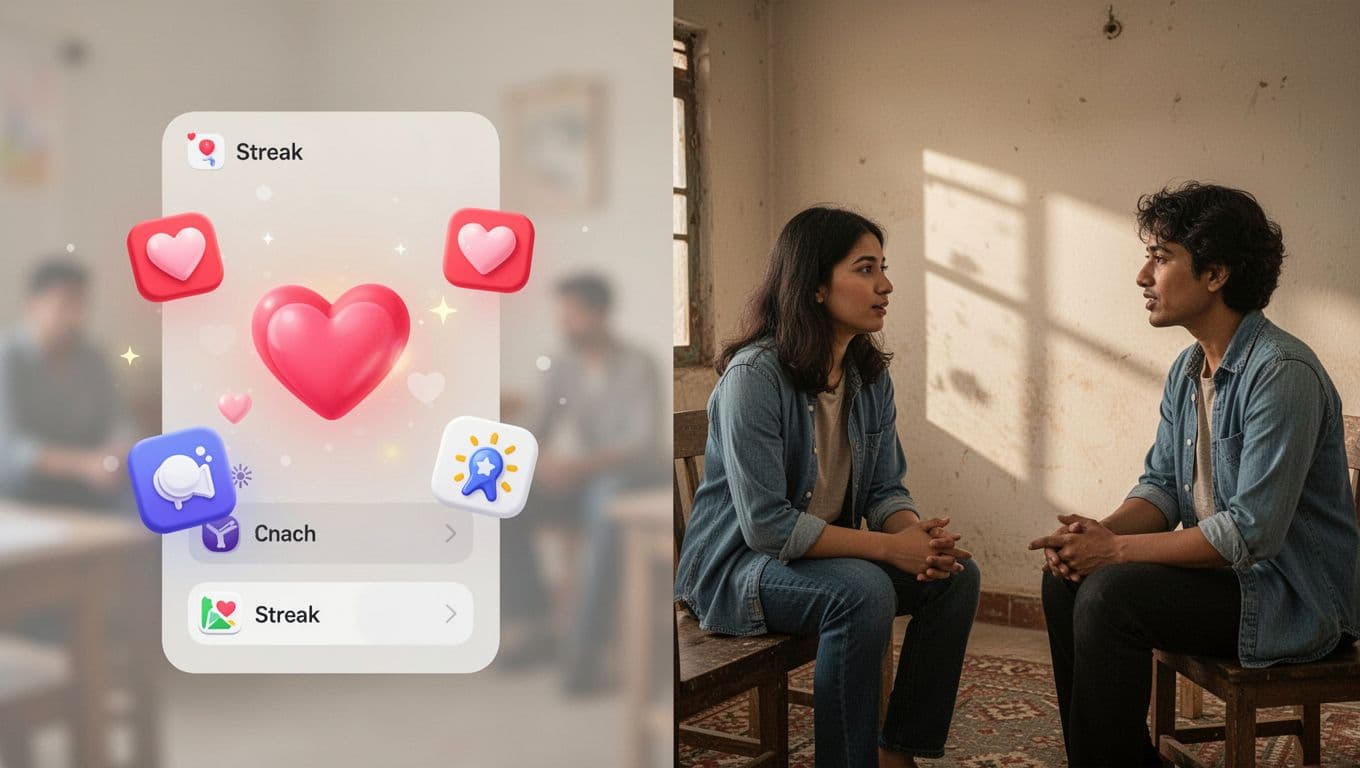
Speaking is the weakest area. Even with Duolingo Max, the AI roleplays are short, and they do not create the messiness of real talk. You are not dealing with accents, interruptions, speed, or the stress of finding words in real time. As a result, many learners finish lessons with good scores and then freeze in live conversation.
If your main goal is speaking, Duolingo can support the goal, but it cannot carry it.
Listening has the same issue. Early audio is clear and controlled, which helps beginners. Later on, serious learners need longer speech, normal speed, and more varied voices. Duolingo offers some of that, but not enough to build strong listening on its own.
Writing also stays narrow. You may type short answers, yet you rarely build paragraphs, argue a point, or get detailed correction. That gap matters once you move past basic travel phrases.
Independent reviews reach much the same conclusion. The Linguist’s 2026 effectiveness review argues that Duolingo is useful for daily contact, but not for fluency. A separate 2026 review on whether Duolingo is enough comes to a similar answer.
If you want to test whether the app is building usable skill, try a language apps 10-minute reality check. Can you say eight original sentences out loud with no hints? Can you understand a short clip outside the app? Those checks matter more than XP.
Should Duolingo be your main resource, and what should you pair it with?
For most serious learners in 2026, Duolingo is best as a supplement, not a main course. There is one exception: absolute beginners in a strong language course can use it as a starting base for a few months. Even then, the app works better when paired with other practice early.
Pricing shapes that decision. The free plan is fine for testing, but ads and heart limits slow down serious study. Super is the best value for committed users, with US pricing often around $59.99 per year or $12.99 monthly, though prices vary by region and offer. Family can make sense for shared use. Max adds AI explanations and chats, but at roughly $168 per year, it still does not replace a tutor or a full speaking tool.
Serious learners should pair Duolingo with missing skills:
- Add live speaking through a tutor, class, or language exchange.
- Add longer listening through podcasts, graded audio, or YouTube.
- Add structured grammar through a course-style app or textbook.
- Add memory support through Anki or a sentence notebook.
If you want a stronger core app, see these best Duolingo alternatives for serious learners. If you are choosing between more structured options, LanguaVibe’s Busuu review for serious learners is also worth reading.
Duolingo earns its place when you treat it like daily conditioning. It helps you stay warm. It does not train the whole match.
Final verdict for real proficiency
Duolingo is still one of the best habit-building language apps in 2026. It is polished, motivating, and genuinely useful at the beginner stage.
Still, serious learners should judge it by proficiency, not streaks. As a daily support tool, it works well. As a full path to confident speaking, listening, and writing, it falls short.
Ready to Take Your Language Learning Further?
Your favorite language-learning app is a great place to start. Rocket Languages can help you go further with interactive audio lessons, pronunciation practice, real-world conversations, and structured learning.
Explore Rocket Languages →Affiliate disclosure: We may earn a commission if you purchase through this link, at no additional cost to you.