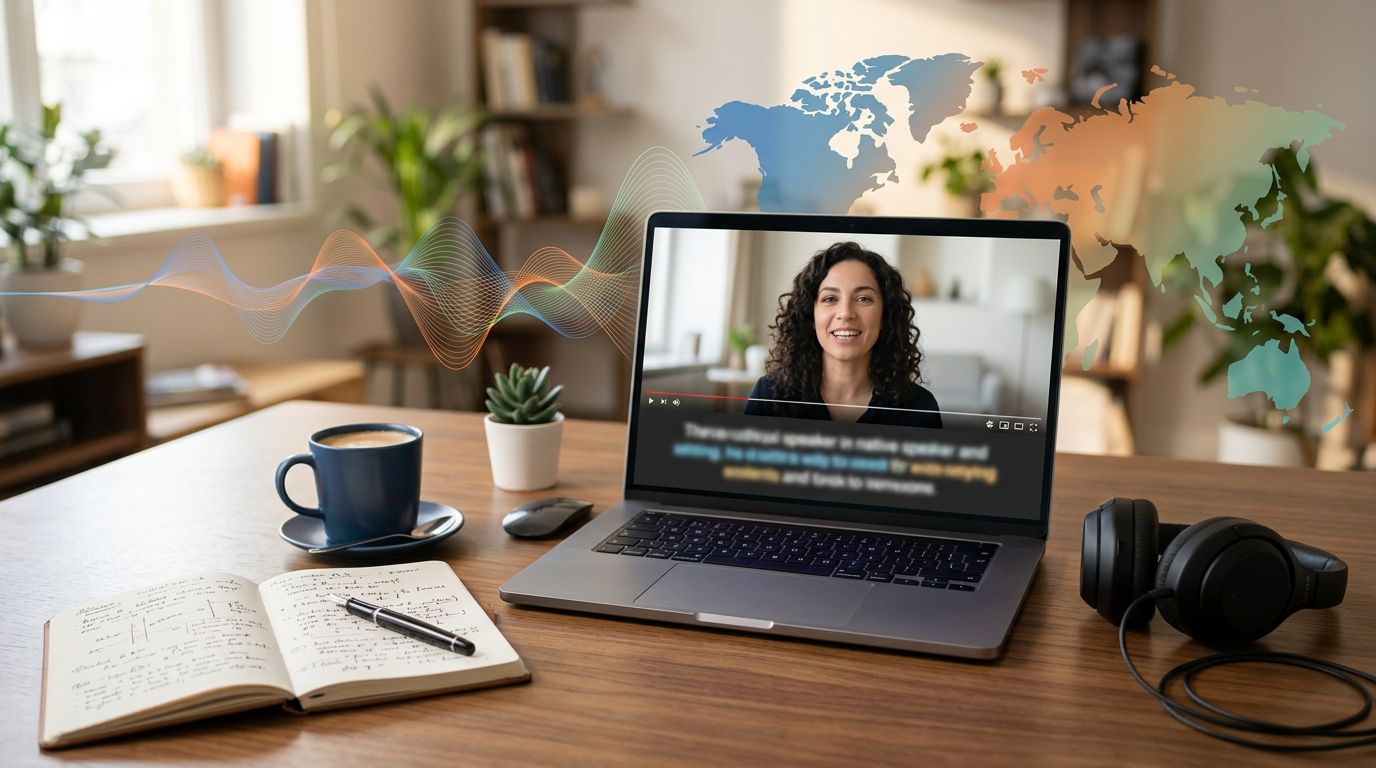
FluentU still looks better than most tap-heavy language apps. Real videos, clickable subtitles, and built-in review feel closer to actual language use than cartoon drills.
That doesn’t mean it’s a complete system. If you care about long-term progress, this FluentU review matters after the first burst of novelty wears off. The real test is whether it helps you understand, remember, and use the language without support.
Where FluentU still earns its place
FluentU’s core method still works well in 2026. You learn through short native videos, then tap words in the subtitles for definitions, audio, example sentences, and follow-up review. That cuts the stop-and-start pain of early immersion.

For serious learners, that setup is more than convenient. It creates supported immersion. You hear normal pacing, see body language, and meet vocabulary inside full sentences. A Spanish learner might watch an interview, tap “quedar,” then notice how it shifts meaning by context. That kind of exposure is hard to get from a standard beginner app.
Because the library is curated, you spend less time hunting for level-appropriate material than you would on YouTube. Downloadable transcripts also help when you want to re-read a clip away from the screen.
This quick snapshot sums up the experience.
| Area | Verdict | What it means |
|---|---|---|
| Immersion | Strong | Real video gives better listening context than canned dialogues |
| Vocabulary retention | Good, with limits | Review tools help, but recall stays easier than free production |
| Grammar support | Basic | Useful hints, weak as a full grammar path |
| Speaking practice | Weak | No real conversational pressure or detailed correction |
| Value for money | Mixed | Strong if you need input, weaker if you need a full course |
The strongest part is the bridge between input and review. FluentU doesn’t leave you alone with a hard video. It turns each clip into a study session, then recycles words through quizzes and spaced review. Public 2026 listings still show support for major languages such as Spanish, French, German, Italian, Portuguese, Mandarin Chinese, Japanese, Korean, Russian, and English, plus web and mobile study. For learners stuck between textbook comfort and native content, that’s a real strength.
Where serious learners hit the ceiling
FluentU is much better at helping you notice language than produce it. That gap matters more over time.
FluentU helps you recognize patterns in context. It does far less to make you say or write them from scratch.
Vocabulary retention shows this clearly. The review system is better than passive watching, and the spacing helps. However, most follow-up work still leans toward recognition. If you can understand a word when it appears in subtitles, you still may not retrieve it in a live conversation two days later. A B1 French learner might follow a news clip with help, then freeze when asked to summarize it aloud. Serious learners often need outside recall practice, such as sentence mining or a separate flashcard system.
Grammar support is also limited. You do get word notes and some grammar help when tapping through subtitles. Yet FluentU doesn’t teach grammar in a tight sequence. If you’re learning German cases, Japanese verb forms, or Spanish tense contrast, context helps, but context alone won’t always sort out the rule. That’s why a structured course like this Babbel review 2026 or a feedback-driven option like this Busuu review for serious learners can feel stronger as a main plan.
Speaking is the weakest area. There are quizzes and some pronunciation-related support, but no built-in live teaching and no real back-and-forth conversation. Any occasional group offering doesn’t change the core self-study model. For long-term acquisition, that is the missing wheel. An app can sharpen listening and vocabulary, yet fluency stalls if you never have to respond under pressure.
Content freshness is better than in script-heavy apps, because real media ages well. Slang, pacing, and register still teach useful things even when a clip isn’t new. Still, freshness varies by language and topic. Big languages tend to have more range, while niche interests can feel thin if you study daily. A few independent 2026 reviewers point to the same tradeoff, strong variety, but not enough output practice to carry your whole routine.
Pricing, long-term value, and the best use case
FluentU’s value depends on what job you want it to do. If you want a guided course that covers grammar, speaking, writing, and testing in one place, the price will feel high for what you get. If you want better listening and more natural vocabulary exposure, the cost makes more sense.
Public 2026 price listings vary by billing cycle and store, but recent third-party summaries place the monthly plan at about $19.99, with lower effective monthly pricing on longer plans. Before paying yearly, it’s smart to check a recent public pricing summary and run a quick 15-minute app review checklist so trial terms and billing are clear.
Compared with rivals, FluentU is easier to recommend as a supplement than as a single solution. Babbel usually gives more structure. Busuu usually gives clearer progression and more output. Meanwhile, FluentU gives richer input and better exposure to natural phrasing than either one. That’s a fair trade if your current weak spot is listening, not grammar.
Used well, FluentU fits a specific slot in a serious study plan. Watch one clip, save a handful of phrases, then retell the clip aloud or write a short summary. That extra output step turns recognition into recall. Without it, FluentU can become an enjoyable viewing habit that feels productive but plateaus.
FluentU is strongest for high-beginners, intermediates, and advanced learners who already know basic grammar and want help crossing into native material. It is weaker for true beginners, because they often need a clearer sequence and more direct explanation. It’s also weaker for learners preparing for job interviews, exam speaking tasks, or daily conversation, because the app doesn’t train live response well enough.
FluentU is still a good tool in 2026, but it isn’t a full system. The videos, subtitles, and review flow make it one of the better apps for supported immersion.
Buy it if you already study with a course, tutor, or conversation partner and want stronger listening plus contextual vocabulary. Skip it as your main app if you need structured grammar, steady speaking practice, or the best value from a one-app subscription. Serious learners get the most from FluentU when they use it as part of a wider plan, not the whole plan.
Ready to Take Your Language Learning Further?
Your favorite language-learning app is a great place to start. Rocket Languages can help you go further with interactive audio lessons, pronunciation practice, real-world conversations, and structured learning.
Explore Rocket Languages →Affiliate disclosure: We may earn a commission if you purchase through this link, at no additional cost to you.