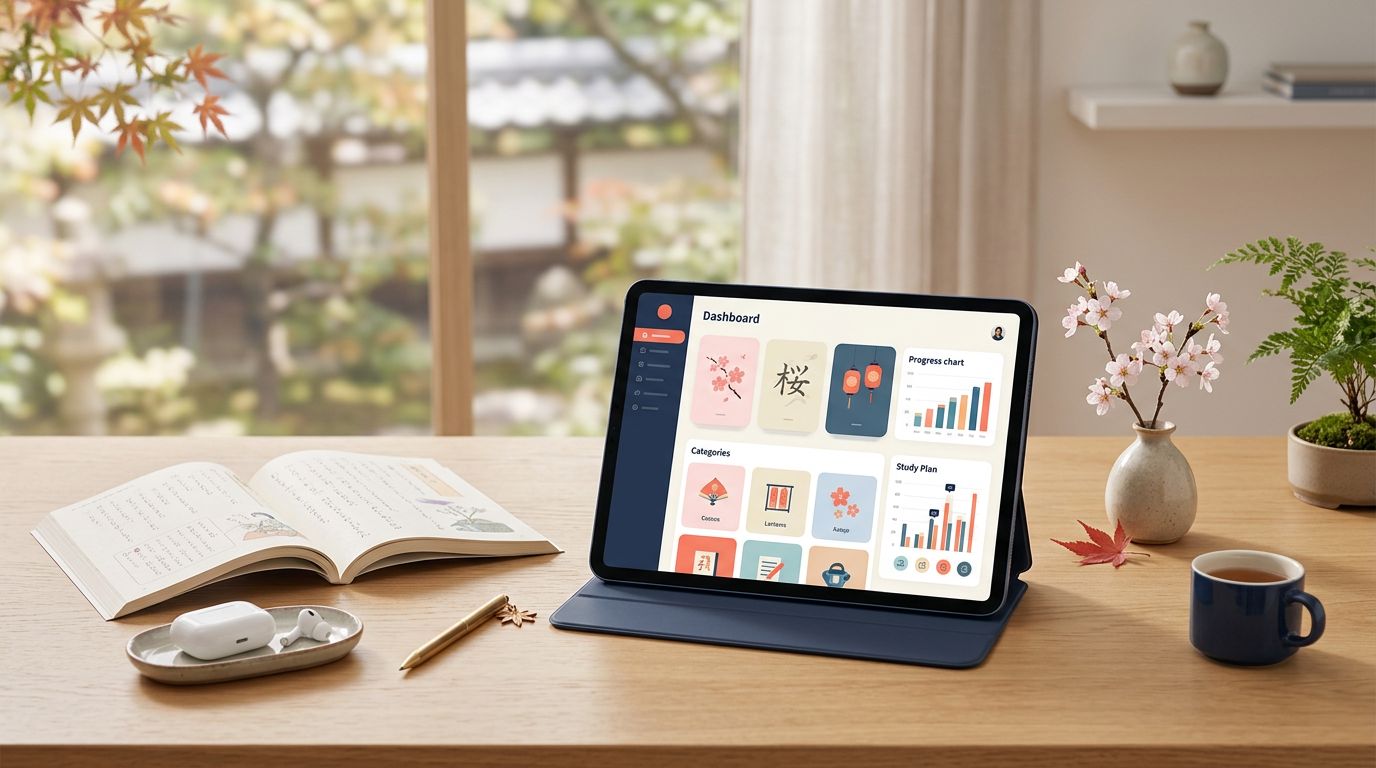
An SRS can keep Japanese vocabulary in your review queue, but it can’t determine whether a paid platform belongs in your daily routine. A Kitsun review is most useful for learners comparing a polished Anki alternative with familiar free tools.
As of August 2026, Kitsun offers a 14-day trial, followed by plans at $8 per month, $64.99 per year, or $199.99 for lifetime access. Its strongest features suit Japanese learners who create cards from reading and video content, while its biggest weaknesses are the subscription cost and limited offline support.
Key Takeaways
- Kitsun combines Japanese-focused SRS reviews with structured lessons, dictionary lookups, reading support, community decks, and subtitle-based card creation.
- Its strongest advantage is reducing the work involved in turning Japanese reading and video immersion into reviewable flashcards.
- Pricing starts with a 14-day trial, followed by $8 monthly, $64.99 yearly, or $199.99 lifetime access; the cost is difficult to justify for occasional use.
- Kitsun is less suitable for learners who need native mobile apps, reliable offline study, or complete control without a subscription.
- It is most worth paying for when immersion card creation and integrated study tools save you time several times each week.
Kitsun review verdict: strong tools, expensive trade-offs
Kitsun is worth trying if you want Japanese study materials, SRS reviews, dictionary lookups, and immersion card creation in one browser-based, Japanese-focused flashcard platform. Its user interface reduces the setup work that often makes Anki feel overwhelming, especially when building cards from anime, subtitles, or articles.
The study platform is less attractive if you need a native mobile app, regular offline study, or a free system without recurring costs. Anki remains difficult to beat on price and control, while some Japanese apps offer more structured lessons at a lower cost.
Use the 14-day trial to see whether Kitsun earns its subscription by replacing several separate workflows. If you mainly need basic flashcards, the price is harder to justify.
During its open beta, Kitsun was an SRS platform positioned between Anki’s flexibility and WaniKani-style guided study. An early community introduction to Kitsun captures that open beta context, but it doesn’t establish how the product performs today. Since the open beta, Kitsun has expanded into a broader set of lessons, reading tools, and shared resources.
What Kitsun includes for Japanese learners
Kitsun combines ordinary flashcard reviews with course content and vocabulary collection tools. That mix gives it wider scope than a basic flashcard platform.
A structured SRS with custom cards
The core system uses a Spaced Repetition System (SRS) to schedule reviews. You can study vocabulary, kanji, kana, conjugation, and grammar through different drills. Kitsun also includes grammar lessons, reading exercises, and an adventure-style course structure for learners who want a sequence to follow.
Study lists can be personal or premade. The platform’s shared progress system helps prevent duplicate lessons and reviews when material appears in more than one list. That matters when you combine a general vocabulary path with a JLPT-focused list.
Flashcard creation is one of Kitsun’s main advantages. You can adjust card fields, add media, and use custom templates with HTML and CSS. Design-focused learners can build detailed systems, while beginners can start with premade materials.
Still, customization has a cost. The more control you use, the more time you may spend adjusting templates instead of reviewing Japanese. Kitsun is easier than starting an Anki collection from scratch, but it can still become a technical project.
Reading, dictionaries, and video card creation
The reading tool helps you parse Japanese text and investigate unfamiliar words. Kitsun’s dictionary tool connects with the SRS. A lookup can become part of a future review, not just a one-time search.
Kitsun’s Jisho.org integration fits into its card workflow. You can look up a word, inspect definitions and readings, then use that information to create a flashcard. This helps when you read content above your current level and want to save relevant vocabulary.
Subs2Kitsun focuses on video immersion. It lets learners generate flashcards from subtitle lines, turning an anime scene or another Japanese video into study material. A card from a sentence provides more context than a translation alone, but verify the subtitle, definition, audio, and example sentence before using it.
These tools suit intermediate learners particularly well. Beginners may struggle with the reading and mining features before they know enough grammar for sentence context. Kitsun’s structured lessons help at the start, but its distinctive features emerge once you read and watch Japanese regularly.
Community decks and shared materials
Community decks give you ready-made vocabulary and grammar content without requiring you to build every card yourself. These resources can cover common study goals, but quality depends on the creator. Check the level, example sentences, audio, and card layout before committing to a large deck.
The community model supports shared learning materials through shared decks, but it isn’t a live collaborative classroom. You can use and share these resources, yet your progress remains your own. Learners who want full control over every sentence may still prefer personal cards.
Kitsun pricing in 2026
Kitsun’s current pricing options are easy to understand, although the lifetime price deserves careful attention.
| Plan | Current price | Best suited to |
|---|---|---|
| 14-day trial | Free | Testing the workflow |
| Monthly | $8 per month | Short-term or flexible study |
| Yearly | $64.99 per year | Learners planning at least nine months |
| Lifetime | $199.99 one time | Long-term users committed to Kitsun |
The yearly plan equals about $5.42 per month and saves $31.01 compared with paying monthly for twelve months. The lifetime plan costs about the same as 25 monthly payments, or just over three years at the annual rate.
Kitsun’s help information has previously rounded the lifetime price to $199, while the live pricing figure is $199.99. Use the amount shown during checkout rather than an older discussion or sale price. Historical promotions from the open beta era have offered a lower lifetime price, but those discounts shouldn’t be treated as permanent options.
The 14-day trial is long enough to test the parts that matter. Create a few personal cards, test the reading tool, review a community resource, and generate one set with Subs2Kitsun. A quick look at the dashboard won’t tell you whether the platform fits your routine.
For a learner studying Japanese for several years, a lifetime subscription can make financial sense. However, language-learning plans often change. If you may switch to another SRS within a year, the monthly subscription or free alternative carries less risk.
Kitsun review vs Anki and other Japanese tools
The best choice depends on whether you value convenience, structure, cost, or control, and whether a web-based alternative suits your workflow.
| Platform | Main strength | Main drawback |
|---|---|---|
| Kitsun | Japanese-focused creation, reading, and SRS tools | Paid subscription and browser dependence |
| Anki | Free core system with extensive customization | More setup and maintenance |
| Renshuu | Broad Japanese curriculum and generous free access | Less focused on custom immersion mining |
| Bunpro | Structured grammar SRS | Primarily grammar-focused |
Anki is the stronger choice for learners who want maximum ownership of their decks and scheduling, including how they import decks. It also avoids Kitsun’s recurring fee at its core. The trade-off is that you may need separate tools for dictionary lookups, subtitle mining, reading support, and course progression.
Kitsun makes more sense when those separate tasks are slowing you down. Its interface and card workflows reduce friction, but the convenience only has financial value if you use them often. Someone who creates a card once a week may not get enough from the subscription.
Renshuu is a useful comparison for learners who want a wider Japanese curriculum without making custom cards the center of study. LanguaVibe’s Renshuu review covers its vocabulary, kanji, grammar, reading, audio, and JLPT-oriented tools.
Grammar-focused learners should also compare Kitsun with the best Japanese grammar apps. Bunpro offers a more focused grammar path, while Kitsun spreads its attention across grammar, vocabulary, kanji, reading, and user-created content.
Learners considering a dictionary-centered system may also encounter jpdb in Japanese study communities. A WaniKani discussion of jpdb shows why it enters the comparison: it combines a Japanese dictionary with vocabulary and kanji review. Kitsun has a broader card-building focus, so the two platforms suit different study habits.
Where Kitsun falls short
The largest practical limitation is device access. Kitsun is presented as a web-based study platform, and current product materials don’t list a native mobile app or offline mode. You should expect an internet connection for regular study rather than assuming you can review during a commute, flight, or unreliable connection.
That issue affects more than convenience. SRS works best when reviews happen consistently. A browser-only workflow can be awkward for learners who study mainly on a phone. A laptop or tablet with reliable access makes Kitsun easier to use.
Users during the open beta questioned whether a paid SRS could compete with Anki. Basic flashcard review doesn’t require a monthly payment. Those open beta concerns remain relevant because a subscription fee must offer value beyond basic reviews. The current lifetime price is also a significant upfront purchase.
Kitsun also lacks strong independent evidence about memory retention over the long term. Its features support a sensible study method, but a polished interface doesn’t prove better memory. Your results will still depend on card quality, review consistency, listening practice, reading volume, and real-world Japanese use.
Who should choose Kitsun?
Kitsun is a good fit for intermediate Japanese learners who regularly watch Japanese media or read native content. Its reading tool and Subs2Kitsun create a smoother path from encountering a word to reviewing it later.
It can also suit beginners who want structured lessons and don’t want to assemble an Anki system by themselves. However, beginners should pair it with listening and speaking practice because language studies involve more than spaced repetition. An SRS platform cannot provide a complete Japanese course on its own.
Choose Anki if price, portability, and deep control matter most. Choose a structured app such as Renshuu or Bunpro if you want a clearer curriculum. Choose Kitsun when its integrated reading, dictionary tool, community materials, and subtitle workflows are features you’ll use several times each week.
Frequently Asked Questions
Is Kitsun worth paying for?
Kitsun is worth paying for if you regularly create flashcards from Japanese reading, videos, or subtitles and want those tools in one platform. If you only need basic SRS reviews, Anki or another free option may offer better value.
How much does Kitsun cost in 2026?
Kitsun offers a 14-day free trial, followed by plans at $8 per month, $64.99 per year, or $199.99 for lifetime access. The yearly plan lowers the effective monthly cost, while the lifetime option makes more sense for learners who expect to use Kitsun for several years.
Is Kitsun better than Anki?
Kitsun is easier to use for Japanese-focused reading, dictionary, and subtitle card workflows, while Anki offers more control without a core subscription fee. The better choice depends on whether convenience or customization, portability, and cost matter more to you.
Does Kitsun work offline or have a native mobile app?
Current product information presents Kitsun as a browser-based platform and does not list a native mobile app or offline mode. Learners who study mainly on a phone or during unreliable internet access may find this limiting.
Who should use Kitsun?
Kitsun suits intermediate Japanese learners who regularly read native content or watch Japanese media and want to turn new vocabulary into SRS cards. Beginners can also use its structured lessons, but they should add listening, speaking, and other forms of practice because Kitsun is not a complete Japanese course.
Conclusion
Kitsun is a capable Japanese SRS with useful tools for custom flashcard creation, reading support, dictionary searches, and subtitle-based study with Subs2Kitsun. Its 14-day trial makes the decision easier, but the $8 monthly fee and $199.99 lifetime price require more than occasional use.
The clearest verdict is simple: Kitsun is worth paying for when immersion card creation saves you time every week. If you mainly need straightforward flashcard reviews or dependable offline mobile study, Anki or another Japanese app is likely the better fit.
Ready to Take Your Language Learning Further?
Your favorite language-learning app is a great place to start. Rocket Languages can help you go further with interactive audio lessons, pronunciation practice, real-world conversations, and structured learning.
Explore Rocket Languages →Affiliate disclosure: We may earn a commission if you purchase through this link, at no additional cost to you.