
A memorized Nepali greeting helps less if you can’t understand the answer. To learn Nepali on your phone, combine one lesson sequence with script practice and recordings you can replay.
Your strongest measure of progress is active recall: saying or typing something without seeing the answer. Give each tool a clear job, then use the same useful language across reading, listening, and speaking.
Key Takeaways
- Choose one resource for new lessons, then add tools that address missing skills rather than repeat the same introductions.
- Keep Devanagari beside pronunciation guides, and connect written words with reliable audio from the beginning.
- Test lessons, recordings, prices, and offline access before committing. App descriptions and archived course listings don’t prove that every feature works.
Start with Devanagari alongside spoken Nepali
The Nepali language uses Devanagari, written from left to right. Romanized spellings can help you start speaking, but they aren’t a consistent guide to pronunciation.
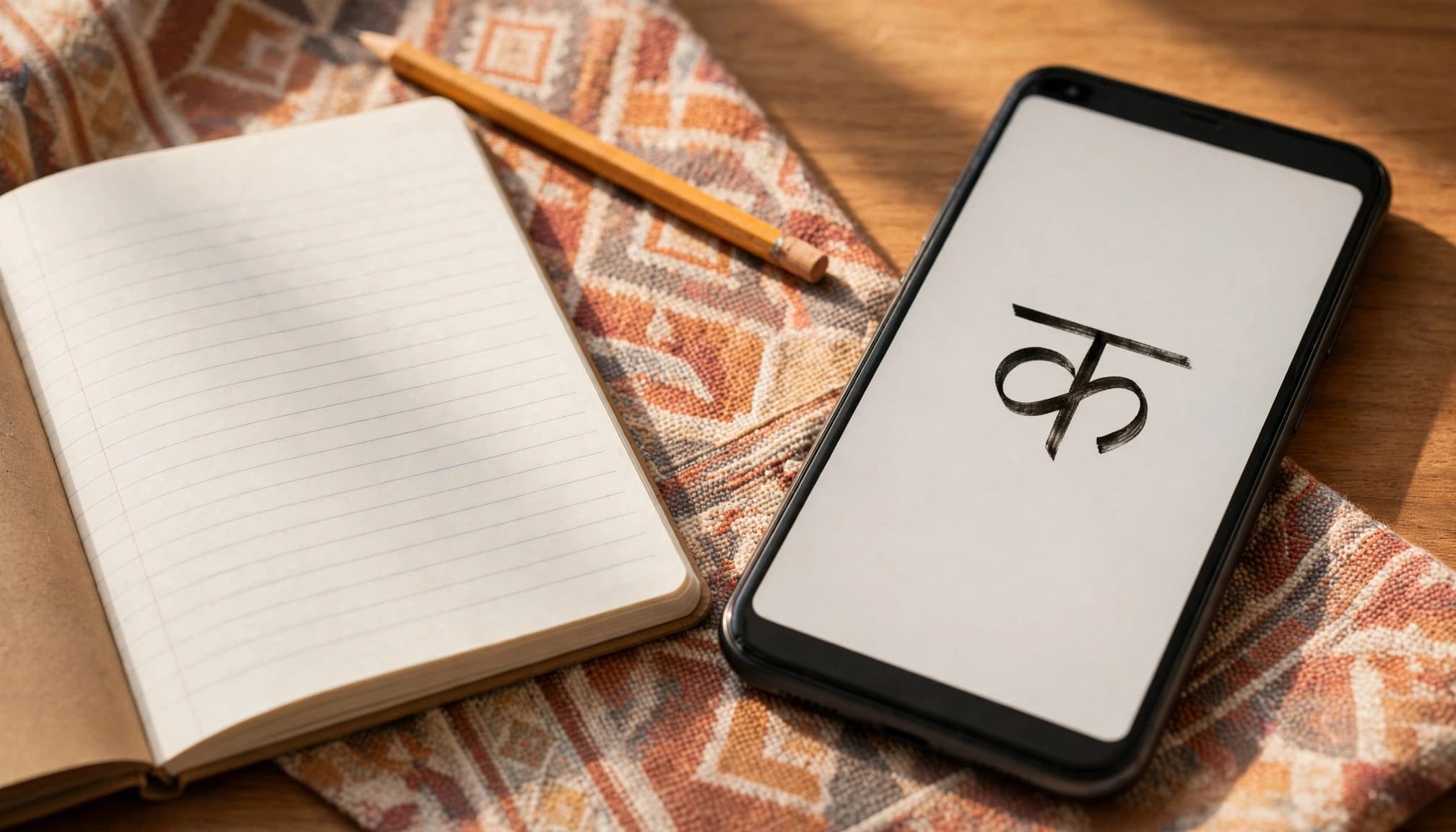
Learn characters inside familiar words
Begin with words you already recognize by ear, such as नमस्ते, commonly used as a greeting. Match the recording to the written word before studying its individual characters.
Next, learn how vowel signs attach to consonants. For example, क and का differ because the second includes a vowel sign. Combined consonant forms also need attention as your reading expands.
A useful script lesson explains these patterns rather than asking you to trace shapes alone. Handwriting can reinforce recognition, but always connect each shape with its sound. If useful, character-recognition puzzles can supplement learning while you continue linking forms to sounds.
Keep romanization available as temporary support. Gradually cover it when reviewing familiar words.
Use your keyboard as reading practice
Gboard supports Nepali on Android, although layouts and available features can vary. Add Nepali in its language settings, then check which layout your device offers.
A keyboard is a typing tool, not script instruction. Copy a short checked phrase first, then hide the model and type it again.
On other phones, inspect the current keyboard options rather than assuming identical support. Predictive suggestions can help you finish a word, but they can also hide spelling gaps.
Save new phrases with Devanagari, a meaning, and an audio reference. That keeps each reading drill connected to speech.
Make audio produce a spoken answer
Clear recordings matter because beginners borrow sound habits from their models. Prefer identified native-speaker recordings when available, and sample complete dialogues as well as individual words.
Listen before revealing the translation
Play a short recording once without reading. Then check the meaning, replay it, and repeat aloud after each phrase.
Once the line feels familiar, answer a related prompt without looking. For example, use short conversations to rehearse a request for water and the response you might hear.
Our guide to listen-and-repeat language practice offers a repeatable routine for short clips. Start with material you understand rather than trying to shadow rapid conversations immediately. For a practical pronunciation app test, use a clip you already understand.
Recognizing a phrase while reading its English translation doesn’t show that you can understand it by ear.
Record specific pronunciation contrasts
Nepali distinguishes sounds that English-speaking learners may initially group together. These include aspirated and unaspirated consonants, such as क and ख, and dental versus retroflex consonants, such as त and ट.
Record yourself speaking as you repeat a reliable model. Compare one feature at a time rather than judging whether your whole accent sounds convincing.
Ask a Nepali speaker for one correction when possible. Speech analysis tools may score an understandable attempt without explaining which sound to change.
Also compare rhythm and pauses. Correct individual sounds won’t necessarily make a complete sentence easy to follow.
Compare resources before choosing your main course
Several resources can help you learn Nepali, but they don’t offer interchangeable teaching. Separate published reference material from app features that need a hands-on trial.
| Resource | Script instruction | Audio | Structure | Suitability for beginners |
|---|---|---|---|---|
| NepaliGo resources | Published Devanagari reference | Check recording availability | Eight practical phrasebooks and connected quizzes | Useful reference and extra practice |
| Learn Nepali App | Inspect whether lessons explain script patterns | Sample voices and playback controls | Check the current sequence | Consider after testing explanations and recall |
| LingFast | Verify dedicated script teaching | Test pronunciation models and feedback | Inspect material beyond the opening section | Consider after a trial |
| FSI Nepali archives | Check whether usable text is available | Archived recordings need checking | Course listings have conflicting details | Supplement cautiously |
The main distinction is between instruction and reference. A phrasebook helps you find a useful expression; a course should teach you how to adapt it.
If a resource is interactive, check whether its exercises ask you to produce language. A vocabulary builder, a word search, and puzzles can support recognition, but don’t prove a complete course.
The NepaliGo learning resources include a Devanagari reference, eight phrasebooks, and connected quizzes. That’s a practical place to explore written forms and topic-based language, without assuming it replaces a complete syllabus.
For Learn Nepali App and LingFast, inspect the current listing on your own platform. Confirm the developer, lesson access, and purchase terms. Similar names can make identification confusing.
Don’t choose by vocabulary totals alone. A smaller collection with clear explanations and repeated sentence practice can be more useful than hundreds of isolated words.
Check course depth and free archive limitations
A beginner course needs a visible path. You should know what follows greetings and how earlier material returns.
Test learning beyond the opening unit
Before paying, inspect lessons beyond the opening unit if access allows. Look for connected dialogues, grammar explanations, and questions that require you to produce language.
After a sample lesson, change one noun in a sentence and say it aloud. If you can only select the original answer, you need more practice or clearer instruction.
Also check replay controls, transcripts, and whether recordings remain accessible during review. For feedback tools, use a practical pronunciation app test as a model, adapting the sound contrasts to Nepali.
Check the full subscription cost, renewal terms, and cancellation process on your device.
Treat archived courses as supplementary materials
Free archives can provide useful exercises, but check every component before building your routine around them.
The FSI Nepali Course archive has conflicting catalog details and reports problems with missing text and recordings. Don’t assume the listing describes a complete, functioning course.
Similarly, Live Lingua’s FSI Nepali Basic Course page describes ebook and audio materials but also displays “No Ebook Found For This Course.”
Open the files, test playback, and confirm that the text matches the recording. Working sections may help, but gaps require another resource.
Learn grammar through useful Nepali sentences
Vocabulary becomes more useful when you can put it into a sentence. Review vocabulary in context, since Nepali commonly uses subject-object-verb order, unlike English’s usual subject-verb-object pattern.
For example, म पानी पिउँछु। means “I drink water.” The verb follows पानी, “water.”
Keep complete sentences in your review notes. However, learn what each part does so you can change the sentence rather than memorize it as an indivisible phrase.
Another useful expression is मलाई पानी चाहिन्छ।, meaning “I need water.” Its structure differs from a word-for-word English rendering. This is why translation alone can’t provide your grammar syllabus.
Politeness also belongs in beginner study, since language choices reflect culture and context. तपाईं is a respectful form of “you,” while तिमी is more familiar. Pronoun choices affect verb forms, so study them together.
For travelers, prioritize polite requests, numbers, directions, and clarification. Heritage learners may need more reading and spelling practice, even when everyday spoken phrases already feel familiar.
A useful course pairs dialogues with explanations of sentence patterns and grammar. When an explanation is missing, keep a checked sentence and a short note about its pattern.
Build a phone routine that connects the skills
You don’t need several broad beginner subscriptions. One lesson source, a keyboard, and reliable recordings can support a focused routine.
Use a 20-minute practice routine built around the same small set of sentences:
- Spend five minutes reviewing familiar Devanagari words, then type one sentence without copying.
- Use five minutes for a lesson that introduces a sentence pattern.
- Replay its audio for five minutes, first without text and then with it. Repeat and record a difficult line.
- Finish with five minutes of recall. Say an answer aloud, change part of the sentence, and check your attempt.
Keep new material modest enough that you can revisit it. If yesterday’s items disappear without answer choices, spend more time reviewing before adding vocabulary.
Once a week, have short conversations with a tutor, language exchange partner, or Nepali-speaking relative. Bring a few dialogues from your lessons and ask for corrections.
Before traveling, test your setup in airplane mode. An installed app doesn’t necessarily contain downloaded content. Screenshots preserve written sentences, but they don’t preserve the associated recordings.
Measure progress toward fluency through tasks: read a familiar sentence, understand it without text, and produce an appropriate reply.
FAQ About Learning Nepali on a Phone
Can I learn Nepali on an app without learning Devanagari?
You can begin speaking through recordings and pronunciation guides. However, avoiding Devanagari limits your access to messages, signs, dictionaries, and written explanations.
Start with characters inside familiar words instead of waiting to memorize the entire script. If travel is approaching, give spoken requests more time while maintaining a small daily reading habit. You can develop both skills together without treating script mastery as a prerequisite for speaking.
Can one resource make me conversational?
A course can teach vocabulary, sentence patterns, and rehearsed responses. No single resource can make every learner fluent on its own. Conversations also require understanding unexpected replies and responding without a fixed prompt.
Use lessons to prepare language, then practice it with people. If your primary resource lacks clear script instruction or reliable audio, add a targeted resource for that gap. Another broad beginner course may simply repeat material you already know.
Make Phone Practice Lead to Real Replies
To learn Nepali effectively, connect written forms, reliable audio, and spoken recall around useful sentences. Choose resources by the skill they teach, and test their materials before paying or depending on them.
Your phone practice is working when you can understand a familiar request and answer without reopening the lesson. Measure fluency by that practical task, not app completion alone.
Ready to Take Your Language Learning Further?
Your favorite language-learning app is a great place to start. Rocket Languages can help you go further with interactive audio lessons, pronunciation practice, real-world conversations, and structured learning.
Explore Rocket Languages →Affiliate disclosure: We may earn a commission if you purchase through this link, at no additional cost to you.
