
Two resources labeled “Quechua” can teach different pronunciation, spelling, and everyday expressions. If you want to learn Quechua online, start with a named regional variety, then combine structured lessons with replayable audio and short reading.
A free multimedia course can provide your foundation; a paid phrase app can add useful repetition. Your first decision is which Quechua-speaking community you want to understand.
Choose a Quechua Variety Before You Start
Quechua is a family of related language varieties, not one uniform language. Some varieties differ enough that speakers can’t easily understand one another.
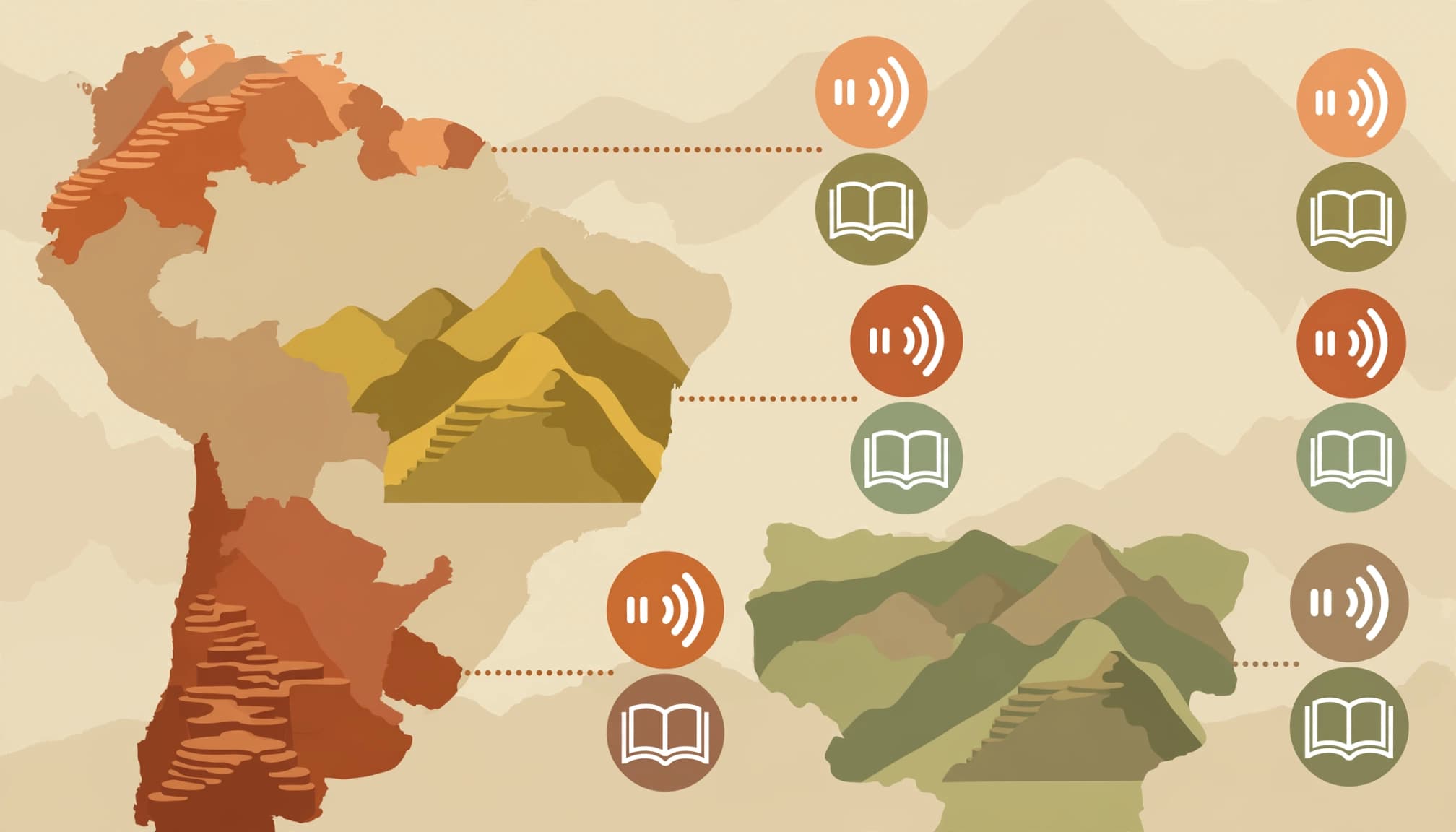
Match your course to your purpose
If you’re learning for family conversations, use that family’s variety as your starting point. For travel or community work, choose materials connected to the region where you’ll use the language.
Cusco-Collao is a Southern Quechua variety taught by Quechua Tinkuy. uTalk labels its offering “Quechua (Cuzco).” Cuzco and Cusco are alternative spellings of the same place, although these resources don’t necessarily use identical wording throughout.
Ecuadorian Kichwa and Central Peruvian varieties need their own learning materials. A Cusco-focused course shouldn’t be presented as an interchangeable introduction to every variety.
Keep your first resource set consistent
For your first weeks, keep lessons, recordings, and vocabulary notes within one regional model. Otherwise, you may mistake a regional difference for a pronunciation error.
Write the variety beside each resource in your study notebook. When a provider doesn’t identify one, treat its material as supplementary rather than your main pronunciation reference.
You can explore other varieties later. First, build enough familiarity to recognize when forms differ.
Start With a Structured Course and a Phrase Supplement
The strongest beginner resources serve different purposes. Choose a main course for progression, then add another tool only when it fills a gap.
These two options identify their regional focus clearly.
| Resource | Variety | Access | Strongest role |
|---|---|---|---|
| Quechua Tinkuy | Cusco-Collao | Free online materials | Structured multimedia study |
| uTalk Quechua | Cuzco | Paid subscription | Practical vocabulary and phrase rehearsal |
Tinkuy is the clearer foundation; uTalk is useful for extra spoken repetition.
Quechua Tinkuy: free multimedia lessons
The University of Texas at Austin’s COERLL lists Quechua Tinkuy’s multimedia curriculum for basic-to-intermediate study. It includes audio, video, graphics, and activities covering speaking, grammar, and reading.
Its Cusco-Collao model draws on speech in Puca Puca, Apurímac, and Quehuar, Cusco. That regional detail helps you understand what you’re learning.
The materials support both classroom teaching and independent study. Work through them in sequence rather than collecting isolated vocabulary pages. Because the course brings several skills together, it can anchor a no-cost beginner plan.
uTalk: paid practice for useful phrases
uTalk’s Quechua Cuzco course offers short lessons with native-speaker audio. Topics include greetings, family, travel, and numbers.
Its practical format suits brief sessions when you want to rehearse familiar words and phrases. However, phrase practice needs grammar explanations and connected reading alongside it.
Use uTalk as a supplement to Tinkuy or another structured course. Completing themed exercises doesn’t establish that you can understand an unfamiliar conversation or construct your own replies.
Other Self-Paced Quechua Options
Additional courses can suit learners who prefer text lessons or a different lesson structure. Keep their role separate from your main audio reference.
Free text-based study
Linguardia describes its Quechua course as free, with lessons accessible without registration or through a free account. Its material draws on 2,000 Quechua sentences.
Enquechua.com offers a free, self-paced beginner course with 19 lessons, more than 800 vocabulary words, and over 50 everyday phrases. Its current lessons are text-based, so pair them with reliable recordings elsewhere.
Neither resource identifies a variety in its cited course description. They can provide additional written practice, but that makes them less suitable as your sole regional pronunciation model.
Paid modular study
Targumi lists 179 lessons across 37 modules. Its beginner section contains 95 lessons in 23 modules, and it offers monthly, quarterly, and lifetime plans.
Those counts describe the size of the catalog, not the learning outcomes. A large course still needs regular review and spoken practice.
If Tinkuy already gives you a workable sequence, another broad course may duplicate your study. Paid support is most useful when it addresses a missing skill.
Use Quechua Audio to Practise Replies
Audio teaches you how written forms sound in speech. Yet repeated listening works better when you also retrieve language without seeing the answer.

Move beyond background listening
Start with a short recording from your main course. Listen once for meaning, then replay it with the text if available.
Next, hide the written version and try to say a familiar response. Compare your attempt with the recording. Finally, change one detail using vocabulary you’ve already learned.
The Quechua program at Penn emphasizes communicative learning. Apply that priority to self-study: practise understanding an exchange and producing a reply, not only recognizing individual words.
If you recognize a phrase only while its translation is visible, you haven’t yet shown that you understand it by ear.
Compare one pronunciation feature at a time
Cusco-Collao distinguishes plain, aspirated, and ejective consonants. Spellings such as k, kh, and k’ indicate different sounds, not optional stylistic choices.
Use your phone’s recorder to capture one familiar sentence. Record separately rather than speaking over the original, then compare a single consonant or the sentence’s rhythm.
A proficient speaker can explain an uncertain contrast more usefully than a general pronunciation score. Bring one short phrase for correction rather than asking someone to assess your entire accent.
Find Beginner-Friendly Reading With Audio
Short course passages are a better starting point than long articles. You need enough familiar language to follow meaning without looking up every word.
Read passages connected to your lessons
Begin with a dialogue or brief paragraph that uses vocabulary you’ve already heard. Read once for the overall message, then examine the endings attached to familiar words.
Quechua builds many grammatical meanings through suffixes. For example, wasi means “house,” while wasikuna means “houses.” Recognizing a familiar base helps you understand longer forms.
Save the complete sentence with its meaning, not only the dictionary entry. Context shows how the word functions and gives you something useful to recall aloud.
Add authentic material gradually
Ohio State University’s Quechua study resource directory includes Cusco-area radio, text-and-audio resources, and cultural material such as poetry, songs, jokes, and video clips.
These are useful additions once course recordings feel manageable. However, a radio broadcast or poem isn’t automatically beginner-level because it’s freely accessible.
Choose one short passage with text or translation support. Listen, read, and return to the same passage before moving on.
Our guide to moving beyond graded readers explains how to increase reading difficulty gradually. For Quechua, apply that principle to short authentic texts before attempting a full book.
Build a Repeatable Beginner Study Routine
A modest routine gives each resource a clear job. Start with about 20 minutes per session rather than an ambitious schedule you can’t maintain.
- Spend five minutes on one course explanation or sentence pattern.
- Replay related audio for five minutes, first without text and then with it.
- Read a short passage for five minutes and identify familiar words and endings.
- Finish with five minutes of spoken recall, including one changed detail.
Keep new vocabulary small enough to revisit the next day. If yesterday’s phrases disappear without answer choices, use the next session for review.
Anki can support that review, but it doesn’t supply a Quechua curriculum. Build cards using accurate sentences from your chosen course, including audio when you’re permitted to reuse it. Our AnkiMobile and AnkiDroid comparison explains the mobile options.
Once a week, practise a short exchange with a proficient speaker. Bring familiar course material and ask for a correction you can apply during the next session.
Measure progress through tasks: understand a greeting without text, read a familiar passage, and answer a simple prompt. App completion alone doesn’t show whether you can do those things.
Key Takeaways
You don’t need several subscriptions to learn Quechua online. A consistent regional model and active practice matter more than collecting tools.
- Choose a named variety before combining resources.
- Use free Quechua Tinkuy for a Cusco-Collao foundation, with paid phrase practice only if it fills a gap.
- Connect listening, reading, and spoken recall around the same short passages.
Frequently Asked Questions
Can I learn Quechua online for free?
Yes. Quechua Tinkuy provides free multimedia materials for basic-to-intermediate Cusco-Collao study. Linguardia and Enquechua.com also describe free self-paced courses, although their cited descriptions don’t identify a regional variety.
A free plan still needs active listening, review, and opportunities to receive correction. Paying for an app doesn’t remove those requirements.
Which resource is the clearest beginner starting point?
For Cusco-Collao, Tinkuy is the clearest foundation among these resources because it combines a named variety with structured multimedia study.
If your goal concerns another Quechua-speaking region, begin with that region’s variety instead. uTalk’s Cuzco offering is better treated as additional phrase rehearsal than as a replacement for your main course.
Choose One Foundation and Practise Using It
The first challenge is choosing a consistent variety, then turning lesson content into language you can understand and produce. A structured course, reliable recordings, and manageable reading give you that foundation.
Start with one short lesson and revisit it until you can respond without the text. Usable recall is a stronger sign of progress than another completed exercise.
Ready to Take Your Language Learning Further?
Your favorite language-learning app is a great place to start. Rocket Languages can help you go further with interactive audio lessons, pronunciation practice, real-world conversations, and structured learning.
Explore Rocket Languages →Affiliate disclosure: We may earn a commission if you purchase through this link, at no additional cost to you.