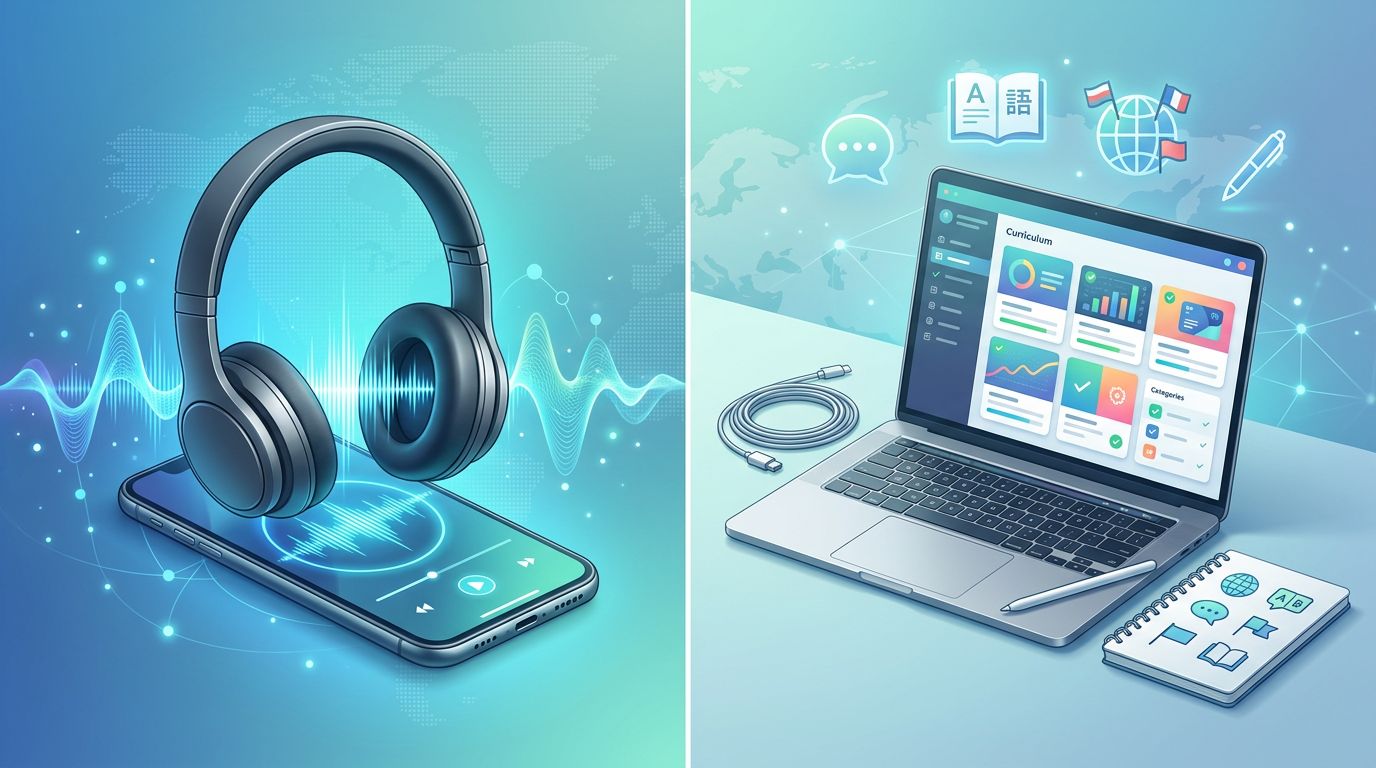
If speaking sooner matters more than collecting lessons, Pimsleur usually gets you there faster. Rocket Languages can still be the better choice when you want more explanation and a steadier lesson flow. The real winner depends on whether you need raw speaking reps or a clearer map of the language.
That choice matters more in 2026 because both apps still aim at self-study learners, but they train different habits. One pushes recall through audio repetition. The other gives you more structure, which can help when grammar feels slippery.
How Pimsleur and Rocket Languages train speech
Pimsleur is built like a spoken drill session. You hear a prompt, wait, answer out loud, then hear the model response. That back-and-forth forces your brain to retrieve language instead of just recognizing it.
The current Pimsleur plans are also easy to pin down. Published pricing sits around $20 a month for one language, about $21 a month for All Access, or roughly $150 to $165 a year depending on the plan. A free trial and a 30-day money-back guarantee are still part of the offer, which helps if you want to test the pace before paying.
Rocket Languages takes a more lesson-based path. It gives you more explanation, more visible structure, and more chances to see how a phrase fits into a pattern. That usually feels calmer for learners who want to understand before they speak.
Here’s the short version:
| Factor | Pimsleur | Rocket Languages | Faster speaking edge |
|---|---|---|---|
| Lesson style | Audio-first, repeat after prompts | Guided lessons with more explanation | Pimsleur |
| Listening recall | Strong, because you must answer from memory | Good, but more supported | Pimsleur |
| Pronunciation practice | Frequent spoken repetition | Solid, but less drill-heavy | Pimsleur |
| Sentence formation | Learnt through use | Learnt through explanation and review | Rocket for clarity |
| Confidence | Builds through quick wins | Builds through understanding | Depends on the learner |
| Best fit | Busy beginners, travelers, audio learners | Learners who want grammar support | Tie, based on style |

The table makes the tradeoff plain. Pimsleur is a speaking gym. Rocket is more like a guided class.
A recent Pimsleur vs Rocket Languages comparison reaches the same broad conclusion. Pimsleur pushes output faster. Rocket gives you more support while you learn.
What helps your ear, mouth, and memory fastest
The fastest speaking progress usually comes from three things working together: listening recall, pronunciation, and sentence building. Pimsleur leans hardest into the first two.
Listening recall improves because you cannot coast. When the prompt ends, you have to produce the phrase yourself. That delay is small, but it matters. It trains your brain to move from hearing to speaking without a pause for translation.
Pronunciation also gets strong training because you repeat full phrases many times. Pimsleur’s newer Premium features add speaking exercises, fill-in-the-blank practice, flash cards, review tools, AI pronunciation feedback, Speed Round games, and reading lessons with cultural notes. Those extras make the platform feel more complete than the old audio-only version.
If you freeze when someone speaks fast, repeated audio recall matters more than extra menus.
Rocket Languages is slower at pure recall, but it often helps sentence formation more. You see the grammar pattern, hear examples, and then use the phrase in a lesson context. That can stop bad guessing early, especially if you hate learning by trial and error.
For lower-intermediate learners, that difference matters. You may already know some words, but you still need to build sentences without guessing at the order. Rocket tends to support that process better.
What about confidence? Pimsleur often wins there at first. You say more, sooner. Rocket can catch up later because you understand more of what you are saying. In other words, Pimsleur gives you momentum, while Rocket gives you a firmer floor.
Where Rocket Languages makes more sense
Rocket Languages is the safer pick if you need the “why” behind a phrase. That is especially true for absolute beginners who panic when they hear grammar terms, and for self-study users who want a lesson to feel explained instead of guessed.
It also suits learners who prefer to see the language on screen. Some people hear well and speak slowly, but they still want visual support before they commit to a phrase. Rocket gives them that bridge.
Travelers can still use Rocket, but Pimsleur usually wins for short-term trip prep. If you want hotel phrases, directions, food, and basic politeness fast, Pimsleur’s audio loop gets you moving quicker. Rocket makes more sense if your trip is a step in a longer study plan.
For learners who want deeper grammar support, Rocket has a clear edge. It is easier to understand sentence shape when the app explains the structure in front of you. That matters once you move past survival phrases and want to build your own sentences.
If you want to compare that style with another structured app, Babbel vs Busuu in 2026 shows a similar split between guided study and output-focused practice. The lesson design shapes the result more than the brand name does.
Pricing and value in 2026
Price matters, but speaking speed is the real test. A cheaper app that sits unopened is still expensive.
Pimsleur’s pricing is more transparent in 2026. Its current plans are published around $20 to $21 per month, or roughly $150 to $165 per year, depending on whether you want one language or All Access. That is not the cheapest option in the market, but it is easy to understand.
Rocket Languages is harder to pin down because promos and bundles change more often. If you want the live number, the safest move is to check the current checkout page. A live snapshot like the Rocket Languages vs Pimsleur comparison helps, but it should not replace the final checkout price.
If you are comparing more than these two, the language app comparison roundup gives you a wider view of common pricing models. That can help if you are deciding between a speech-first app, a grammar-first app, or something more game-like.
The value question is simple. Pimsleur is worth it if you use it daily and want speaking reps with very little setup. Rocket is worth it if you want more explanation and a slower, more guided path that may reduce confusion later.
Who should choose each app
The best choice depends on your routine, not your taste in app design.
Choose Pimsleur if you are an absolute beginner and want to start speaking right away. It also fits busy learners who commute, walk, or study while doing something else. Travelers usually get the most immediate payoff from it.
Choose Rocket Languages if you want grammar support and a clearer lesson path. It fits learners who like to understand patterns before they speak them aloud. Lower-intermediate students often get more value here, because they need structure as much as practice.
Choose Pimsleur if your main problem is hesitation. Repetition, recall, and oral practice will push you past that barrier faster.
Choose Rocket Languages if your main problem is confusion. When you keep asking why a sentence works, the extra explanation can save time.
A simple rule helps here: if you want to sound usable fast, pick Pimsleur. If you want to feel less lost while learning, pick Rocket.
Conclusion
Pimsleur usually builds speaking speed faster because it makes you answer out loud from the start. That pressure is useful, especially when you need quick recall, sharper pronunciation, and more confidence in real speech.
Rocket Languages is the better choice when you want more explanation, more structure, and more help with sentence building. It may feel slower at first, but some learners speak more accurately because they understand the pattern before they try it.
If your goal in 2026 is to speak sooner, Pimsleur has the edge. If your goal is to speak with more control, Rocket Languages makes a strong case.
Ready to Take Your Language Learning Further?
Your favorite language-learning app is a great place to start. Rocket Languages can help you go further with interactive audio lessons, pronunciation practice, real-world conversations, and structured learning.
Explore Rocket Languages →Affiliate disclosure: We may earn a commission if you purchase through this link, at no additional cost to you.