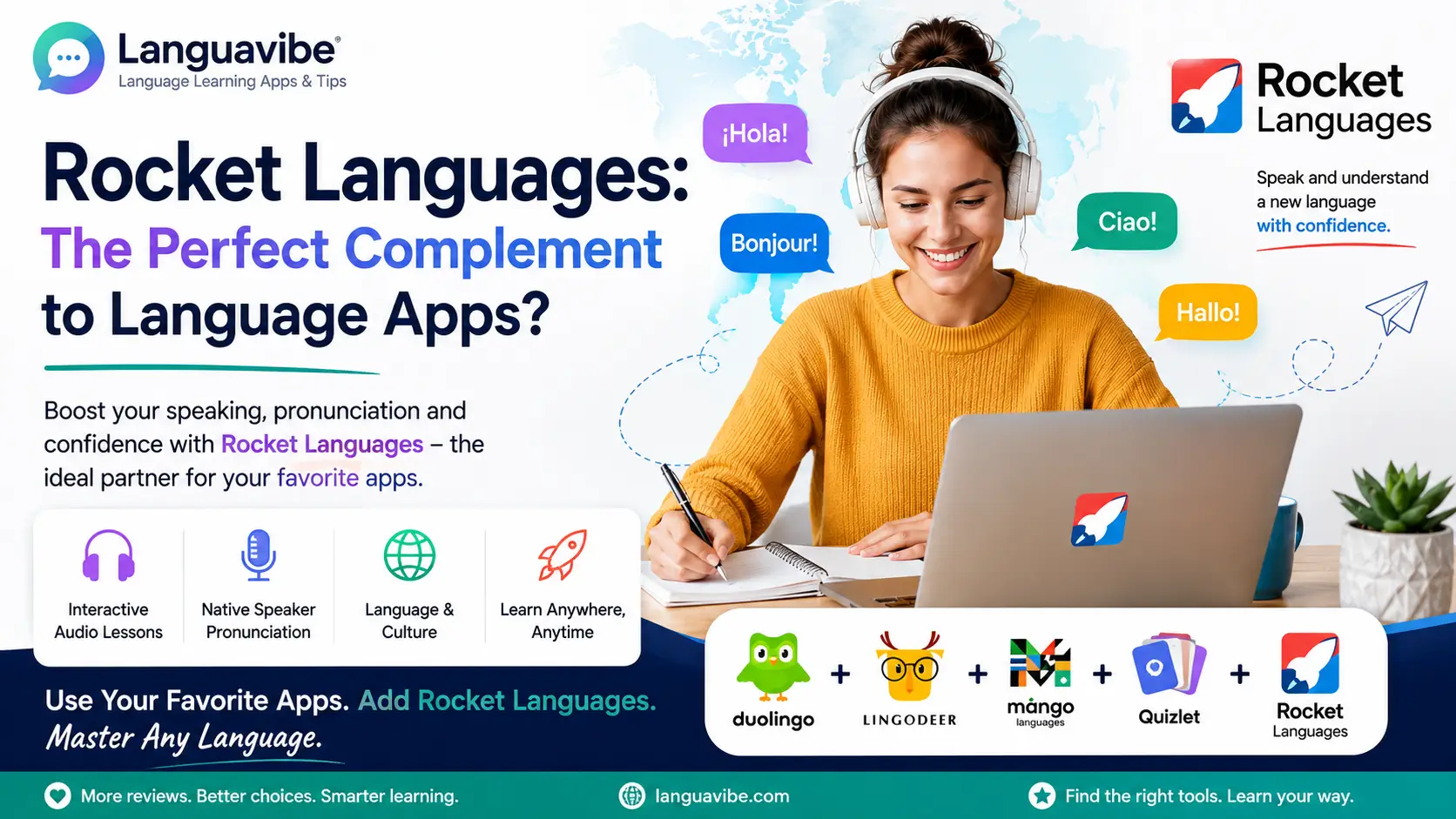
Language-learning apps have made studying a new language easier than ever.
You can practice vocabulary with Duolingo, work through structured grammar lessons with LingoDeer, learn conversational phrases with Mango Languages, or combine several apps depending on your goals.
But there is a problem many learners eventually discover:
Using an app every day does not automatically mean you will feel comfortable speaking the language in real life.
That is where Rocket Languages can become especially useful.
Rather than asking you to abandon the language-learning apps you already enjoy, Rocket Languages can work alongside them as a more structured, conversation-focused learning system.
For many learners, that makes it one of the most interesting complements to the apps we review here at Languavibe.
Affiliate disclosure: This article may contain affiliate links. If you purchase through one of these links, Languavibe may earn a commission at no additional cost to you. This helps support the site and allows us to continue creating language-learning guides and reviews.
What Is Rocket Languages?
Rocket Languages is an online language-learning platform built around interactive audio lessons, pronunciation practice, language and culture instruction, and practical conversations.
The company currently offers courses across 14 languages and says it has served more than 2 million members. Rocket Languages also emphasizes native-speaker audio and voice-recognition technology designed to help learners compare and improve their pronunciation.
Instead of relying primarily on short exercises, points, streaks, and game-like activities, Rocket Languages puts considerable emphasis on actually hearing and producing the language.
That distinction matters.
Vocabulary apps can help you recognize words.
Grammar exercises can help you understand sentence structure.
But eventually, you need to turn that knowledge into something you can actually use.
That is where Rocket Languages fits particularly well.
Why We See Rocket Languages as a Complement — Not a Replacement
At Languavibe, we review different language-learning apps because no single tool is perfect for every learner.
Each platform tends to have its own strengths.
Duolingo, for example, remains excellent at making daily practice easy and keeping learners engaged. But as we discussed in our Duolingo review, learners aiming for real proficiency may eventually need resources beyond short daily app exercises.
LingoDeer offers a more structured experience, particularly for beginners and learners studying Asian languages, but open-ended speaking can become a limitation as learners progress.
Mango Languages also provides a useful foundation, particularly for beginners and returning learners, although serious learners may eventually want additional resources for more advanced proficiency.
This is why we think about Rocket Languages differently.
Instead of asking:
“Should I stop using my current app and switch to Rocket Languages?”
A better question may be:
“Could Rocket Languages fill the gaps my current app leaves behind?”
For many learners, the answer could be yes.
1. Use Your Favorite App for Daily Practice
One of the biggest advantages of apps such as Duolingo is convenience.
You can complete a lesson while waiting for an appointment, commuting, taking a break at work, or relaxing at home.
That habit matters.
Language learning requires repeated exposure, and an app that encourages you to come back every day can help keep your target language fresh in your mind.
There is no reason to throw that advantage away.
Instead, consider keeping your favorite app as your daily practice tool.
Then use Rocket Languages for more focused sessions during the week.
For example:
Morning: 10 minutes with your normal language app.
Evening: 20–30 minutes with a Rocket Languages audio or conversation lesson.
That combination gives you both frequency and depth.
2. Add More Serious Pronunciation Practice
One of the biggest weaknesses of studying independently is surprisingly simple:
You may know the correct word without knowing whether you are saying it correctly.
Reading “gracias” on a screen and recognizing its meaning is different from producing the word naturally in a conversation.
Rocket Languages places substantial emphasis on pronunciation. Its courses include native-speaker recordings as well as voice-recognition features intended to let learners practice thousands of useful words and phrases and compare their pronunciation.
That makes Rocket Languages especially interesting when paired with an app that mainly teaches through tapping, matching, reading, or multiple-choice exercises.
Your regular app can help build vocabulary.
Rocket Languages can help you say that vocabulary out loud.
That is a much more complete learning loop.
3. Turn Passive Knowledge Into Conversation Skills
Many learners experience a frustrating phenomenon.
They open their language app and understand almost everything.
Then someone actually speaks to them in the language and suddenly their mind goes blank.
This happens because recognition and production are different skills.
Recognizing the correct answer from four options is easier than creating the sentence yourself during a live conversation.
Rocket Languages’ audio-focused approach encourages learners to listen and respond rather than simply recognize information on a screen.
For someone already using vocabulary and grammar apps, this can provide an important additional layer of practice.
Think of it this way:
Your app teaches you what the language looks like.
Rocket Languages can help you practice what the language sounds and feels like in conversation.
You ultimately need both.
4. Learn More Than Just Words
Language and culture are closely connected.
Knowing the dictionary definition of a phrase does not necessarily tell you when native speakers would actually use it.
Rocket Languages incorporates language-and-culture material alongside its core lessons, rather than treating language entirely as isolated vocabulary.
That can be valuable for learners preparing for:
- international travel
- conversations with native speakers
- relocation
- relationships
- work
- study abroad
- cultural interaction
Learning the language within context can make phrases easier to understand and remember.
More importantly, it helps move you toward communicating appropriately rather than merely translating words.
5. Build a More Structured Study Routine
Some learners love the flexibility of apps.
Other learners eventually find themselves wondering:
What exactly should I study next?
A structured course can eliminate part of that uncertainty.
Rocket Languages organizes learning into a broader course system rather than a collection of disconnected practice activities.
This is one reason we particularly like the idea of combining it with lightweight mobile apps.
You can let your regular app provide spontaneous practice while Rocket Languages provides the backbone of your learning plan.
The relationship might look like this:
Primary course: Rocket Languages
Daily vocabulary practice: Duolingo or another app
Extra grammar: LingoDeer or another grammar-focused resource
Flashcards: Anki or Quizlet
Authentic listening: YouTube, podcasts, movies and music
Real conversation: Tutor or language-exchange partner
Suddenly, you are no longer depending on one app to somehow teach you everything.
You have created a language-learning system.
6. Lifetime Access Changes the Economics
Another interesting difference is the way Rocket Languages approaches course access.
Rocket Languages currently promotes lifetime access to purchased courses, including future updates and improvements, rather than requiring learners to maintain access indefinitely through a standard monthly subscription.
That can be appealing if you prefer buying a resource once and returning to it whenever necessary.
Language learning rarely happens in a perfectly straight line.
You might study intensely for three months, become busy, take a break, and return later.
With lifetime course access, taking that break does not necessarily mean starting another monthly subscription when you return.
Course prices and promotions can change, however, so always check the current offer before purchasing.
Which Apps Work Well With Rocket Languages?
Here is how we would think about pairing Rocket Languages with several popular types of language apps.
Rocket Languages + Duolingo
This may be one of the easiest combinations for casual learners who want to become more serious.
Use Duolingo for:
- short daily practice
- vocabulary exposure
- maintaining consistency
- gamified motivation
Use Rocket Languages for:
- longer audio lessons
- pronunciation
- guided speaking
- practical conversations
- deeper structured study
Best for: Duolingo users who enjoy their streak but want to become more comfortable actually speaking.
Rocket Languages + LingoDeer
LingoDeer already provides stronger grammatical structure than many gamified apps and is particularly notable for its Asian-language courses.
Use LingoDeer for:
- grammar explanations
- sentence construction
- reading
- structured beginner study
Use Rocket Languages for:
- additional listening
- spoken responses
- pronunciation practice
- conversational reinforcement
Best for: Learners who understand grammar reasonably well but need more confidence using it aloud.
Rocket Languages + Mango Languages
Mango already emphasizes useful conversations and contextual language learning.
That means the two platforms overlap more than some other combinations.
However, learners who enjoy Mango’s conversational philosophy may appreciate Rocket Languages as a broader structured course with additional pronunciation-focused practice.
Best for: Learners who prefer practical language over game mechanics.
Rocket Languages + Flashcard Apps
Flashcard tools such as Anki and Quizlet are excellent for memorization.
But remembering a word on a flashcard is not the same thing as understanding it instantly in speech.
Use flashcards to strengthen memory.
Use Rocket Languages to hear those words inside sentences and conversations.
Best for: Learners with strong vocabulary who still struggle with listening and speaking.
Who Should Consider Rocket Languages?
Rocket Languages makes the most sense for learners who:
- want to speak rather than only complete app exercises;
- prefer guided lessons;
- want native-speaker audio;
- need additional pronunciation practice;
- enjoy learning through listening;
- want cultural context alongside vocabulary;
- prefer purchasing lifetime course access over continuously paying for another subscription;
- already use a language app but feel something is missing.
It could be particularly useful if you have reached the stage where you can successfully complete lessons in your favorite app but still hesitate when someone asks you a simple question in the language.
That gap between knowing and speaking is exactly the gap you should start attacking.
Who Might Not Need It?
Rocket Languages will not necessarily be the right choice for everyone.
If you only want five minutes of casual vocabulary practice each day, a free or freemium app may already give you what you need.
Likewise, highly advanced learners who primarily need unrestricted conversation with native speakers may get more value from tutors, language exchanges, podcasts, books, and authentic media.
Rocket Languages is most compelling for learners somewhere between those two extremes:
people who have moved beyond casual experimentation but still want guided instruction before tackling fully independent conversation.
A Better Way to Think About Language Apps
The language-learning industry often encourages us to ask:
Which app is the best?
We think that question can be misleading.
A better question is:
Which combination of tools gives me the skills I need?
Speaking a language requires several abilities:
Vocabulary.
Grammar.
Listening.
Pronunciation.
Recall.
Reading.
Speaking.
Cultural understanding.
Confidence.
Expecting one application to be equally strong in every area is unrealistic.
Instead, build your own learning stack.
Keep the app you already enjoy.
Identify its weaknesses.
Then add tools that address those weaknesses.
For many Languavibe readers, Rocket Languages may be one of the strongest candidates for filling the speaking, listening, pronunciation, and structured-learning side of that stack.
Our Recommended Rocket Languages Routine
If you decide to combine Rocket Languages with another language app, you do not need to spend hours studying every day.
Try this simple schedule:
Monday–Friday
10–15 minutes with your favorite app.
Three days per week
Complete 20–30 minutes of Rocket Languages study.
Twice per week
Review previous Rocket material and repeat difficult phrases aloud.
Weekend
Spend 20–30 minutes consuming real content in your target language: YouTube, podcasts, television, music, or conversation.
This approach gives you repetition, structured learning, pronunciation practice, and authentic exposure.
More importantly, it is sustainable.
Final Verdict: Don’t Replace Your Favorite App — Complete It
If Duolingo keeps you motivated, keep using Duolingo.
If LingoDeer helps you understand grammar, keep using LingoDeer.
If Mango Languages suits your learning style, keep using Mango.
The goal is not to endlessly jump from one platform to another searching for a mythical perfect app.
Instead, identify what your existing app does well—and what it does not.
Then fill those gaps strategically.
Rocket Languages stands out as an especially interesting companion because of its emphasis on interactive audio, pronunciation practice, practical language use, native-speaker material, cultural instruction, structured courses, and lifetime course access.
For learners who already spend time tapping, matching, reading, and memorizing inside language apps, adding more listening and speaking may be exactly what their routine needs.
Ready to Add Speaking Practice to Your Language Routine?
You don’t have to give up the language app you already love.
Use it alongside a more structured program and build a system around your actual goal: communicating confidently in another language.
Prices, course contents, available languages, promotions, and product features can change. Check Rocket Languages directly for the latest details before purchasing.
Ready to Take Your Language Learning Further?
Your favorite language-learning app is a great place to start. Rocket Languages can help you go further with interactive audio lessons, pronunciation practice, real-world conversations, and structured learning.
Explore Rocket Languages →Affiliate disclosure: We may earn a commission if you purchase through this link, at no additional cost to you.