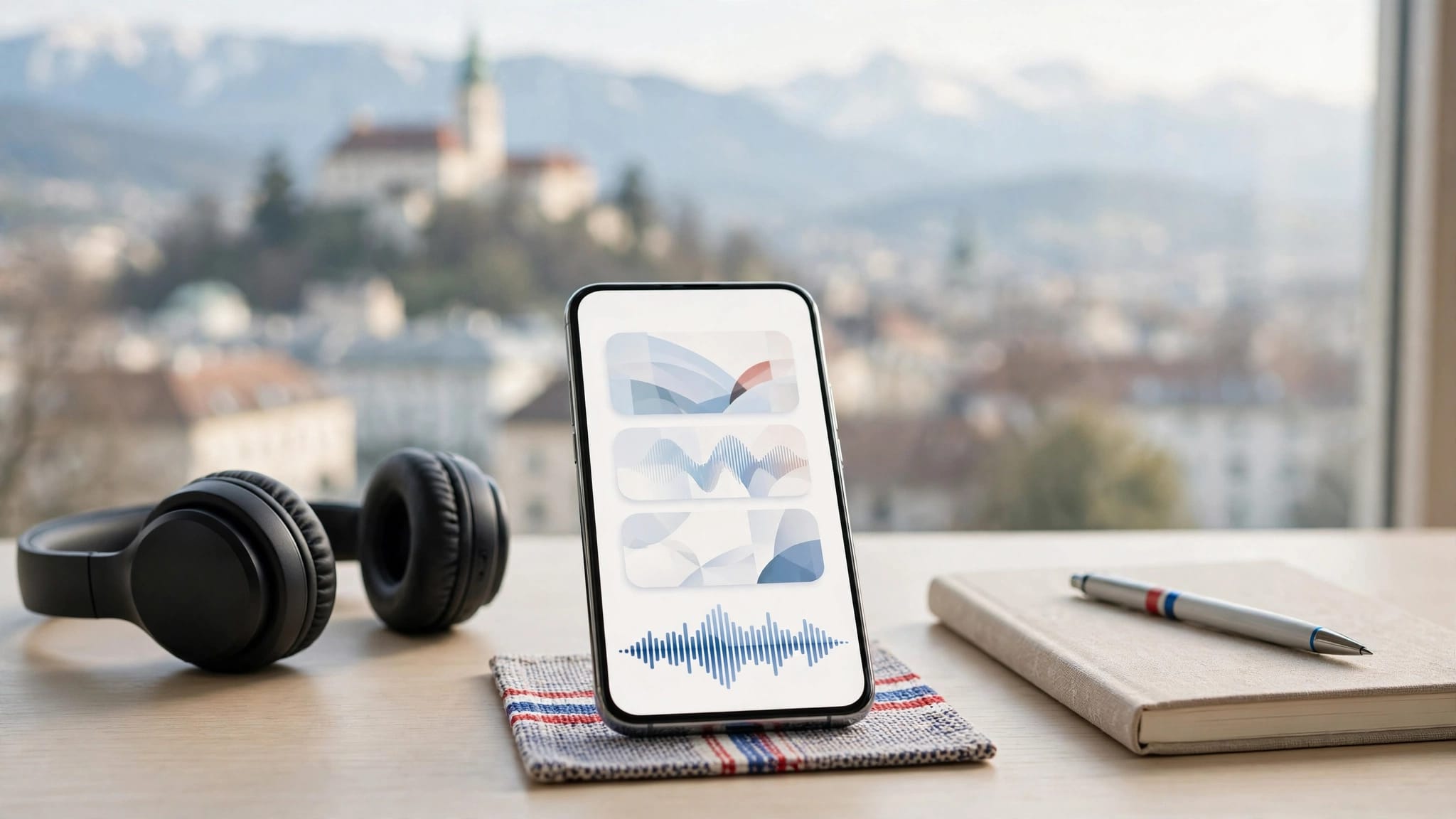
The Slovenian language rewards steady, active study. Its spelling is fairly consistent, but cases, verb forms, and fast natural speech quickly expose the limits of casual tapping.
To learn Slovenian effectively, a language learning app should give each study session a clear job: learn useful sentences, review them until recall is quick, then meet the language in real audio and conversation. No single app currently handles every part well.
Choose one main tool, add only what fills a real gap, and measure progress by what you can understand and say without prompts.
What serious Slovenian learners should expect from an app
A serious course needs more than travel vocabulary and a streak counter, because structured review and retrieval support language acquisition. It should revisit older material, include understandable audio, and make you retrieve whole answers before revealing them.
Look for progression, not a large word count
Early interactive lessons should build pronunciation, greetings, common questions, numbers, high-frequency verbs, and basic noun patterns in useful phrases. A concise pronunciation guide can help you interpret spelling and sound before repeated speaking practice begins.
Be cautious when an app presents many isolated Slovenian words but no clear route beyond food, directions, and introductions. A phrasebook can prepare you for a trip. It can’t teach you to explain a problem, tell a story, or follow everyday conversation.
Treat speaking feedback realistically
Speech recognition can prompt you to speak aloud and catch broad sound mismatches. However, it won’t reliably judge hesitation, grammar choices, or whether your response fits the situation.
An app can rehearse spoken Slovenian, but a tutor or language partner is still better at correcting a real exchange.
Use apps for repetition, then bring recurring mistakes to a conversation session. That division of work produces faster improvement than collecting overlapping subscriptions.
Slovenian learning apps at a glance
The strongest option depends on which part of the Slovenian language you need next. This comparison separates core study tools from resources that work best as companions.
| App | Best fit | Level range | Main strengths | Main limitation |
|---|---|---|---|---|
| Memrise | Retaining Slovenian vocabulary and phrases | Beginner to lower intermediate | Native-speaker video, review plans, speaking drills | Limited grammar sequence and free conversation |
| LingQ | Reading and listening | High beginner to advanced | Real-world audio and text, word tracking, offline use | Requires self-direction and outside grammar help |
| 50LANGUAGES | Offline basics and travel | Beginner | Short lessons, MP3 downloads, tests, mobile access | Light grammar and limited open-ended output |
| Learn Slovenian by Ali Umer | Sampling basic material | Beginner | Free iPhone option | Course depth and feedback are unclear |
For most adults, Memrise is the better starting point, while LingQ becomes more useful once you understand basic sentence patterns. 50LANGUAGES works well when you need dependable offline review before travel.
Memrise for vocabulary, listening, and phrase recall
Memrise’s Slovenian course combines vocabulary review with pronunciation practice, short tests, and videos of native speakers using everyday phrases. It works on phones and computers, and downloaded lessons can be used offline.

Where Memrise earns its place
Memrise is effective when you need words and phrases to stay available under pressure. Its review system brings material back after gaps, which helps turn recognition into recall. Native-speaker clips also expose you to more natural delivery than synthetic audio alone.
Use it to learn complete chunks such as requests, time expressions, and common replies. Then say each phrase before looking at the answer. That small change turns a recognition exercise into speaking practice.
For a deeper assessment of its strengths and ceilings, see this Memrise review for vocabulary practice.
Limits, devices, and price
Memrise offers mobile apps and web access, with syncing across devices. Its paid tier adds more practice features, including speaking activities and native-speaker video and audio content.
U.S. App Store examples list $24.99 per month, $61.99 per year, and $329.99 for lifetime access. Prices, trials, and included content can differ by country and change without notice, so check your store for current 2026 pricing before subscribing.
Memrise isn’t a complete Slovenian language course for a serious learner. Grammar explanations are too light for mastering declensions and verb patterns, while short drills don’t create spontaneous conversation.
LingQ for authentic Slovenian input
LingQ’s Slovenian library is the best choice here for learners who want to spend serious time reading and listening. It supports lessons built from authentic content such as podcasts, ebooks, YouTube material, and other real sources.
Why comprehensible input matters
Comprehensible input means working with material that is mostly understandable, while meeting some unfamiliar words and patterns in context. Instead of memorizing a grammar rule first, you repeatedly see and hear it in sentences that carry meaning.
Repeated meaningful exposure can support language acquisition, but it doesn’t replace explicit grammar study. LingQ supports this process by tracking unknown vocabulary as you read and listen. Start with short, clearly narrated material. Re-listen until you can follow the main message, then reread without translating every line.
This approach gives intermediate learners much-needed contact with the Slovenian language at natural pacing. It also exposes you to structures that neat app dialogues often avoid.
What LingQ doesn’t replace
LingQ gives you access to input, not a tightly sequenced beginner curriculum. A new learner may struggle to tell which grammar point deserves attention or which texts are manageable.
Use a basic grammar reference alongside it, and write down a few useful sentence patterns from each lesson. Add regular speaking, because reading and listening alone won’t make replies automatic.
LingQ supports offline study and synchronizes when you reconnect. Public iOS storefront examples list $12.99 for one month, $71.99 for six months, and $107.99 for 12 months. Regional prices and plans vary, so verify the current offer before payment.
50LANGUAGES for offline basics and travel
50LANGUAGES is a practical, low-cost companion for beginners preparing for travel in Slovenia. It covers basic Slovenian phrases and works without a constant connection. The app offers lessons, tests, games, downloadable MP3 audio, and Android and iOS access.
Useful features for a first trip
The short lessons cover common situations such as greetings, transport, shopping, food, and accommodation. Downloadable audio is useful on flights, trains, and in places with weak mobile service.
The official site describes 100 beginner lessons. However, the Google Play listing describes the free app as containing 30 lessons. Check the current version on your device before assuming the full set is included.
Its audio files are useful for repetition, but public materials don’t clearly establish whether every recording uses native speakers. Listen closely before building pronunciation habits around them.
Keep it in a supporting role
50LANGUAGES doesn’t provide enough connected listening, detailed grammar explanation, or free response practice to support independent learning. It works best as a phrasebook and offline refresher.
Pair it with a structured grammar resource and real Slovenian audio. If you can only study for ten minutes, review five phrases, cover the translation, and answer aloud in full sentences.
Smaller Slovenian apps need closer scrutiny
Smaller apps can help, but their listings often reveal less about lesson depth, audio quality, and long-term course design. Treat a free download as a trial, not proof of a complete curriculum.
Learn Slovenian by Ali Umer
The Learn Slovenian App Store listing describes a free iPhone app marketed around learning Slovenian in 31 days. It may suit travelers who want a simple entry point into the Slovenian language and a small daily routine.
Still, the public listing doesn’t establish substantial grammar instruction, advanced material, offline access, or human feedback. Use it to sample basic Slovenian, then move to a tool with clear review and listening features if progress matters.
Don’t assume broad apps include Slovenian
TALL Embark covers more than 70 languages, yet public information does not confirm Slovenian support. Don’t subscribe to a broad language platform based on its overall catalog.
The same warning applies to famous brands. Check the language inside the app, inspect several real lessons, and test the audio before paying. A polished interface can’t compensate for an absent or shallow Slovenian course.
Speaking, listening, and grammar need separate attention
Pronunciation and grammar are where many learners of the Slovenian language outgrow app-only study. Build a routine that asks you to listen, respond, and notice patterns in complete sentences.
Make audio active, not background noise
Listen to a short clip once for the main idea. When possible, choose recordings identified as coming from native speakers.
Next, replay the clip and pause after each sentence. Repeat aloud, then answer a related question without reading a prompt.
Add regular conversation practice to build response speed. Speech recognition can offer feedback, but it doesn’t replace real interaction or careful listening.
This method trains sound recognition, phrase recall, and response speed at the same time. It also reveals whether you understand an audio clip or only recognize its written translation.
Audio-focused courses can build useful habits, as the Pimsleur speaking and pronunciation review explains. Yet Slovenian learners still need to confirm that a particular course exists before subscribing.
Study grammar through sentences
Slovenian endings change according to case, gender, number, and sentence role. Isolated noun lists rarely make those changes stick. Instead, collect short phrases that show one pattern in use, then write three new sentences based on them.
Keep notes brief. Record the phrase that caused trouble, the pattern you noticed, and one sentence you can use this week. That creates a personal grammar reference instead of a pile of rules you never revisit.
Duolingo and a practical study stack
Duolingo currently has no listed Slovenian course. A current overview of languages Duolingo doesn’t offer includes Slovenian, so don’t waste time searching for a hidden course in the app.
A beginner plan that stays focused
A beginner who wants to learn Slovenian can start with Memrise or 50LANGUAGES for 20 minutes, five days per week. Practice common phrases aloud, then review them without looking at translations.
After four weeks, add LingQ for 10 to 15 minutes of easy listening and reading. Keep the text short enough that you understand the overall message. Add one conversation or recorded two-minute monologue each week.
A stronger plan for intermediate learners
Use LingQ as the main source of Slovenian input. Mine useful sentences, review a modest set of phrases, and speak about the same topics with a tutor or exchange partner.
Avoid adding several broad beginner apps. They often repeat the same greetings while leaving listening, grammar, and real interaction untouched. A smaller system is easier to maintain and easier to measure learning progress.
Frequently asked questions
Can an app make you conversational in Slovenian?
An app can build a strong base in vocabulary, phrase recall, and listening. Conversation also requires unscripted replies, correction, and regular contact with natural speech. Use an app for training, then speak with people as soon as you can manage basic exchanges.
Which app is best for a Slovenia vacation?
50LANGUAGES works as a practical phrasebook companion for basic offline phrases, while Memrise is stronger for retaining useful expressions and hearing native-speaker clips. Learn transport, restaurant, accommodation, and emergency language before departure, then rehearse it aloud.
Is LingQ suitable for complete beginners?
It can be, but it isn’t the easiest first tool. Beginners need a small base of high-frequency phrases and basic grammar before authentic content becomes productive. Start with short, clear audio rather than long videos or difficult articles.
Choose tools that match your next skill
The best Slovenian learning apps are not interchangeable. Together, they cover complementary parts of the Slovenian language: Memrise helps you retain phrases, LingQ brings authentic listening and reading, and 50LANGUAGES offers a reliable offline fallback for beginners.
Serious progress comes from a repeatable system, not a phone full of language apps. Pick one main tool, add real Slovenian input, and create regular chances to speak before the answer appears on a screen.
Ready to Take Your Language Learning Further?
Your favorite language-learning app is a great place to start. Rocket Languages can help you go further with interactive audio lessons, pronunciation practice, real-world conversations, and structured learning.
Explore Rocket Languages →Affiliate disclosure: We may earn a commission if you purchase through this link, at no additional cost to you.