A course can teach useful phrases and still leave you lost when people speak at normal speed. The best Spanish listening apps give you repeated contact with connected speech, clear support when you need it, and enough regional detail to match your goals.
Mexican Spanish and Rioplatense Spanish are both widely understood varieties, yet their pronunciation, vocabulary, and common forms of address can differ. Choose an app for its actual audio and labels, then build regional exposure around it.
Key Takeaways
- Babbel is the clearest pick for learners who want an explicitly labeled Mexican Spanish course, although it currently stops at A2.
- Pimsleur Spanish (Latin American) is useful for audio-first beginners, but its broad Latin American label does not make it a Mexican or Rioplatense course.
- Dreaming Spanish gives learners a large, level-organized source of understandable video input, with a free tier and paid plans.
- Lingopie is strongest when interactive subtitles, replay, and real-world video matter more than a structured curriculum.
- No major app in this comparison should be treated as a verified Rioplatense Spanish course. Check individual speakers and clips before paying.
What Regional Spanish Listening Practice Should Include
Regional listening works best when the speech matches the variety you expect to hear most often. An app’s course title matters, but sample audio matters more.
Mexican Spanish is more than a course label
Mexican Spanish includes many local accents and speech styles. Still, an app that clearly labels a Mexican course is a better starting point than one that only says “Spanish” or “Latin American Spanish.”
Listen for everyday phrasing, the pace of dialogue, and whether the speakers sound like people you want to understand. Babbel is the rare large app with a Mexican Spanish course label, but its available course reaches A2 rather than advanced levels.
Rioplatense Spanish needs direct evidence
Rioplatense Spanish is associated with areas around the Rio de la Plata, including much of Argentina and Uruguay. Learners often notice voseo, such as vos tenes, and a different pronunciation of “ll” and “y” in some places.
Those features do not make the variety harder or less correct. They simply change what your ear expects. Before subscribing, use this dialect accuracy check for language learning apps to inspect labels, voices, vocabulary, and short samples.
Best Spanish Listening Apps for Different Goals
This comparison separates regional labels from general listening quality. Prices can change by country, platform, promotion, and subscription length.
| App | Best use | Regional clarity | Listening tools | Price and access |
|---|---|---|---|---|
| Babbel | Mexican Spanish beginners | Mexican Spanish through A2 | Guided short lessons | First lesson free, subscription pricing varies |
| Pimsleur | Spoken recall and pronunciation | Broad Latin American course | Audio lessons and transcript review | Free lesson, US pricing has listed Premium near $19.99 |
| Dreaming Spanish | High-volume input | Check individual guides and videos | Level-based video content | Free plan, Premium €8.99 monthly |
| Lingopie | Subtitle-supported video | Check each show and speaker | Dual subtitles, looping, clickable words | 7-day trial, prices vary by storefront |
| Language Transfer | Free audio foundations | No verified regional track | Audio course, optional transcript | Free with no ads or sign-up |
| SpanishPod101 | Dialogues with study support | No verified regional track | Read-along transcripts, role-play | Plans start around $4, terms vary |
The best choice depends on the job you need it to do. For broader comparisons of structure, speaking, grammar, and listening, see LanguaVibe’s guide to the best Spanish learning apps.
Structured Courses for a Strong Start
A structured course helps beginners turn familiar words into phrases they can catch in full sentences. It is also easier to measure progress when lessons build in order.
Babbel for Mexican Spanish through A2
Babbel’s Mexican Spanish course is its clearest advantage for learners focused on Mexico. The course gives beginners a named regional starting point rather than asking them to assume that generic Spanish will match their needs.
However, Babbel lists Mexican Spanish only through A2, while its European Spanish course runs through C1. Use it to build early comprehension, core vocabulary, and sentence patterns. Then add Mexican podcasts, videos, tutors, or conversations as your listening needs become more advanced.
The first lesson in each Babbel course is free. Subscription prices vary by location, plan length, and whether you subscribe on the web or through an app store.
Pimsleur for Latin American audio practice
Pimsleur is useful when you want to listen away from a screen. Its Spanish catalog separates Spanish (Latin American) from Spanish (Spain-Castilian), which is more useful than a single unlabeled course.
The Latin American course should not be presented as Mexican or Rioplatense Spanish. It offers a broader pronunciation model. Still, its listen-and-recall format can help beginners hear a prompt, pause, and produce an answer instead of reading one first.
Pimsleur includes a free lesson, and its app has offered written transcript review. In the United States, Spanish Premium has appeared near $19.99 monthly, though local pricing can differ.
Video Apps for Natural Speech and Subtitles
Video platforms add casual conversations, emotion, interruptions, and background noise that scripted drills usually avoid. They are most effective when you replay short scenes with a clear purpose.

Dreaming Spanish for level-based input
Dreaming Spanish organizes video content by difficulty, which makes it easier to find speech you can mostly follow without translating every line. Its official plans include a free option, Premium at €8.99 per month, and Premium Double at €12.99 per month.
That volume is especially useful if you have finished basic lessons but still struggle with normal spoken Spanish. Start with material that feels understandable, then move up when you can follow the main point without pausing constantly.
The platform does not replace speaking practice or provide a verified Rioplatense track. Read the full Dreaming Spanish review before treating it as your only study tool.
Lingopie for repeatable real-world clips
Lingopie uses television and video content with dual subtitles, clickable translations, line-by-line navigation, looping, and autoplay. Those controls make difficult scenes manageable because you can replay one sentence until the sounds stop blurring together.
It offers a 7-day free trial, not a permanent free plan. Reported prices differ across storefronts. US App Store listings have shown $13.99 monthly and $83.99 yearly, while other markets show different currencies and annual options.
Use the trial to test Spanish content, speaker origin, and subtitle quality. LanguaVibe’s detailed Lingopie review explains where its listening strengths end and active recall still needs support.
Free and Flexible Listening Options
Free resources can make an excellent second app. They work best when they fill a specific gap rather than duplicate a subscription you already use.
Language Transfer for audio-first foundations
Language Transfer’s Complete Spanish course is free. It requires no sign-up, includes no ads, and is available through its website, app, YouTube, SoundCloud, and downloadable audio.
The course focuses on understanding how Spanish works through guided audio explanations. It is valuable for beginners who need to hear patterns and build phrases without a heavy visual interface. A transcript PDF exists, although the course advises using it sparingly.
It does not provide a verified Mexican or Rioplatense listening track. Pair it with regionally chosen material once basic sentences feel familiar.
SpanishPod101 and Coffee Break Spanish
SpanishPod101 offers read-along lesson transcripts and dialogue role-play. Its pricing page lists plans beginning around $4 monthly, with higher tiers and lower effective rates for longer commitments. The service can support regular listening, but confirm the speakers and course details before using it for a regional goal.
Coffee Break Spanish is another flexible audio resource for guided lessons. It can suit learners who want short sessions during a commute or walk. However, do not assume its audio covers Mexican or Rioplatense Spanish without checking the material you plan to use.
Build a Routine That Trains Your Ear
A good app matters less if every session becomes passive scrolling. Keep the routine short enough to repeat most days.
Use transcripts after a first attempt
First, listen once without reading. Try to catch the situation, the speakers, and a few key words. Next, use subtitles or a transcript to identify what you missed. Then replay the same clip without text.
A transcript should reveal missed sounds after listening, not replace the listening attempt.
This order stops you from mistaking reading comprehension for listening comprehension. Use LanguaVibe’s subtitle dependency test if you find yourself unable to follow any clip without text.
Match practice to your current level
Beginners should replay short dialogues and learn to recognize frequent chunks, such as greetings, question forms, and common verb endings. Intermediate learners need longer clips, more speakers, and less immediate translation.
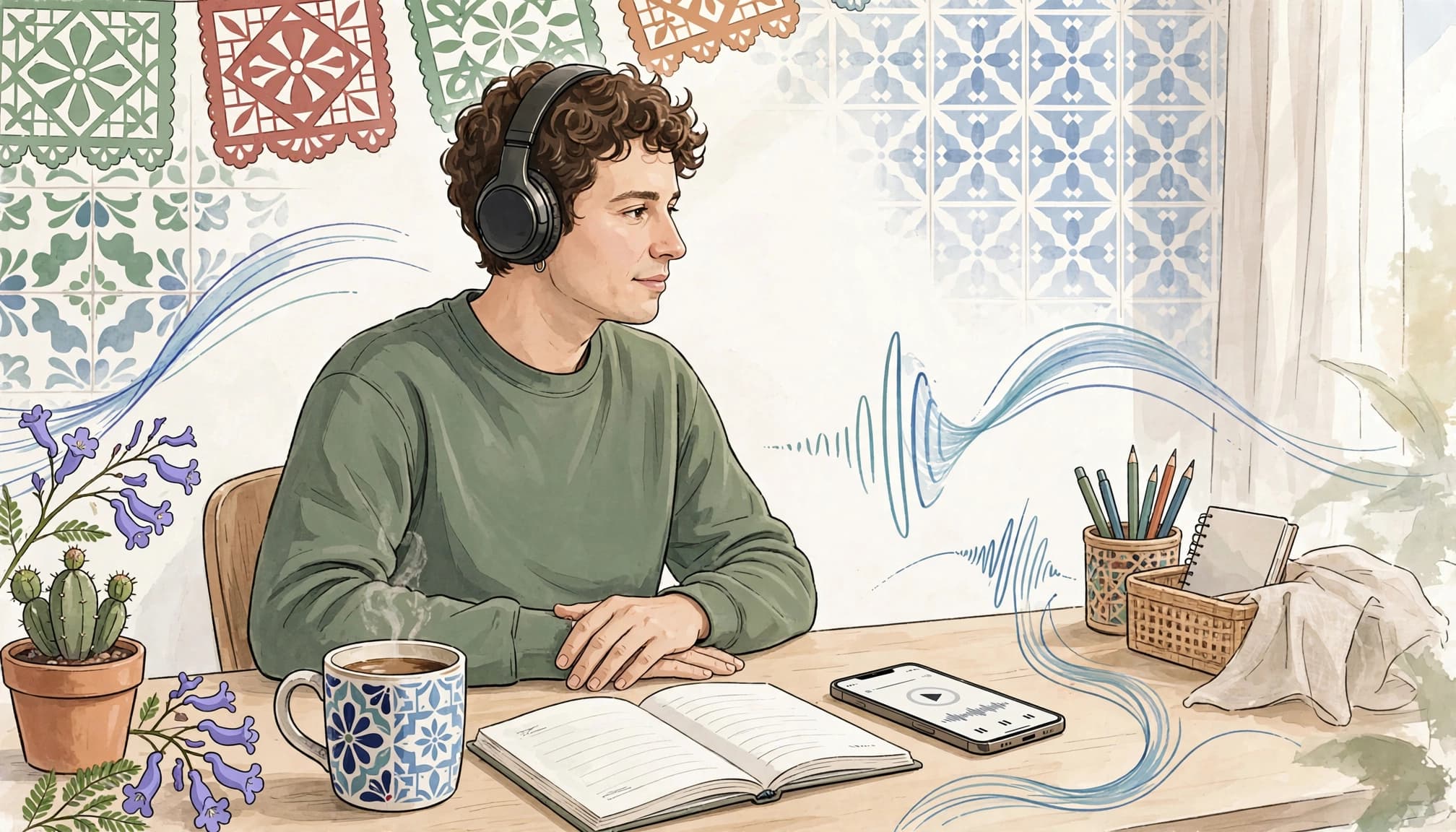
For a Mexican or Rioplatense goal, keep a small log of expressions that recur in your chosen audio. Record phrases in complete sentences, then listen again for their rhythm and stress.
Frequently Asked Questions
Which app is best for Mexican Spanish listening?
Babbel is the clearest option for beginners because it explicitly offers Mexican Spanish through A2. For more advanced listening, add authentic Mexican content with transcripts or subtitles, since Babbel’s regional course does not extend beyond that level.
Is there an app dedicated to Rioplatense Spanish?
No major app in this comparison has verified, clearly labeled Rioplatense Spanish coverage. Look for individual Argentine or Uruguayan speakers, vos forms, and vocabulary within video libraries, podcasts, and tutor materials before committing to a subscription.
Should beginners use subtitles?
Yes, but not from the first second of every clip. Listen once, check the text, and replay. Playback controls and subtitles help you notice word boundaries, but progress requires occasional listening without visual support.
Choose Audio You Want to Hear Again
The best Spanish listening apps give you understandable speech today and harder material tomorrow. For Mexican Spanish, Babbel offers the strongest explicit starting label. For Rioplatense Spanish, inspect real samples instead of trusting a broad course name.
Build a small study stack with one core app, one source of regional audio, and regular replay. Your listening improves when familiar sounds become recognizable phrases at normal speed.
Ready to Take Your Language Learning Further?
Your favorite language-learning app is a great place to start. Rocket Languages can help you go further with interactive audio lessons, pronunciation practice, real-world conversations, and structured learning.
Explore Rocket Languages →Affiliate disclosure: We may earn a commission if you purchase through this link, at no additional cost to you.