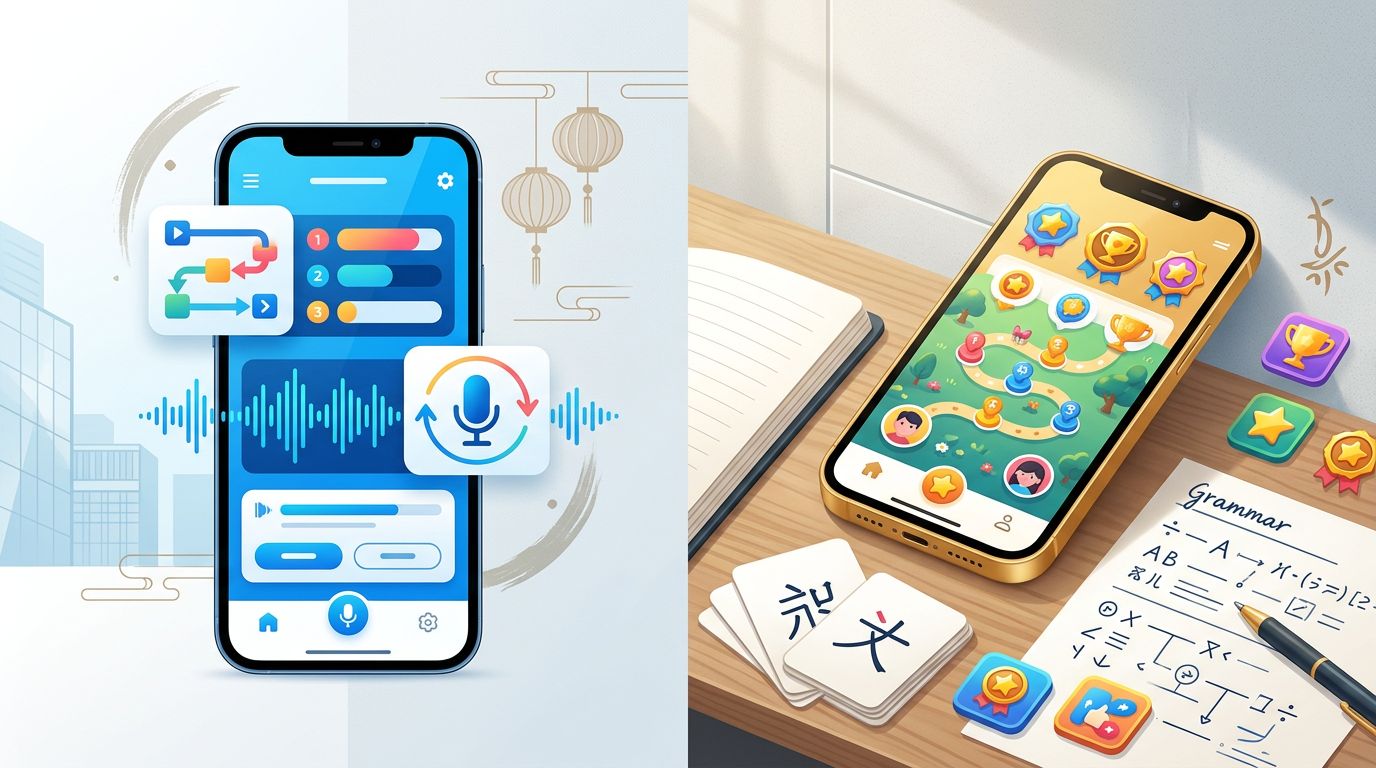
Choosing SuperChinese vs Ninchanese means matching the app to your study priorities, not finding one universal winner. Language learning apps work best when they fit your study habits rather than a universal ranking, and these products represent different types of Mandarin Chinese learning apps.
For Beginner Chinese learners, either app can build a useful foundation in Pinyin and tones, vocabulary, and everyday phrases. Pronunciation practice supports those basics, while more advanced learners should compare lesson depth, feedback, device support, and overall value in 2026.
Key Takeaways
- SuperChinese is the better fit for beginners who want short, guided lessons, frequent speaking practice, and automated pronunciation feedback.
- Ninchanese offers broader course coverage through HSK 6, more explicit grammar instruction, stronger character tools, and deeper gamification.
- SuperChinese focuses more on recognition, listening, and controlled speaking, while Ninchanese gives learners more flexibility with sentence building, writing, and custom review decks.
- Pricing and device support can affect the decision: Ninchanese publishes clear subscription rates, while SuperChinese pricing varies by plan, region, platform, and promotion.
- Neither app replaces real conversations, authentic listening, handwriting practice, or feedback from native speakers and tutors.
Quick Comparison of the Two Apps
The main differences become easier to see when the SuperChinese app and Ninchanese app are placed side by side.
| Feature | SuperChinese | Ninchanese |
|---|---|---|
| Best fit | Structured lessons and speaking practice | Gamified study with broad course coverage |
| Course range | Public listings describe 400+ lessons across nine levels, commonly mapped around HSK 1-5 | HSK 1-6 curriculum, plus specialized content |
| Lesson style | Interactive lessons with stories and guided review | Story-based worlds, sentence building, and Gamification features |
| Review | Guided repetition and lesson practice | Spaced repetition with flexible review tools |
| Character study | Chinese characters, recognition, and some writing guidance | Character breakdowns, writing, and custom vocabulary decks |
| Grammar | Grammar introduced within dialogues and lesson activities | More explicit Grammar explanations and sentence construction |
| Pronunciation | Speech recognition and scoring | Voice recognition included, but less central to the course |
| Price | Free basics, with paid features and plans that can vary | $10 monthly, $54 for six months, or $96 annually |
| Platform notes | Mobile-focused app experience | Web and Android, with limited iPhone browser voice support |
SuperChinese is the more focused choice if you want each session to feel guided. Ninchanese is better suited to learners who want a larger course map and more ways to review.

Course Depth and HSK Progression
SuperChinese gives beginners a clear starting point. Lessons introduce useful vocabulary, sentence patterns, and pronunciation basics in small steps. Listening practice, stories, and animated situations make phrases easier to remember than isolated flashcards.
The official SuperChinese app listing describes more than 400 lessons divided into nine Chinese levels. In practice, many learners view the curriculum as covering roughly HSK 1 through HSK 5, although the app’s internal level names don’t match HSK labels perfectly.
That distinction matters. Nine app levels do not equal nine HSK exam levels, and completing a SuperChinese level doesn’t guarantee exam readiness. Still, the progression gives beginners and lower-intermediate learners a clear next lesson.
Ninchanese has a longer HSK curriculum, spanning HSK 1 through HSK 6 and including specialized areas beyond the core sequence. The platform advertises more than 150 grammar points, over 10,000 useful sentences, plus extensive Mandarin vocabulary and a large library of Chinese characters. You can find a closer look at its structure in this Ninchanese review.
Ninchanese’s HSK labels also need context. The course follows the familiar six-level structure, which doesn’t automatically mean full alignment with the newer HSK 3.0 framework. If you plan to take a current Chinese proficiency test, compare the app’s vocabulary and grammar against the official test requirements.
SuperChinese offers a tighter guided path, while Ninchanese gives serious learners more room to continue before they need another core course.
Chinese Characters and Grammar
How each app teaches Chinese characters is one of the clearest differences in the SuperChinese vs Ninchanese comparison.
SuperChinese introduces characters alongside spoken vocabulary and sentence practice. It includes some stroke order activities, but many early exercises focus on recognition, listening, and choosing the correct answer. That approach works well if your first goal is understanding common Mandarin. It feels less complete if you want to handwrite every new character repeatedly.
Ninchanese gives characters a more visible role. Its dictionary can show character components, meanings, pinyin, tones, example sentences, idioms, and stroke order animations. Writing activities and custom Nincha Decks also give learners more control over which vocabulary they review.

Grammar explanations in SuperChinese are brief and appear within dialogues, stories, and short lessons. You learn patterns such as questions, comparisons, time expressions, and sentence order in context. The format keeps lessons moving, although it may not give you a detailed reference when you want to study a rule again.
Ninchanese spends more time on sentence construction. Learners arrange words, complete structures, and see how Chinese grammar changes meaning. That makes it a stronger choice for students who often recognize vocabulary but struggle to build their own sentences.
If handwriting is your top priority, neither app should be your only tool. Add regular writing practice with a dedicated handwriting resource or paper practice. For beginners who want especially clear stroke order instruction, the HelloChinese app is also worth considering. The HelloChinese vs SuperChinese comparison highlights its more structured support for this need, although its course does not extend as far as Ninchanese’s HSK 1-6 track.
Speech Recognition and Pronunciation Practice
SuperChinese puts automated scoring near the center of its learning design. You repeat words and sentences, receive a score, and try to improve your pronunciation. These controlled drills help with Pinyin and tones, as well as common phrases.
The feedback has limits. A strict score can encourage careful pronunciation, but it can also reject speech that a person would understand. Background noise, microphone quality, speaking speed, and regional accent can affect results, while translations generated by Artificial intelligence may sound awkward in some contexts.
Use the score as a repetition prompt, not as a final judgment about your accent. SuperChinese can show that a target phrase differs from its expected pattern. It cannot explain whether the problem comes from a tone contour, vowel, consonant, or sentence context.
Ninchanese also includes voice recognition and speaking activities, but pronunciation is less dominant than its vocabulary, grammar, and game systems. The platform’s device support matters here. On iPhone and iPad, Ninchanese works through a browser, but voice recognition isn’t available there. It requires Chrome or Edge on Mac, Windows, Linux, or Android.
For learners comparing HelloChinese vs SuperChinese, SuperChinese has the clearer advantage for daily speaking drills. For learners who want pronunciation as one part of a wider course, Ninchanese is adequate. Listening practice helps with natural speech, while tutors, language exchange partners, and native speakers provide more useful corrections. A community discussion about SuperChinese also shows why user experience with speech scoring can vary.
Pricing, Free Access, and Platform Value
The Ninchanese app has clear subscription pricing in 2026:
- The monthly plan costs $10.
- Six months costs $54, which works out to $9 per month.
- Twelve months costs $96, or $8 per month.
Ninchanese has a free tier, including access to HSK vocabulary. Paid access removes restrictions and opens the complete experience.
SuperChinese offers free basics, including its pinyin course and early lessons. Its official SuperChinese FAQ confirms that the app combines free and paid features. The exact premium price can vary by billing period, platform, region, and promotion. Check the renewal amount inside your current app or store checkout before subscribing.
That makes the annual cost comparison less simple than it first appears. Ninchanese gives you a clear $96 yearly reference point. SuperChinese may be cheaper or more expensive depending on the plan shown to you. Some premium speaking or artificial intelligence features may sit behind different access levels.
For a short trial, SuperChinese’s free opening content is convenient. For a full year of structured study, Ninchanese’s published pricing is easier to calculate in advance.
Which App Fits Your Learning Goal?
Absolute beginners
Beginner Chinese learners should choose SuperChinese if they want short lessons, clear prompts, and frequent speaking practice. Interactive lessons in SuperChinese are short and guided, so you make fewer decisions when starting pinyin, tones, and sentence patterns.
Ninchanese also works for beginners, especially those who enjoy story-based lessons and game rewards. Its larger course can feel busy at first, so learners who prefer a quieter interface may find SuperChinese easier to follow.
Speaking-first learners
SuperChinese is the stronger pick for learners who need structured speaking work. It asks you to produce more controlled spoken answers and gives pronunciation feedback throughout the course.
When comparing HelloChinese vs SuperChinese, judge both by the amount and quality of controlled speaking work. However, don’t treat a high app score as proof of conversational fluency. Start Listening practice with real speakers and regular conversations once you can form basic sentences.
Learners who prefer gamified study
Ninchanese has the richer game structure. Gamification features such as themed worlds, continuing characters, rewards, leaderboards, time-based challenges, and multiplayer elements give study more variety. Spaced repetition and custom decks also make review feel less repetitive.
SuperChinese uses stories, progress markers, and short lesson goals, but its experience feels more like a guided course than a language game. Choose it when motivation comes from finishing lessons rather than collecting rewards.
Students targeting intermediate and advanced content
Ninchanese is the better long-term choice between these two apps because its stated HSK path reaches level 6. SuperChinese can carry many learners through the lower and middle stages, but advanced students may eventually need more reading, listening, and grammar material.
Remember that HSK 6 content inside an app isn’t the same as full advanced fluency. You will still need authentic reading materials, conversations with native speakers, writing practice with feedback, and regular discussions.
Intermediate learners who want to skip basics
Don’t assume a placement test will identify every gap. If your version offers a placement assessment or level selection, use it as a starting point, then sample lessons at the suggested level.
Pay close attention to tones, measure words, word order, and listening speed. An intermediate learner may recognize hundreds of words but still need beginner practice with pronunciation or grammar. SuperChinese’s level progression makes gradual skipping practical, while Ninchanese’s HSK worlds make it easier to choose a target stage manually.
Frequently Asked Questions
Is SuperChinese or Ninchanese better for beginners?
SuperChinese is usually easier for absolute beginners because its lessons are short, guided, and focused on pronunciation and everyday phrases. Ninchanese is also suitable for beginners, especially those who enjoy story-based learning and game rewards.
Which app is better for speaking and pronunciation practice?
SuperChinese has the stronger focus on controlled speaking drills and automated pronunciation scoring. Its feedback can be useful for repetition, but learners should also practice with real speakers because app scores do not measure conversational fluency perfectly.
Does Ninchanese cover more Chinese than SuperChinese?
Yes, Ninchanese states that its curriculum extends from HSK 1 through HSK 6 and includes extensive grammar, vocabulary, sentences, and character content. SuperChinese offers a more tightly guided progression that is commonly viewed as covering roughly HSK 1 through HSK 5.
Which app is better for learning Chinese characters and grammar?
Ninchanese is the stronger choice for learners who want explicit grammar explanations, sentence construction, character components, stroke order, and writing activities. SuperChinese introduces grammar and characters in context, but its explanations and handwriting support are less extensive.
Is Ninchanese worth paying for compared with SuperChinese?
Ninchanese may offer more predictable long-term value because it publishes monthly, six-month, and annual prices and provides a longer course path. SuperChinese can be convenient for trying free basics, but its premium cost varies by billing period, platform, region, and promotion, so check the current price before subscribing.
Which Mandarin App Should You Choose?
SuperChinese suits beginners seeking guided mobile study and speaking support, including readers comparing HelloChinese vs SuperChinese. Its short lessons make daily study manageable, while Artificial intelligence can provide automated feedback but won’t replace human correction.
Ninchanese is the stronger option for learners who want broader HSK coverage, explicit grammar, character tools, and sustained gamification. Its web-based access and iPhone voice limitation may affect your decision.
Among Language learning apps, choose the one that matches your daily goal. Add real listening, handwriting, and conversation, because a Chinese learning app cannot replace them.
Ready to Take Your Language Learning Further?
Your favorite language-learning app is a great place to start. Rocket Languages can help you go further with interactive audio lessons, pronunciation practice, real-world conversations, and structured learning.
Explore Rocket Languages →Affiliate disclosure: We may earn a commission if you purchase through this link, at no additional cost to you.