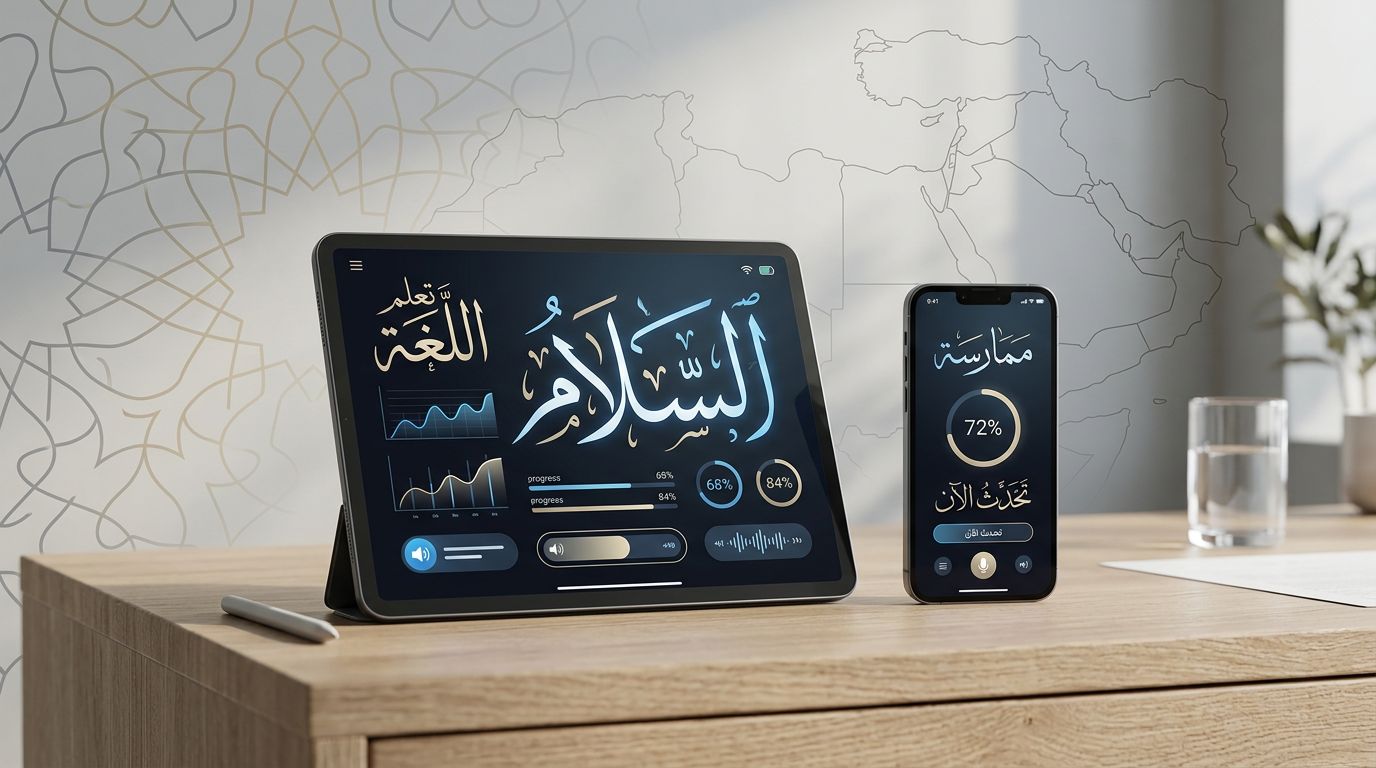
Arabic is hard to fake your way through. You can tap through lessons for months and still struggle with script, sound, or real conversation.
If you want actual progress, the best Arabic learning apps in 2026 are the ones that teach a clear skill and fit your level. Some are strong core courses. Others work better as review or speaking support.
That mix matters more than streaks. The right app should match Modern Standard Arabic, a dialect, or both, and it should move you beyond recognition.
What serious Arabic learners need from an app
Serious Arabic study starts with the script. Letters change shape, short vowels matter, and spoken Arabic often looks very different from the textbook path. A good app helps you read, hear, and recall the language without guessing.
That means four things matter most, clear Arabic script instruction, strong pronunciation support, spaced repetition for review, and a clean split between Modern Standard Arabic and dialects.
Most learners get farther by combining one core course, one review app, and one speaking tool than by chasing a single perfect app.

If an app can handle those four jobs, it can anchor your study. If it can’t, it belongs in the support stack.
A quick comparison of the strongest Arabic apps in 2026
A few 2026 roundups, like KALIMAH’s Arabic app list and Preply’s Arabic app comparison, point to the same pattern: the strongest setup is usually one core course plus one review tool.
| App | Best for | 2026 price | Main trade-off |
|---|---|---|---|
| Rosetta Stone | Beginners who want a clean MSA path | $7.99/mo yearly or $199 lifetime | Light grammar detail |
| Pimsleur | Speaking and listening | $20/mo, $21 all-access, or $150/level | Little reading and writing |
| Busuu | Guided self-study with feedback | $9.99/mo, $69.99/yr, $149 lifetime | Less depth than textbook courses |
| Mondly | Daily conversational practice | $9.99/mo, $47.99/yr, $99.99 lifetime | Broad but shallow |
| Madinah Arabic App | MSA grammar and reading | Free | Dated interface |
| Memrise | Vocab and phrase review | From $89.99/yr | Thin grammar support |
| Anki | Custom spaced repetition | Free, iOS $24.99 one-time | No built-in lessons |
| ArabicPod101 | Audio-heavy self-study | $4/mo to $13.73/mo | More library than curriculum |
That split matters more than the number of apps you install. Rosetta Stone, Pimsleur, and Busuu can anchor study. Madinah, Memrise, Anki, and ArabicPod101 fill the gaps.
Apps that are strongest for structured study and speaking
Rosetta Stone
Rosetta Stone is the best beginner-friendly pick if you want a polished MSA path. It runs on iOS, Android, web, Windows, and Mac, and the 2026 AI conversation partner adds a useful speaking layer.
The downside is price and a lighter grammar explanation. It works best when you want guided practice, not textbook detail.
Pimsleur
Pimsleur suits learners who want to speak out loud every day. The lessons are audio-first, voice matching is strong, and the new Egyptian and Levantine add-ons help if you need dialects. It runs on iOS, Android, and web.
It gives you very little reading or writing practice, so it works best alongside a script tool.
Busuu
Busuu is the balanced option. The lessons are clear, native speaker feedback still matters, and the 2026 AI grammar checker makes self-correction easier. It runs on iOS, Android, and web.
The course is useful for beginners and early intermediate learners, but it does not go as deep as a full textbook path.
Mondly
Mondly works as a daily practice app, especially if you want low-pressure conversation. Its chatbots, AR lessons, and new dialect packs give it more variety in 2026, and it runs on iOS, Android, web, and VR.
Still, it is better for repetition than for serious mastery. Use it as a speaking warm-up, not your main Arabic plan.
Apps that help most with script, vocabulary, and review
Madinah Arabic App
The Madinah Arabic App is the most classroom-like free option. It follows the Madinah University course, gives you structured MSA lessons, and pairs grammar with audio. It runs on iOS and Android, and the web version is still available.
The interface feels dated, but the content is solid. That makes it a strong choice for serious self-study.
Memrise
Memrise is strongest for vocabulary and sentence recall. Its AI spaced repetition and beginner videos make it easy to keep Arabic in rotation, and the 2026 live classes add some human support. It runs on iOS, Android, and web.
Use it for phrases and pronunciation, not for deep grammar. It is friendly for beginners and still useful for lower intermediate review.
Anki
Anki is the best memory tool here for advanced learners. It is free on desktop, Android, and web, with a one-time iOS purchase, and it lets you build decks for script, grammar, or exam prep.
The catch is setup time, because you have to make the system work yourself. If you want more free support alongside it, free language apps without daily limits is a useful companion read.
ArabicPod101
ArabicPod101 fits learners who want guided audio and more exposure to real Arabic. In 2026 it adds interactive quizzes and dialect pathways, and it runs on iOS, Android, and web.
It is a strong bridge between textbook study and native material, but it is still content-heavy rather than interactive. If you want to move into reading native text, LingQ for independent learners is the next step many self-students prefer.
Apps that are better as support tools than as core study
Duolingo
Duolingo’s Arabic course is friendlier in 2026, with full vowel marks, stories, and kid mode. The free plan is generous, Super costs $12.99 per month or $83.99 per year, and it runs on iOS, Android, and web.
Still, it stays in MSA and tops out around beginner level, so it works best as a habit builder.
Drops
Drops is useful for fast visual vocab, and the pronunciation games help with quick recall. It gives you five free minutes a day, with unlimited access at $13 per month, $69.99 per year, or $159.99 lifetime.
The limit is fine for warm-ups, but it is not enough for serious study.
Conclusion
Pick Modern Standard Arabic or a dialect first, then choose the app that matches. Rosetta Stone and Madinah give you structure, Pimsleur and Busuu help you speak, Memrise and Anki build recall, and ArabicPod101 pushes you toward fuller input.
Duolingo and Drops can keep the habit alive, but they work best as support. For serious learners, the smarter move is one core app, one review app, and one speaking path that fits your goals.
Ready to Take Your Language Learning Further?
Your favorite language-learning app is a great place to start. Rocket Languages can help you go further with interactive audio lessons, pronunciation practice, real-world conversations, and structured learning.
Explore Rocket Languages →Affiliate disclosure: We may earn a commission if you purchase through this link, at no additional cost to you.