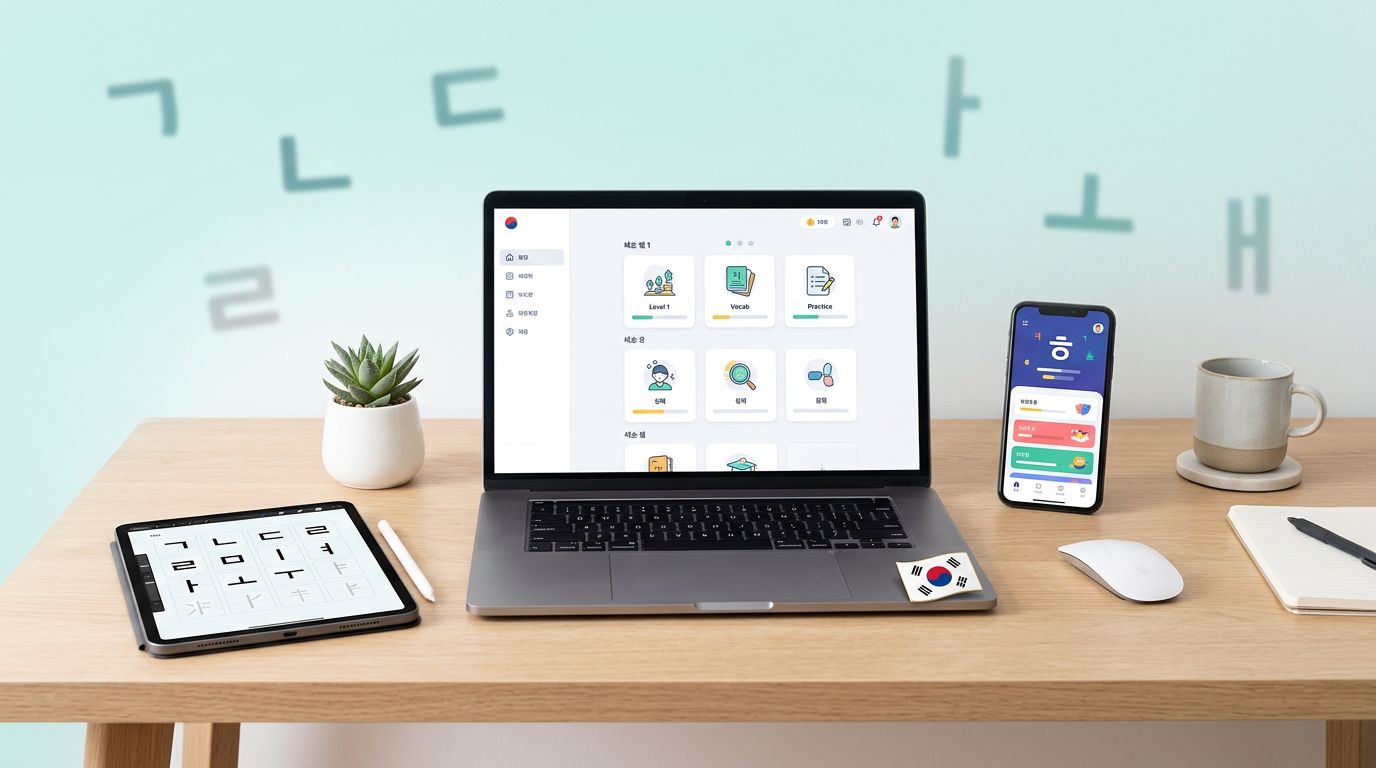
If you want Korean to stick, app choice matters more than app hype. A flashy interface can keep you busy for a week, but serious progress needs structure, recall, and real input.
The best Korean learning apps in 2026 do one job well, then fit into a bigger study system. Some are strong on Korean grammar. Others are better for speaking, vocabulary, or TOPIK prep. The trick is picking the right mix before you waste time on a tool that stops helping after the basics.
Key Takeaways
- Serious Korean progress needs apps with structured paths for Hangul, grammar in context, active recall, and goal fit—not hype or gamification.
- Start with LingoDeer or Talk To Me In Korean (TTMIK) for grammar and basics; add Clozemaster or Anki for vocabulary retention in sentences.
- Use HelloTalk for real speaking practice once basics are solid, and TOPIK One or similar for exam prep under pressure.
- Build a stack: one app teaches (TTMIK/LingoDeer), one reviews (Anki/Clozemaster), one applies (HelloTalk/Language Reactor) for repeatable long-term study.
What serious learners should judge first
The best language learning apps are not the ones with the most features. They are the ones that help you repeat useful work every day.
Serious learners from beginners to advanced should look for four things. First, the app needs a real lesson path to learn Hangul first, not random word lists. Second, it should give Korean in context, because isolated words fade fast. Third, it should push active recall through reviews, quizzes, or speaking practice. Fourth, it should match your goal, because grammar study, listening, and TOPIK prep need different tools.
While some users want to learn Korean for free, serious learners often look for more depth than basic Duolingo-style gamification or just searching for online tutors. For a wider comparison of the field, Preply’s 2026 Korean app roundup and All Language Resources’ test of 20+ Korean apps are useful background. The pattern is the same in both: general apps help you start, but focused apps help you keep going.
| App | Best for | Level | Pricing model | Platform |
|---|---|---|---|---|
| LingoDeer | Grammar and Hangul structure | Beginners to intermediate | Subscription, annual plans near $8/month | Mobile and web |
| TTMIK | Clear grammar and long-term study | Beginners to advanced | Subscription, around $10 to $20/month | Web and app |
| Clozemaster | Vocabulary in real sentences | Intermediate to advanced | Free tier plus paid plan, around $10/month | Web, iOS, Android |
| HelloTalk | Real conversation with native speakers | Intermediate to advanced | Free tier plus premium | iOS, Android |
| Anki | Long-term vocabulary memory | Intermediate to advanced | Free on desktop and Android, paid iOS app | Desktop, web, Android, iOS |
| TOPIK One | TOPIK practice | Intermediate to advanced | Free with in-app purchases | Mobile |
A strong Korean app saves time by removing guesswork. If it only quizzes recognition, you will need other tools fast.

The best Korean learning apps for structured progress
LingoDeer
LingoDeer is one of the cleanest starts for Korean because it treats the language like Korean, not like a generic language course. It gives the Korean alphabet, writing Hangul, grammar, and sentence order the attention serious learners need. The app is available on mobile and web, and pricing usually sits around a subscription model with annual plans near $8 a month.
Its biggest strength is structure. Lessons build in a sensible order with interactive exercises, grammar explanations, and sentence structure that are easier to follow than many broad apps. Its weakness is depth. LingoDeer can get you moving, but it will not carry you all the way to advanced Korean on its own. If you want a deeper look at its Korean-specific flow, the full LingoDeer review for Korean learners is worth a look.
Talk To Me In Korean
TTMIK is still the grammar anchor for many self-studiers. It runs on web and app, and current subscriptions are usually around $10 to $20 a month, depending on the plan. The lesson style is calm, clear, and easy to keep using for months, with famous audio lessons that help sort out particles, endings, sentence patterns, and the honorific system.
That matters because grammar gets messy once you leave the beginner stage. TTMIK helps you sort out particles, endings, and sentence patterns without feeling rushed. It is less useful for live speaking or fast recall, so it works best beside another app. Think of it as your grammar book with better pacing and less friction.
Clozemaster
Clozemaster is strong because it teaches Korean in sentences for better vocabulary acquisition and phrase-focused learning. You are not staring at lonely word cards. You are seeing words where they actually belong. That makes it a smart choice once you already know the basics.
The app works on web, iOS, and Android. It has a free tier and a paid plan, which is usually around $10 a month. Clozemaster is best for intermediate learners who need more exposure, not more hand-holding. It is not a full course, and that is fine. Its job is to harden your vocabulary with context.
HelloTalk
HelloTalk is where your study starts meeting real people through language exchange with native speakers. The app is free on iOS and Android, with premium features for extra filters and tools. You can write posts, send voice messages, and get corrections and pronunciation feedback from native speakers.
That makes it valuable for learners who already know enough Korean to form simple thoughts. It is less useful if you still need a lesson path. Chat apps can wander, and they often do. Still, if you want speaking practice that feels human, HelloTalk is one of the best options. For focused listening plus video input, using Language Reactor for Korean Netflix subtitles with HelloTalk provides an immersive experience.
Anki
Anki is still the most reliable memory tool if you can handle a bit of setup. It is free on desktop and Android, with a paid iOS app. You can use shared Korean decks or build your own.
Its strength is control. You decide what to review, and the spaced repetition system shows you cards right before you forget them. That is great for vocabulary, hanja, and sentence patterns. The downside is obvious, because Anki feels plain and rewards discipline more than excitement. If you want a tool that does not waste your time, though, it is hard to beat.
TOPIK One, Topik Ssam, and Migi TOPIK
TOPIK apps are only worth serious attention if you actually plan to take the TOPIK exam. TOPIK One is a focused practice app with free and in-app purchase options. Topik Ssam adds AI-style weak-spot analysis. Migi TOPIK is a more dedicated paid option with mock tests and detailed exercises.
These apps are best for timing, reading speed, and pattern recognition under pressure for TOPIK exam preparation. They are not substitutes for grammar study. They work after a core course, not before it. If your score matters, a TOPIK app can save a lot of drift.

Pick the app by your main goal
If your goal is Korean grammar, choose Talk To Me In Korean (TTMIK) or LingoDeer first. Both give you structure, but LingoDeer is a cleaner start for Hangul and basic sentence order.
If Korean vocabulary is your weak point, pair Clozemaster with Anki. Clozemaster gives you context. Anki gives you control and repetition. Together, they cover both recognition and recall.
If speaking is the problem and your ultimate objective is conversational fluency, HelloTalk should be in your stack. It will not teach you from zero, but it will show you where your Korean breaks under real use.
If listening is the pain point, use Language Reactor for Korean Netflix subtitles or a similar immersion tool to engage with authentic Korean content, then add a video-first product like Migaku’s Korean learning page if you want more built-in structure.
If your aim is TOPIK, skip the broad apps for a while and go straight to TOPIK One, Topik Ssam, or Migi TOPIK.
A simple app stack that works for long-term study
The strongest setup is usually boring in the best way. One app teaches, one app reviews, and one app gets you to use Korean with people or real media.
A solid routine to build a daily study habit looks like this. Among these language learning apps, use Talk To Me In Korean or LingoDeer for your core lessons. Add Clozemaster or Anki for daily recall. Then use HelloTalk or Language Reactor for output and listening. If you are still early and want more guidance, Rocket Korean for serious beginners is a better first stop than a loose mix of random apps.
That setup works because each tool has a job. No app has to do everything. That matters when you want progress that survives the first month.
Frequently Asked Questions
What’s the best Korean app for beginners?
LingoDeer stands out for its clean structure on Hangul, writing, and basic grammar in Korean sentence order. It beats generic apps by treating Korean specifically, though pair it with recall tools for depth beyond intermediate.
Should I use Duolingo for serious Korean study?
Duolingo works for a quick start but lacks the grammar depth and context serious learners need after basics. Opt for LingoDeer or TTMIK instead, as they build a real path without fading fast.
How do I combine apps for long-term progress?
Pick one core lesson app like TTMIK or LingoDeer, add Anki or Clozemaster for daily recall, and HelloTalk for real use. This stack keeps repetition clear and covers teaching, review, and output without overlap.
Which app is best for TOPIK exam prep?
TOPIK One, Topik Ssam, or Migi TOPIK focus on timed practice, reading speed, and weak spots for the exam. Use them after grammar basics, not as a standalone course.
Are free apps enough for advanced Korean?
Free tiers like HelloTalk or Anki start strong, but paid options in TTMIK or Clozemaster add structure and depth for advanced grammar, vocab, and consistency.
Conclusion
The hardest part of Korean study is not finding content. It is finding a system you can repeat. The best Korean learning apps in 2026 are the ones that make repetition clear, not random. These language learning apps prioritize structure for serious progress.
If you want one core course, pick LingoDeer or Talk To Me In Korean (TTMIK). If you need stronger recall, add Clozemaster or Anki. If you need real use, bring in HelloTalk or a subtitle tool. Among the best Korean learning apps, the one that fixes your weakest skill and fits your schedule works best. For most learners, LingoDeer or Talk To Me In Korean makes the perfect starting point.
Ready to Take Your Language Learning Further?
Your favorite language-learning app is a great place to start. Rocket Languages can help you go further with interactive audio lessons, pronunciation practice, real-world conversations, and structured learning.
Explore Rocket Languages →Affiliate disclosure: We may earn a commission if you purchase through this link, at no additional cost to you.