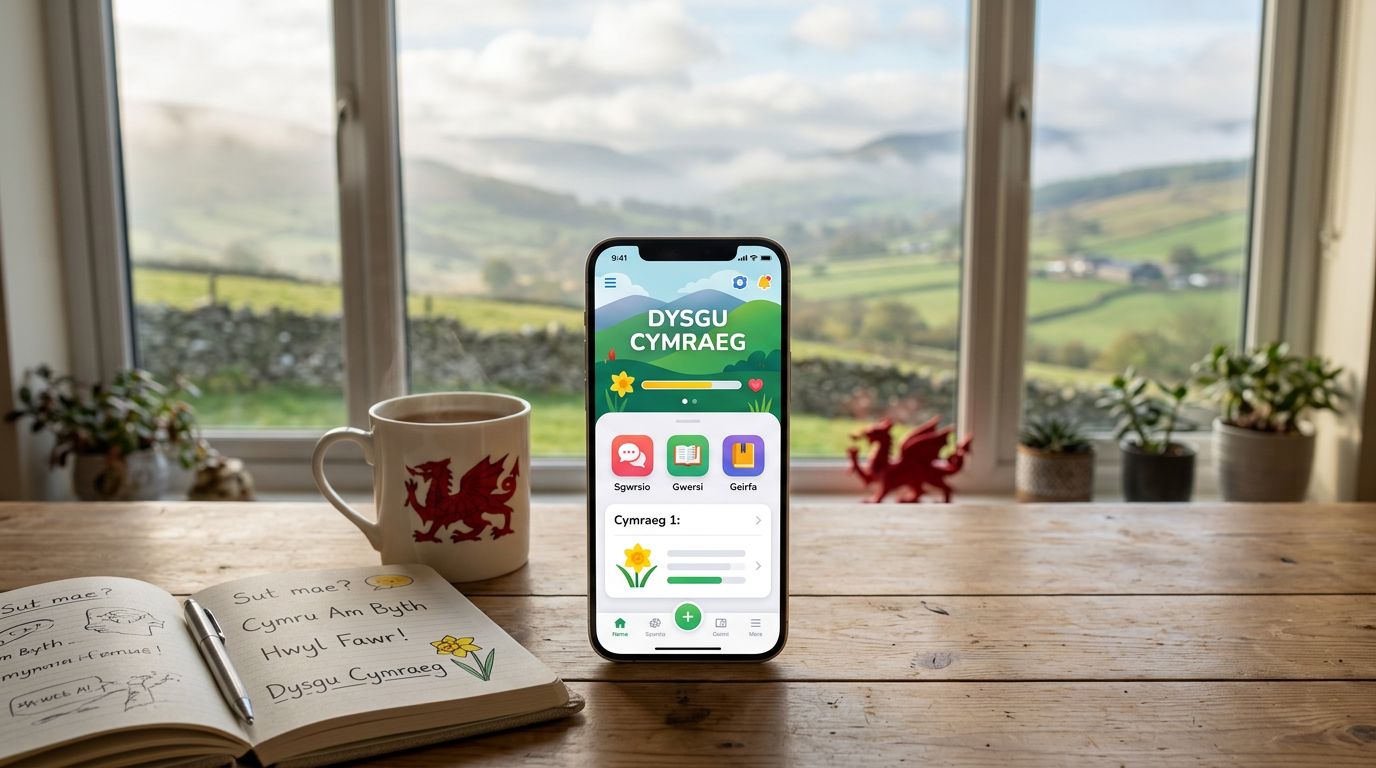
If you want Welsh to stick, streaks alone won’t get you there. The best Welsh learning apps in 2026 are the ones that push you to speak, listen, review, and produce real language often enough to matter.
That matters even more if you’re an adult self-learner, a heritage learner, or someone studying for exams. You need an app that fits a bigger routine, not one that only rewards taps and daily badges.
What serious Welsh learners should expect from an app
A serious Welsh app should teach more than isolated words. It should build phrases, train your ear, and give you enough structure to keep going after the first burst of motivation fades.
It also needs to match your goal. If you want conversational Welsh, speaking practice matters most. If you want exam-ready Welsh, you need lessons that explain grammar, spelling, and register. If you want daily life Welsh, then formal and informal usage matters, especially the difference between ti and chi.
Most apps only do one job well. That is fine, as long as you know which job it is. A good setup often starts with one core course, then adds one speaking tool and one review tool.
A recent 2026 roundup at blas’s Welsh app guide lands in the same place. The strongest apps for serious learners are still the ones that make you use Welsh, not just recognize it.
The Welsh apps worth installing first
Dysgu Cymraeg
For most serious learners, Dysgu Cymraeg is the anchor app. It comes from the National Centre for Learning Welsh, so the structure is built for steady progress rather than quick wins.
That matters if you want a clear path. The lessons suit beginners who want order, but they also help intermediate learners who need gaps filled in a logical way. The teaching leans toward standard Welsh, which is useful for exams, formal writing, and everyday situations where you need safe, correct wording.
It is also one of the better choices for learners who care about register. You get more than a list of phrases. You get a route through the language.
If you only choose one app for serious study, this is the one most learners should start with.
SaySomethingInWelsh
SaySomethingInWelsh (SSiW) is the best app if your main goal is speaking. It builds habits through repetition and fast response, so you stop translating every line in your head.
That makes it strong for beginners who feel stuck, and for heritage learners who understand some Welsh but struggle to speak. It focuses on spoken language first, so it can feel less like a class and more like guided practice. For many learners, that is exactly why it works.
SSiW is less useful if you want long grammar explanations. It also won’t replace formal study if you’re aiming for writing, exams, or polished vocabulary. Still, if you want Welsh to come out of your mouth sooner, this app is hard to beat.
blas
blas is the polished app-first choice for learners who want something modern and focused. It sits between a speaking system and a structured study app, so it can work well as a daily companion.
That said, it is best for learners who already mean business. The interface may feel lighter than an official course, but serious learners can use it well because it supports consistency without drowning you in noise.
For a broader 2026 comparison of the main Welsh apps, blas also publishes its own app roundup. The broad ranking there lines up with the picture serious learners need to hear, Dysgu Cymraeg, SSiW, and blas are the main names worth time.
Memrise
If you need more vocabulary review, Memrise’s Welsh course is useful as a support tool. It gives you native-speaker clips, context, and a way to revisit words without starting from zero each time.
That makes it handy for commuters, short study sessions, and learners who want extra listening exposure. It is less complete than Dysgu Cymraeg, and it will not carry your whole study plan. Still, it can help turn passive recognition into something closer to recall.
Memrise is best for beginner to lower-intermediate learners who already have a main course. On its own, it is too thin for serious long-term progress. Used well, it becomes a sharp review layer.

Learn Welsh Language
The Learn Welsh Language app looks more like a broad beginner tool than a full study path. Its feature set is wide, with thousands of words and phrases, more than 200 topics, and many chapters.
That makes it useful if you want lots of coverage early on. It can be a decent starter app for people who want to build vocabulary fast, or for learners who like topic-based browsing. The limit shows up when you need deeper teaching, more speaking practice, or a stronger sense of how Welsh works in real use.
In other words, it helps you collect material. It doesn’t push you as hard as the top three. Serious learners can use it as a backup, but not as the main course.
Duolingo
Duolingo is not a serious Welsh pick in 2026. The Welsh course is listed as mothballed, so it no longer belongs near the top of a current recommendation list.
That doesn’t mean it taught nothing in the past. It means the app is no longer the place to build a modern Welsh study plan. If you are starting fresh now, choose an active course with better depth.
For Welsh, the best app is the one that still asks you to produce language, not just recognize it.
How the top Welsh apps compare
A quick side-by-side view makes the differences easier to see.
| App | Best for | Teaching quality | Commitment required | Welsh style and usage |
|---|---|---|---|---|
| Dysgu Cymraeg | Exams, daily progress, serious study | High | Medium to high | Strong on standard and formal Welsh |
| SaySomethingInWelsh | Speaking confidence | High for speech | High | More spoken and informal in feel |
| blas | Polished daily study | Good | Medium | Mostly practical, with less focus on deep grammar |
| Memrise | Vocabulary and listening review | Good as support | Low to medium | Helpful for word recall, less strong on register |
| Learn Welsh Language | Early vocabulary building | Fair | Low | Broad beginner content, less depth |
| Duolingo | Casual exposure | Low for serious learners | Low | Not a current serious option |
The pattern is clear. Dysgu Cymraeg gives you the best structure. SSiW gives you the strongest speaking habit. blas is a solid modern middle ground. The other apps help, but they should sit beside a core course, not replace it.
Building a Welsh study system that actually works
Serious progress comes from pairing tools with purpose. One app should teach, one should push output, and one should handle review.
- Use Dysgu Cymraeg as your base.
Treat it like the main course. Work through lessons in order and take notes on sentence patterns, not just words. - Add SaySomethingInWelsh for speaking practice.
Use it when you want fast spoken recall. It helps break the habit of translating everything first. - Use Memrise or blas for short review sessions.
Keep these sessions small. Ten minutes of focused recall beats 30 minutes of passive scrolling. - Pay attention to formality.
If you need Welsh for work, exams, or public situations, watch how ti and chi are used. Apps that skip this leave you guessing later. - Add outside listening once a week.
Apps are helpful, but they are not the whole language. Native audio, subtitles, and short clips help you hear variation, pace, and natural rhythm.
This mix works better than trying six apps at once. Too many tools create shallow habits. A small stack creates repetition, and repetition is what turns Welsh into something you can use.
If you care about North or South Welsh forms, keep one more thing in mind. Most apps teach a fairly standard version, so regional awareness usually comes from listening outside the app. That is normal. It just means your app should build the base, while your wider study fills in the accents and local choices.
Conclusion
The strongest Welsh apps in 2026 are not the most playful ones. They are the ones that keep asking you to understand, speak, and review real language.
For most serious learners, Dysgu Cymraeg is the best base, SaySomethingInWelsh is the best speaking tool, and blas or Memrise can support your daily routine. Pick one main path, then use the others for the parts it does not cover well. That is how app study turns into real Welsh.
Ready to Take Your Language Learning Further?
Your favorite language-learning app is a great place to start. Rocket Languages can help you go further with interactive audio lessons, pronunciation practice, real-world conversations, and structured learning.
Explore Rocket Languages →Affiliate disclosure: We may earn a commission if you purchase through this link, at no additional cost to you.