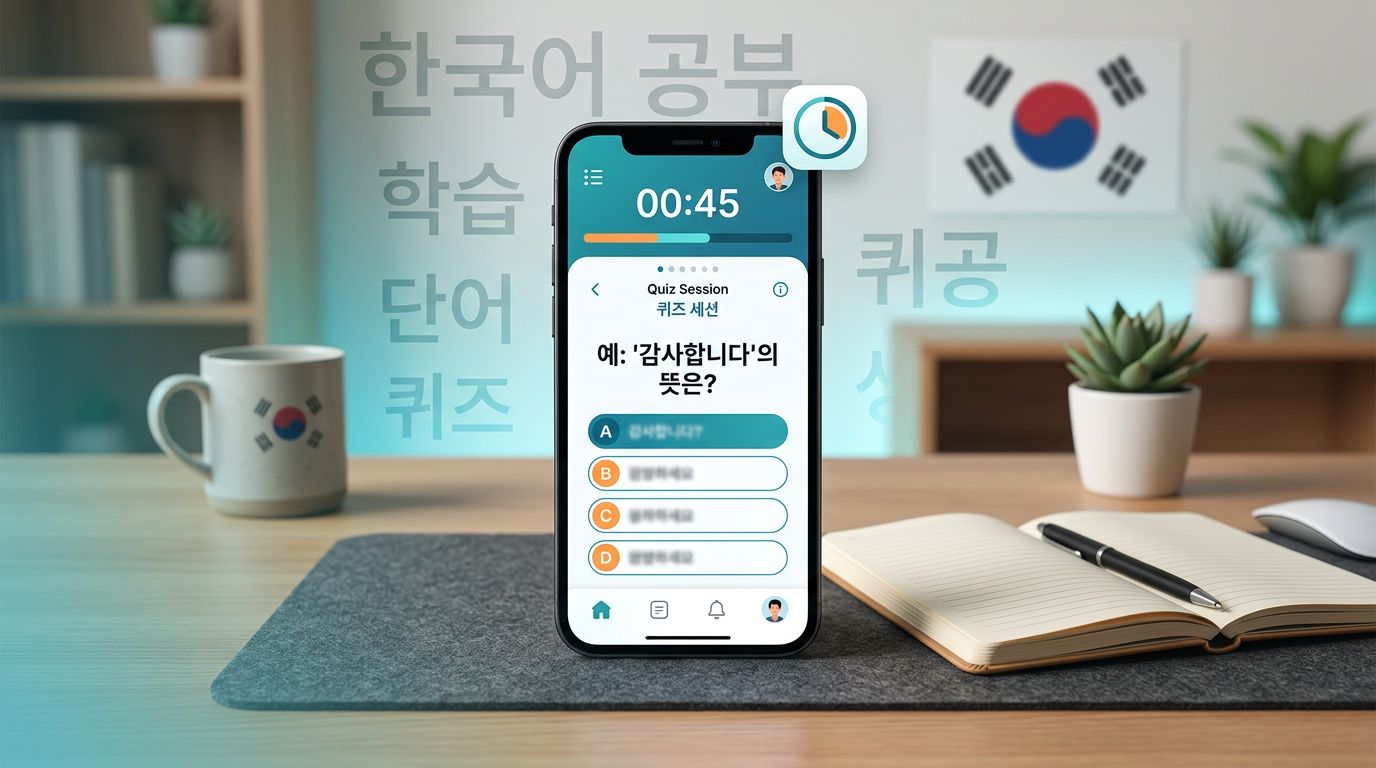
TOPIK prep gets messy fast if your tools are too broad. A polished Korean app can help with daily study, but exam day punishes weak timing, weak recall, and weak format familiarity.
The best TOPIK prep apps in 2026 do a narrow job well. They help you drill timed reading, sharpen listening, lock in vocabulary, and patch grammar gaps without wasting your study time. If you are aiming for TOPIK I or TOPIK II, you need apps that feel useful under pressure, not just pleasant to use.
What a useful TOPIK app does in 2026
A serious TOPIK app should make the exam feel familiar before test day. That means timed questions, realistic item types, and a clean review path after each mistake.
If an app never asks you to work under time pressure, it won’t prepare you for TOPIK.
Look for four things first:
- Timed practice for reading and listening.
- TOPIK I and II fit instead of generic Korean drills.
- Clear review for wrong answers and missed words.
- Support for weak spots, especially vocabulary and grammar.
Writing is the hardest part to cover inside an app. That matters most for TOPIK II. Even the best apps handle writing only partly, so you will still need outside feedback.
If you’re still deciding between tools, how to pick a language app for exam readiness gives a practical checklist. For raw mock papers, TOPIK Guide’s mock tests are a useful benchmark.

A quick comparison of the strongest options
These apps are still worth using in 2026, but they fit different jobs. The right pick depends on whether you need test drills, grammar repair, or fast vocabulary review.
| App | Practice tests | Skill coverage | Difficulty | Offline | Cost model | Platforms | Main limitation |
|---|---|---|---|---|---|---|---|
| TOPIK app | Yes, full exam-style drills | Listening, reading, light vocab, weak writing | Intermediate to advanced | Limited or unclear | Usually free, often ad-supported | iOS, Android | Writing support is thin, explanations vary |
| TTMIK | No full TOPIK mock tests | Grammar, listening, vocab | Beginner to upper intermediate | Partial | Free plus paid lessons | iOS, Android, web | Not exam-timed |
| Anki | Only if you build decks | Vocab, audio, example sentences | All levels | Yes | Free on desktop and Android, paid on iOS | Desktop, Android, iOS | No built-in curriculum |
| LingoDeer | Lesson quizzes, not true mock tests | Listening, reading, vocab, grammar | Beginner to intermediate | Partial | Subscription | iOS, Android, web | Limited TOPIK realism |
| Clozemaster | No full tests | Vocab in context, reading | Intermediate to advanced | Limited | Free plus premium | Web, iOS, Android | Weak writing and exam format |
The table makes one thing clear. Only one app is built for TOPIK first. The others work best as support tools.
TOPIK app: the closest thing to real exam drills
The dedicated TOPIK app is still the most direct choice for exam practice in 2026. It focuses on TOPIK I and TOPIK II, which makes it more useful than general Korean apps that never get close to exam timing.
Its biggest strength is format familiarity. You get used to the pace of listening and reading questions, and that helps reduce panic when the test starts. The app also works well for short daily sessions, which is exactly what most self-studiers need.
On mobile stores, the app is listed for both iOS and Android, so it is easy to keep on your phone. The downside is simple. Writing support is minimal, and explanation quality can vary by version. Offline access can also be limited, so test that before you depend on it during travel or commutes.
The app is best for learners who already know basic Korean and want more exam shape. If you are still building grammar from scratch, use it with another app. Otherwise, it can feel like a rough but useful training lap.
TTMIK: grammar repair for TOPIK I and early TOPIK II
TTMIK is not a TOPIK app in the strict sense, but it helps where many learners break down. Grammar.
That matters because TOPIK reading questions often punish small grammar mistakes. TTMIK gives you clearer explanations than most exam apps, which helps when a sentence pattern keeps showing up in your practice tests. Listening support is useful too, especially for learners who need slower, cleaner input before moving back to timed drills.
This app fits lower to mid-level learners best. If your TOPIK I grammar is shaky, or if you keep missing TOPIK II reading items because of structure, TTMIK can close that gap. The content is more lesson-based than exam-based, so it won’t feel like a test room. That is a weakness if you want pressure practice. It is a strength if you need to fix the foundation first.
TTMIK also has older material mixed with newer content, so not every lesson feels fresh. Use it for core grammar, then move back to actual TOPIK practice.
Anki: the strongest vocab tool if you use it well
Anki is still the best memory tool in this group. It is not built for TOPIK on its own, but it becomes excellent once you load the right deck.
That matters because vocab is one of the fastest ways to improve reading speed. A good TOPIK deck can drill high-frequency words, sample sentences, and even audio. Anki’s spaced repetition keeps hard items coming back until they stick, which is ideal for learners who forget words two days after studying them.
The app has another advantage: offline use is strong. Once your decks are synced, you can review anywhere. The cost model is also simple. Desktop and Android are free, while iOS requires a one-time payment. There are no ads.
Anki has one big limitation. It gives you the engine, not the fuel. If you do not build or find a good TOPIK deck, it does nothing useful. It also offers no real practice tests and no writing feedback. For serious learners, that is fine. Just don’t expect it to replace an exam app.
LingoDeer: structured study when your Korean needs rails
LingoDeer works well for learners who want structure without chaos. It is not a TOPIK simulator, but it can help you build the grammar and reading habits that TOPIK expects.
Its lessons are cleaner than many general Korean apps. That makes it good for learners who need a steady path through grammar points, listening practice, and short reading tasks. For TOPIK I, and for the lower end of TOPIK II, that structure can save a lot of wasted time.
Writing support is limited. You may type answers in some lessons, but it does not train the full TOPIK II writing section. Practice tests are also light, so you should not treat it as an exam replacement. Think of it as support work, not the main event.
LingoDeer uses a subscription model and is available on iOS, Android, and web. Offline access is usually better than on many free apps, but it still depends on plan and device. It is a solid pick if you want guided study and your Korean still feels shaky.
Clozemaster: sentence practice for reading speed and recall
Clozemaster is useful when you already know some Korean and need more contact with real sentences. It is strongest for vocabulary in context, which helps reading speed and word recall.
That makes it a smart companion for TOPIK II, especially if reading feels slow. The app pushes you to recognize words inside sentences instead of memorizing them alone. That is a better fit for the exam than isolated word lists, because TOPIK reading questions rarely hand you easy context.
Clozemaster is weaker on test realism. It does not give you full TOPIK mock exams, and it does not solve writing practice. Offline use is also limited compared with Anki. Still, it can be very helpful for intermediate and advanced learners who want more reading exposure without opening a full textbook.
The app offers a free tier and a premium plan. It runs on web, iOS, and Android. Use it after your basics are in place, not as your first Korean app.
The smartest app mix for TOPIK I and TOPIK II
The best setup is usually a small stack, not a crowded phone screen.
For TOPIK I, a good mix is:
- TOPIK app for mock questions and timing.
- Anki for vocabulary review.
- LingoDeer if you still need grammar structure.
For TOPIK II, a better mix is:
- TOPIK app for exam-style reading and listening.
- TTMIK for grammar cleanup.
- Anki for high-volume vocab review.
- Clozemaster if you need more sentence-level reading.
The reason this works is simple. Each app covers a different weak spot. No single app handles listening, reading, vocab, grammar, and writing well enough on its own.
If you are sitting TOPIK in Korea, the logistics matter too. CIEE’s guide to taking TOPIK in Korea covers the basics of registration and exam day prep, which can save you stress later.
Conclusion
The best TOPIK prep apps in 2026 are the ones that match the exam, not just the language. The dedicated TOPIK app gives you format practice, while TTMIK, Anki, LingoDeer, and Clozemaster fill the gaps around it.
If you want one clear takeaway, make it this: use one app for test shape, one for grammar, and one for vocabulary. That mix covers the parts of TOPIK that trip up serious learners most often.
The test rewards familiar patterns and fast recall. Build both, and the exam stops feeling random.
Ready to Take Your Language Learning Further?
Your favorite language-learning app is a great place to start. Rocket Languages can help you go further with interactive audio lessons, pronunciation practice, real-world conversations, and structured learning.
Explore Rocket Languages →Affiliate disclosure: We may earn a commission if you purchase through this link, at no additional cost to you.