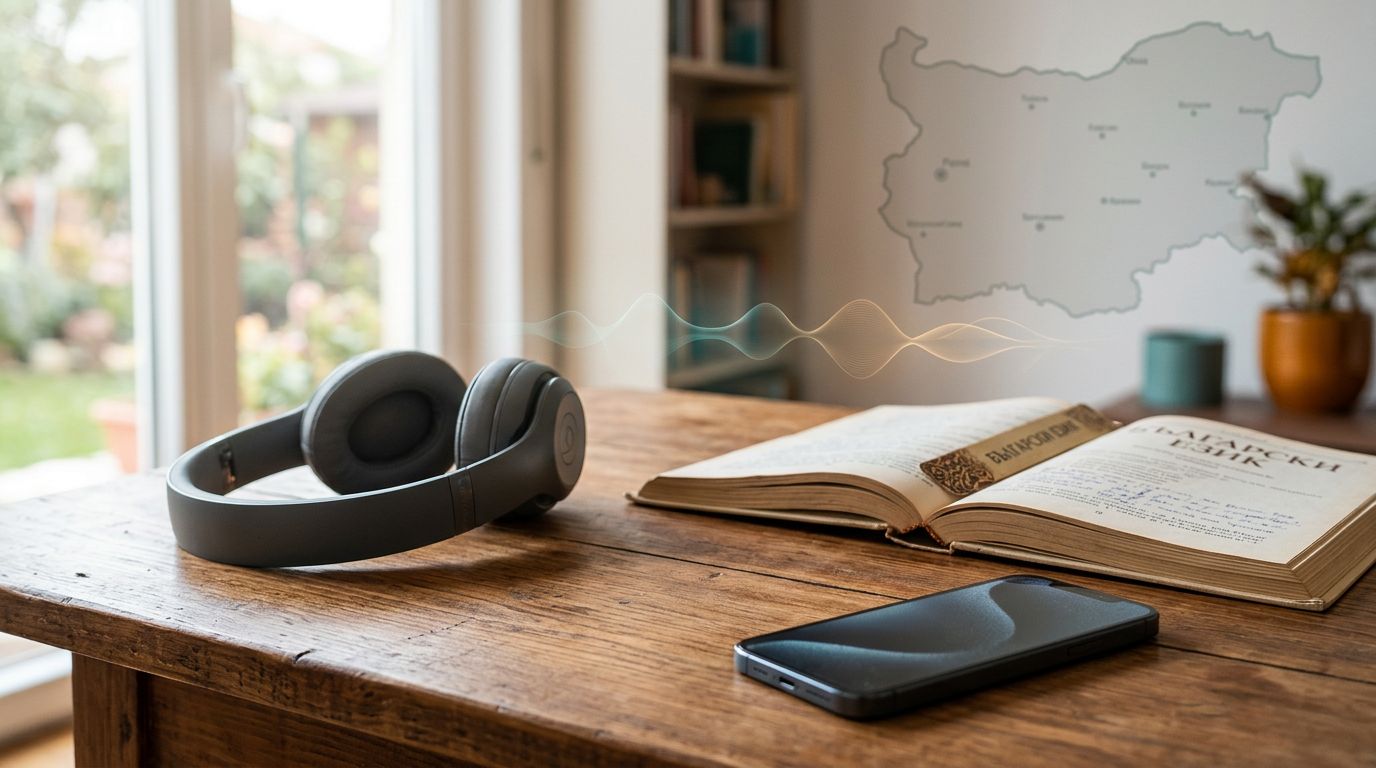
Bulgarian asks more from you than a stack of flashcards. Cases, verb aspect, and fast speech expose weak apps quickly, so casual tools run out of road fast.
If you want real progress in 2026, you need apps that do more than hand you vocabulary taps. You need listening practice, recall-based review, and a way to hear your mistakes corrected by a real person.
What a serious Bulgarian app needs
A serious Bulgarian app should help you do three things well. First, it should give you direct Bulgarian content, not a vague promise that you can “build skills” with a generic interface. Second, it needs native audio or very strong speech input, because Bulgarian pronunciation and rhythm matter from the start. Third, it should help with recall, since passive listening alone will not carry you far.
That last point matters more than most app pages admit. Bulgarian has grammar that rewards careful attention, especially with sentence structure, verb forms, and the habit of noticing patterns instead of memorizing single words. If an app never makes you produce language, it will stall early.
Popular roundups like Preply’s Bulgarian app guide still lean toward starter-friendly tools, which is fine if you know that’s only the first layer. Before paying, read how to critically read language app reviews and run a 48-hour app trial so you can see whether the lessons hold up after the first shiny session.
Bulgarian progress usually comes from one app that teaches, one that drills, and one person who corrects you.
The strongest Bulgarian learning apps at a glance
Here’s the short version before the deeper breakdown.
| App | Direct Bulgarian content? | Best for | Main limitation |
|---|---|---|---|
| BulgarianPod101 | Yes | Guided listening and lesson flow | Can feel passive if you only consume audio |
| Ling | Yes | Daily drills and speaking basics | Light on deep grammar and advanced reading |
| Glossika | Yes | Sentence repetition and pronunciation | Thin explanations, repetitive by design |
| italki | No, tutor-led | Real conversation and feedback | You need your own study plan |
| uTalk | Yes | Vocabulary and survival phrases | Limited grammar and long-form listening |
| Bulgaro | Yes | Beginner structure and spaced review | Not enough advanced content for serious progress |
That spread matters. If you only want one casual app, almost anything can work for a while. If you want steady Bulgarian progress, the mix has to cover different jobs.
BulgarianPod101 is the best anchor for guided listening
BulgarianPod101 is one of the strongest choices for learners who want structure without losing flexibility. The format works well for people who like audio lessons, especially if you study on commutes or during short breaks. It gives you a sense of progression, and that matters when Bulgarian starts feeling dense.
Its biggest strength is guided listening. You get exposure to the language in a way that feels more natural than isolated word drills. For learners who want to hear real sentences again and again, that repetition helps a lot.
The weak spot is depth. It can carry you through the early and middle stages, but it will not fix everything on its own. Cases and verb aspect still need careful study, and you may have to slow down and take notes outside the app.
BulgarianPod101 is best for self-studiers who want a clear path. It is less useful for people who only want quick gamified wins.
Ling gives you short daily Bulgarian practice
Ling is a solid pick for learners who need consistency more than long lessons. Its Bulgarian app on Google Play is built around short daily sessions, native audio, and a style that nudges you to keep showing up. That makes it useful for busy learners who still want a real habit.
The short format helps. You can finish a session without putting your life on hold, and that lowers friction. Ling also works well as a warm-up app before deeper study.
Still, Ling has limits. It is good for daily repetition, but it does not go far enough on grammar explanation for learners who want to understand why a form changes. Bulgarian cases and aspect need more than matching games and quick prompts.
Ling is strongest as a supplement or a second app. It supports momentum, but it should not be your only source of Bulgarian input.
Glossika is where repetition starts to pay off
Glossika suits learners who care about listening and speaking patterns. Its sentence-based approach is useful for Bulgarian because it pushes you to hear full structures, not just single words. That matters when you want your brain to stop translating everything one piece at a time.
For intermediate learners, this can be a serious advantage. Bulgarian sentence patterns start to feel less random when you hear them often enough. Glossika also gives you a rhythm that can improve pronunciation, especially if you speak along with the audio.
The trade-off is clear. Glossika is not a friendly grammar teacher, and it does not explain much. If you need case charts, aspect notes, or detailed breakdowns, you will have to get those somewhere else.
That makes it better for learners who already know the basics and want automatic recall. It is less satisfying for complete beginners who still need a map.
italki solves the biggest Bulgarian app problem
Apps can teach you a lot, but they cannot replace real speech. That is where italki matters most. Since it connects you with tutors, it is one of the best ways to practice Bulgarian conversation and get immediate correction.
This is where Bulgarian learners often hit a wall. You can memorize endings and still freeze in a real chat. A tutor helps you notice what slips, including word order, case usage, and the difference between forms that look similar in a lesson but sound wrong in speech.
Italki is not a course, so it only works if you bring your own structure. That can be a good thing. You can ask for role-play, homework review, or focused correction. You can also choose tutors who match your level and pace.
For serious learners, italki is the bridge between app study and real life. If you live in Bulgaria, plan to stay there, or want heritage fluency, it is hard to beat.
uTalk and Bulgaro are useful, but mostly early-stage tools
uTalk and Bulgaro have a narrower job. Both are more helpful for beginners than for advanced learners, and that is fine as long as you know what you are buying.
uTalk is good for phrases, core vocabulary, and native-speaker audio. It works well when you want to name things fast and build a small usable base. The picture-based style can make early recall easier, especially if you are starting from zero.
Bulgaro is more of a structured beginner layer. It uses spaced review and frequency-based vocabulary, which helps you get the first hundred or two hundred items under control. That can be useful if you want a simple entry point without getting lost in too many features.
Neither app is enough for long-term mastery. They do not give you enough advanced content, and they will not carry you through reading, grammar, or real listening by themselves. Memrise can still work as a spare flashcard layer, but it should sit behind stronger tools, not in front of them.
How to build a Bulgarian study stack that lasts
A good Bulgarian stack looks simple. One app teaches the material, one app drills the material, and one human helps you use it. That setup covers more ground than a single all-in-one app.

A practical weekly routine can stay short and still work. Use a 10-minute language study plan on busy days, then give your stronger app more time on weekends. Bulgarian improves when you repeat the same forms often enough to notice them in speech.
The best routine also avoids fluff. Listen, repeat, write a few sentences, then speak them out loud. If an app offers speech feedback, use it. If it does not, record yourself and compare it with native audio.
Which app fits which learner and budget
If you want the cleanest match, start here.
- Best overall for serious self-study: BulgarianPod101, with Ling as a daily companion. This mix gives you structure and short repetition.
- Best for speaking fast: italki, paired with Glossika. You get real correction and sentence-level drills.
- Best low-budget starter: Bulgaro or uTalk. These are fine if you want to test the water before paying for tutoring.
- Best for heritage learners: italki first, then Glossika or BulgarianPod101. Heritage learners usually need fluency cleanup, not just vocabulary.
- Best for long-stay expats: BulgarianPod101, Ling, and italki. That combination covers listening, habits, and real-life speech.
If your budget is tight, use one app with a free or low-cost plan and put most of your money into tutoring sessions. If your budget is healthier, combine one structured course with one speaking app and one tutor. That balance usually beats paying for three weak subscriptions.
Conclusion
Bulgarian is a hard language for shallow apps, because it asks for more than recognition. The strongest tools in 2026 are the ones that build listening, force recall, and get you speaking with a real person.
For most serious learners, BulgarianPod101 plus italki is the safest core. Add Ling or Glossika if you want more daily repetition. If you only want a starter app, uTalk or Bulgaro can help, but they should not be the end of the road.
The best Bulgarian learning app is the one that keeps showing you your weak spots, then gives you a way to fix them.
Ready to Take Your Language Learning Further?
Your favorite language-learning app is a great place to start. Rocket Languages can help you go further with interactive audio lessons, pronunciation practice, real-world conversations, and structured learning.
Explore Rocket Languages →Affiliate disclosure: We may earn a commission if you purchase through this link, at no additional cost to you.