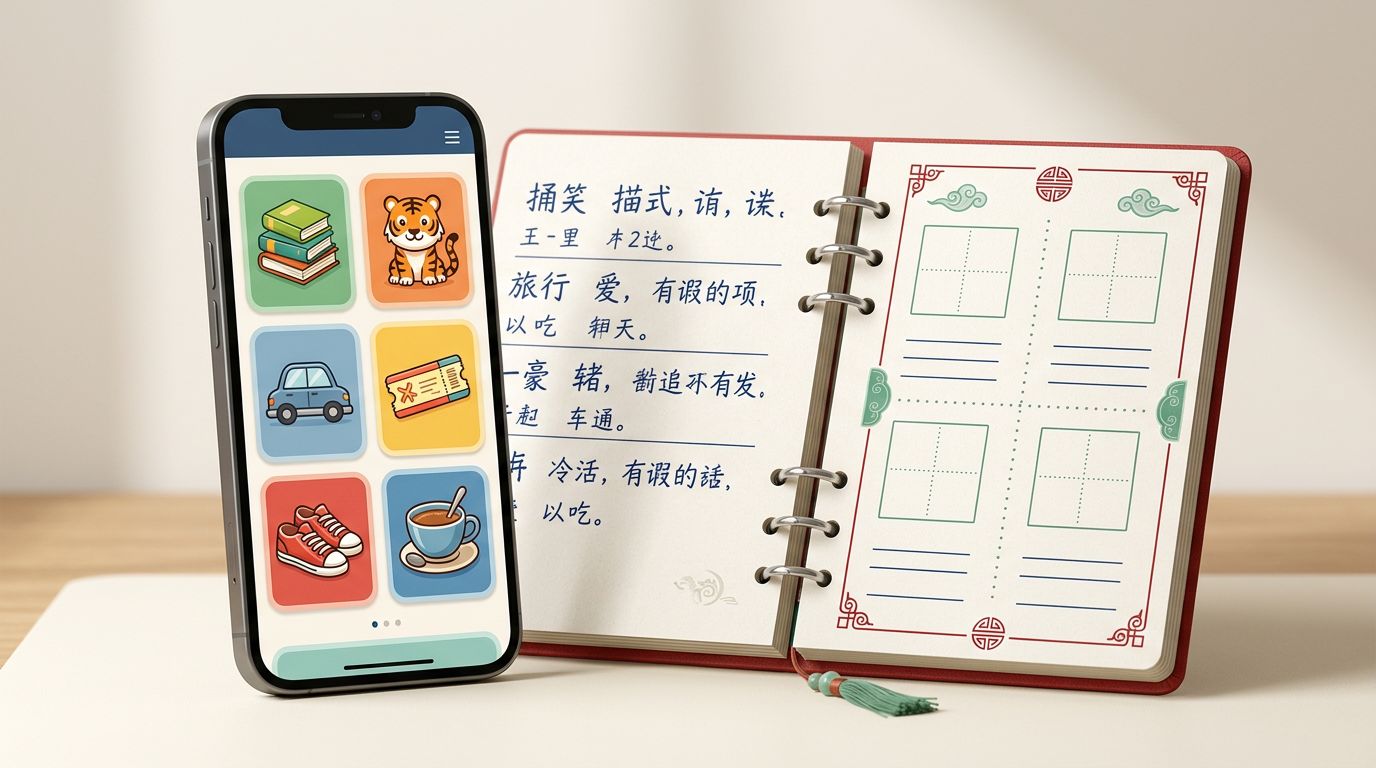
One tiny word can make an otherwise correct Mandarin sentence sound unnatural. You may know 三本书, “three books,” yet still hesitate before an animal, vehicle, ticket, or pair of shoes.
Searches for Chinese measure words apps usually start with that hesitation. The right tool won’t make you memorize Mandarin Chinese measure words in one sitting. It will help you retrieve each classifier beside the noun, recognize it in context, and use it accurately.
The strongest setup combines one focused quiz tool with a dictionary or flashcard system. This Chinese beginner guide first explains Mandarin Chinese measure words, then compares these options.
Key Takeaways
- Mandarin measure words come between numbers and nouns, as in 三本书 (three books), and should be learned together with the nouns they modify.
- Start with frequent classifiers such as 个, 本, 张, 只, 辆, 把, 双, 杯, 件, and 条 before expanding to less common pairings.
- Liàng is best for focused classifier quizzes, while Pleco and Arch Chinese help check usage and examples.
- Anki and Skritter support long-term retention through spaced repetition, while HelloChinese and SuperChinese provide broader beginner courses.
- The most effective routine combines active recall, speaking full phrases aloud, example sentences, and reviews spaced over several days.
Why Mandarin Chinese measure words matter
Mandarin Chinese measure words, also called Chinese classifiers, come between numbers and countable nouns. This number-plus-classifier-plus-noun structure is an important point of Chinese grammar:
number + measure word + noun
For example:
- 三本书 (sān běn shū), three books
- 两辆车 (liǎng liàng chē), two cars
- 一张票 (yì zhāng piào), one ticket
- 五只猫 (wǔ zhī māo), five cats
Unlike English, measure words in Chinese normally come between the number and noun. The same pattern appears after demonstratives, such as 这本书 (zhè běn shū), “this book,” and 那辆车 (nà liàng chē), “that car.”
These words aren’t random grammatical obstacles. They connect Mandarin grammar and nouns through shape, function, or category. 本 fits bound books, 张 fits flat objects, and 辆 fits wheeled vehicles. The general classifier 个 (gè) works with many nouns, but speakers choose a more specific word when one is expected.
A noun and its classifier are best learned as a pair, not as two separate vocabulary items.
Mandarin Chinese measure words also matter in listening. In quick speech, the classifier may be the only clue that the speaker means a book, a vehicle, a pair, or a flat object. For HSK preparation, a level-based list of Mandarin Chinese classifiers is more practical than memorizing every classifier at once. The Chairman’s Bao’s guide to Chinese measure words notes that HSK materials introduce 28 measure words.
Start with the most frequent pairings, then expand your list of Mandarin Chinese measure words.
General and specialized classifiers
个 is the safest starting point because it works with people and many everyday objects:
- 一个人 (yí ge rén), one person
- 一个问题 (yí ge wèntí), one question
- 一个苹果 (yí ge píngguǒ), one apple
However, replacing every classifier with 个 can make your Mandarin sound less natural. Use 本 for books, 只 for animals, 双 for pairs, and 辆 for vehicles. You don’t need perfect coverage on your first week, but you should learn the most common pairings early.
How classifier practice tools compare
These tools aren’t all built for the same job. A few focus directly on Mandarin Chinese measure words, while other language learning tools help you find, review, hear, or write noun-classifier combinations. Only a small number focus directly on Chinese classifiers.

| Tool | Best use | What it helps you practice | Standalone solution? |
|---|---|---|---|
| Liàng | Focused classifier practice | Visual-first quizzes built around measure words | Usually no, add dictionary examples |
| Pleco | Quick reference | Definitions, pinyin, classifier entries, OCR, and flashcards | No, it is mainly a reference tool |
| Arch Chinese | Detailed lookup | A complete measure word list with usage examples | No, it is a web reference |
| Anki | Spaced repetition | Custom noun-classifier cards and sentence recall | Only for review, not explanations |
| Skritter | Character writing | Writing classifiers and retaining vocabulary with SRS | No, pair it with examples and listening |
| HelloChinese | Beginner structure | Measure words inside guided grammar and vocabulary lessons | No, it covers much more than classifiers |
| SuperChinese | Structured Mandarin study | Vocabulary and grammar review in a broader course | No, use a dedicated review tool too |
Liàng for direct classifier drilling
Liàng is the closest match for learners who want a measure word app rather than a general Mandarin course. Its visual-first rounds act as an interactive quiz trainer. If the current product listing confirms that format, it can feel like a Chinese word game.
That focused design is useful when 个, 只, 张, and 把 keep blending together. Short rounds help you retrieve Mandarin Chinese measure words through noun-classifier pairings. When Liàng is available in your app store, use it for targeted practice. Then confirm new combinations in Pleco or Arch Chinese.
Pleco for checking the right pairing
Pleco is one of the most useful Chinese learning apps for daily reference. Search a noun, check its dictionary entry, and review the Mandarin Chinese measure words used with it. Its core tools include dictionary lookups, OCR, stroke-order support, flashcards, and Pinyin pronunciation guides, although exact add-ons and pricing can vary by store and region.
Pleco doesn’t replace a dedicated classifier course. It becomes more useful when you turn mistakes into review cards and check example sentences. For example, if you confuse 一张照片 with 一本照片, save the correct phrase and test yourself later.
LanguaVibe’s comparison of the best apps to learn Mandarin also places dictionary and review tools in separate roles. That approach fits measure words well because no single app handles explanation, reference, recall, and writing equally well.
Arch Chinese for detailed lookup
Arch Chinese is a browser-based reference, similar to other online dictionaries. Its detailed measure word list and usage examples make it useful for checking combinations. It complements Pleco and dedicated drills rather than replacing them.
Anki and Skritter for retention
Anki works well when you want complete control over your deck. Create flashcards for Chinese that show the noun on one side and require the full phrase on the other, such as “two pairs of shoes” -> 两双鞋. Add pinyin, audio, a short sentence, and an image when those details help.
Skritter suits learners who want to write characters while reviewing vocabulary. Its built-in spaced repetition supports repeated practice with words such as 本, 张, 辆, and 双. Still, writing a classifier won’t tell you every noun it can modify, so add dictionary examples or course content.
HelloChinese and SuperChinese are stronger choices for beginners who need a guided Mandarin course. They can introduce Mandarin Chinese measure words through lessons, pronunciation practice, and sentence patterns, but neither should be your only classifier resource.
Prices, subscriptions, and platform support change over time. Check the current store listing before purchasing, especially if you want a tool that works across several devices.
Ten common Chinese measure words to learn first
These ten cover many everyday conversations and form a practical core set of Mandarin Chinese measure words. To build Chinese vocabulary, practice measure words in Chinese with at least two nouns each, using the example sentences as a guide.
- 个 (gè) works as a general classifier for people and many objects. Example: 一个人, one person.
- 本 (běn) is used for books, magazines, and other bound reading materials. Example: 一本词典, one dictionary.
- 张 (zhāng) describes flat or spread-out objects. Example: 一张照片, one photo.
- 只 (zhī) is common for animals and one member of a pair. Example: 一只狗, one dog.
- 辆 (liàng) is used for cars, buses, bicycles, and other wheeled vehicles. Example: 一辆出租车, one taxi.
- 把 (bǎ) fits many objects with handles or a graspable form. Example: 一把雨伞, one umbrella.
- 双 (shuāng) marks a pair of matching items. Example: 一双袜子, one pair of socks.
- 杯 (bēi) measures a cup or glass of a drink. Example: 一杯咖啡, one cup of coffee.
- 件 (jiàn) commonly measures clothing and some matters or pieces of work. Example: 一件衣服, one item of clothing.
- 条 (tiáo) is used for long, flexible, or narrow things, including fish and some clothing. Example: 一条鱼, one fish.
Pay attention to the difference between 只 and 双. 一只鞋 means one shoe, while 一双鞋 means a pair of shoes. Learning these Mandarin Chinese measure words in full phrases makes the contrast easier to recall.
A study routine that makes classifiers stick
When learning Chinese measure words, randomly scrolling through a list creates recognition, but active recall builds usable memory. A short routine works better than a long session you rarely repeat.
- Choose five noun-classifier pairs from your current lesson on Mandarin Chinese measure words. Keep them connected by a topic, such as transport, food, or clothing.
- Test both directions. Show yourself 车 and recall 辆, then see 一辆车 and explain the meaning.
- Say the full phrase aloud. Include the number, classifier, and noun instead of reviewing only the classifier.
- Write example sentences for each difficult pair. Context helps separate similar choices, such as 张 for photos and 本 for books.
- Review the cards after a gap, then revisit them the next day and later in the week.
Use Pleco or Arch Chinese when a pairing feels uncertain. For a larger reference list with examples, HSK Lord’s Chinese measure words guide can expand your study of Mandarin Chinese measure words beyond the beginner core. A short Chinese classifier video lesson adds listening and visual reinforcement. These Chinese learning resources are supplementary, so they shouldn’t replace retrieval practice.
The most effective tools for studying Mandarin Chinese measure words fit into this routine rather than compete with it. A focused quiz tool supplies repetition, a dictionary checks usage, and Anki or Skritter brings difficult items back at the right time.
Frequently Asked Questions
What are Chinese measure words?
Chinese measure words, also called classifiers, are placed between a number or demonstrative and a countable noun. For example, 一本书 uses 本 for a book, while 一辆车 uses 辆 for a vehicle.
Which Chinese measure words should beginners learn first?
Beginners should start with common classifiers such as 个, 本, 张, 只, 辆, 把, 双, 杯, 件, and 条. Learning each one in complete noun-classifier phrases makes the combinations easier to remember.
What is the best app for practicing Chinese measure words?
Liàng is the closest match for focused measure word drilling because it centers on visual quizzes and classifier retrieval. Pair it with Pleco or Arch Chinese to confirm meanings, usage, and example combinations.
Can Pleco replace a dedicated measure words app?
Pleco is excellent for looking up nouns, checking classifiers, listening to pronunciation, and creating flashcards. However, it is mainly a reference and review tool, so a dedicated quiz app or structured course can provide more targeted practice.
How can I remember Chinese measure words more effectively?
Practice the full number-classifier-noun phrase in both directions, say it aloud, and write example sentences for difficult pairs. Review the phrases after a gap and again the next day to strengthen recall.
Conclusion
Mandarin Chinese measure words become less intimidating when learned beside real nouns, not as an isolated grammar list. Start with 个, 本, 张, 只, 辆, 把, 双, 杯, 件, and 条, then practice each classifier in a complete phrase.
For most learners, Liàng offers focused practice; Pleco handles lookup, Arch Chinese provides reference support, Anki reinforces repetition, and Skritter supports writing. Choose Chinese measure words apps according to your task, then practice complete phrases until the right classifier comes naturally.
Ready to Take Your Language Learning Further?
Your favorite language-learning app is a great place to start. Rocket Languages can help you go further with interactive audio lessons, pronunciation practice, real-world conversations, and structured learning.
Explore Rocket Languages →Affiliate disclosure: We may earn a commission if you purchase through this link, at no additional cost to you.