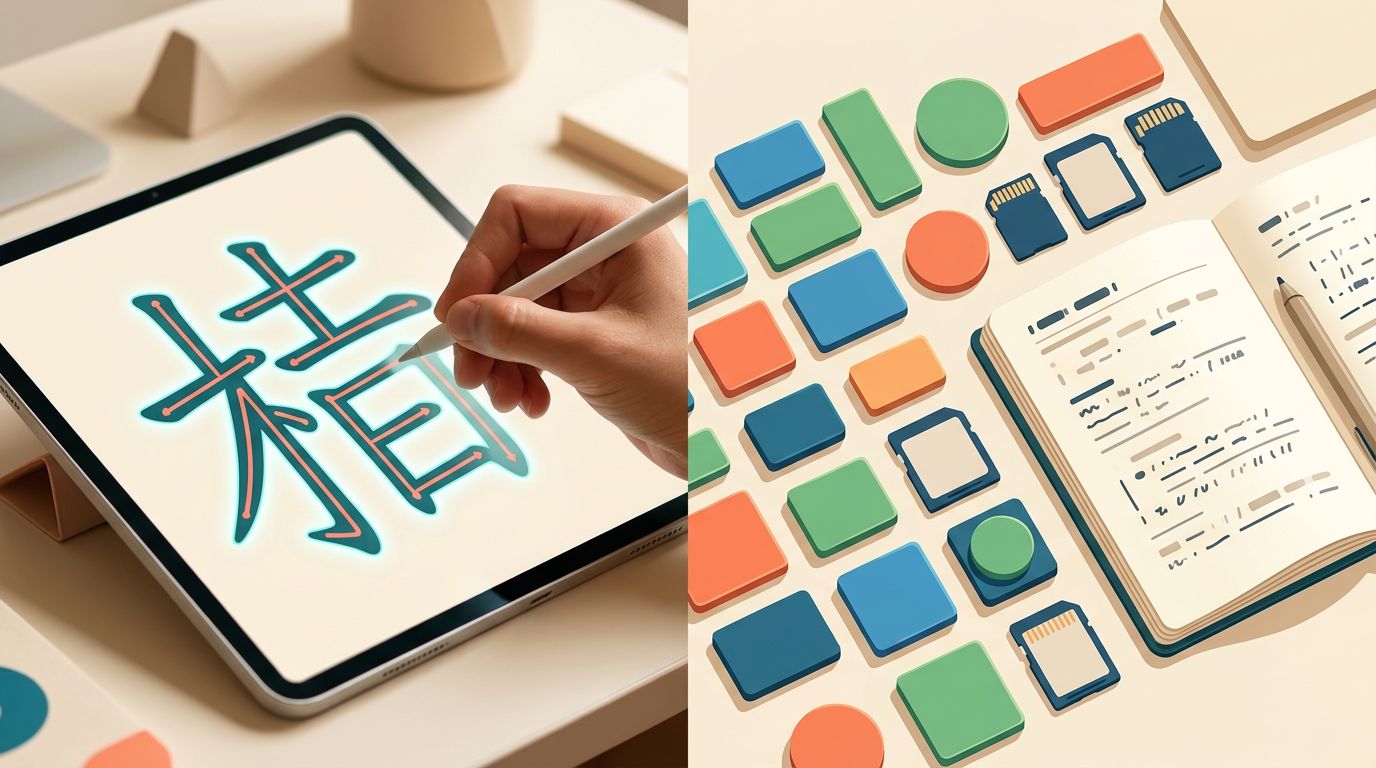
A character app can help people learning Chinese recognize hundreds of Chinese characters, yet recognition alone won’t make writing feel automatic. The real choice in Skritter vs HanziHero is between two study methods: repeated handwriting with immediate feedback, or structured review that builds character memory.
Skritter suits learners who want to produce characters stroke by stroke. HanziHero suits learners who prefer a guided curriculum that explains how characters fit together. Both use active recall and scheduled review, but they ask different things of your study time.
Key Takeaways
- Skritter is the stronger choice for learners who need to produce Chinese characters by hand, practice stroke order, and receive real-time writing feedback.
- HanziHero focuses on character components, sound associations, mnemonics, and a guided curriculum that makes unfamiliar characters easier to remember.
- Both apps use active recall and spaced repetition, but Skritter makes recall physical through handwriting while HanziHero emphasizes recognition, structure, sounds, and vocabulary.
- HanziHero offers a permanent free tier and a lifetime plan, while Skritter provides a seven-day trial and specializes in a writing-first study workflow.
- Choose based on your target outcome: use Skritter for handwriting production and HanziHero for structured character memory and curriculum guidance.
Two Different Learning Models
Skritter treats writing Chinese characters as the center of its approach. You draw a character on a phone, tablet, or computer, and the app checks your input as you go. It provides stroke-level feedback, reinforces stroke order, and uses spaced repetition to bring difficult cards back more often.
Writing prompts create physical retrieval through active recall, not passive recognition. Each review requires more effort than tapping an answer button. You must remember the character’s shape, select the correct stroke direction, and complete the expected form. As a result, Skritter is a strong fit if you need to write by hand for school, work, exams, or personal goals.
A comparison of Chinese character websites also identifies Skritter’s handwriting practice as its defining feature. Its mobile app supports simplified characters and traditional characters, alongside Chinese and Japanese study, audio, vocabulary lists, textbook-based material, and user-created lists.
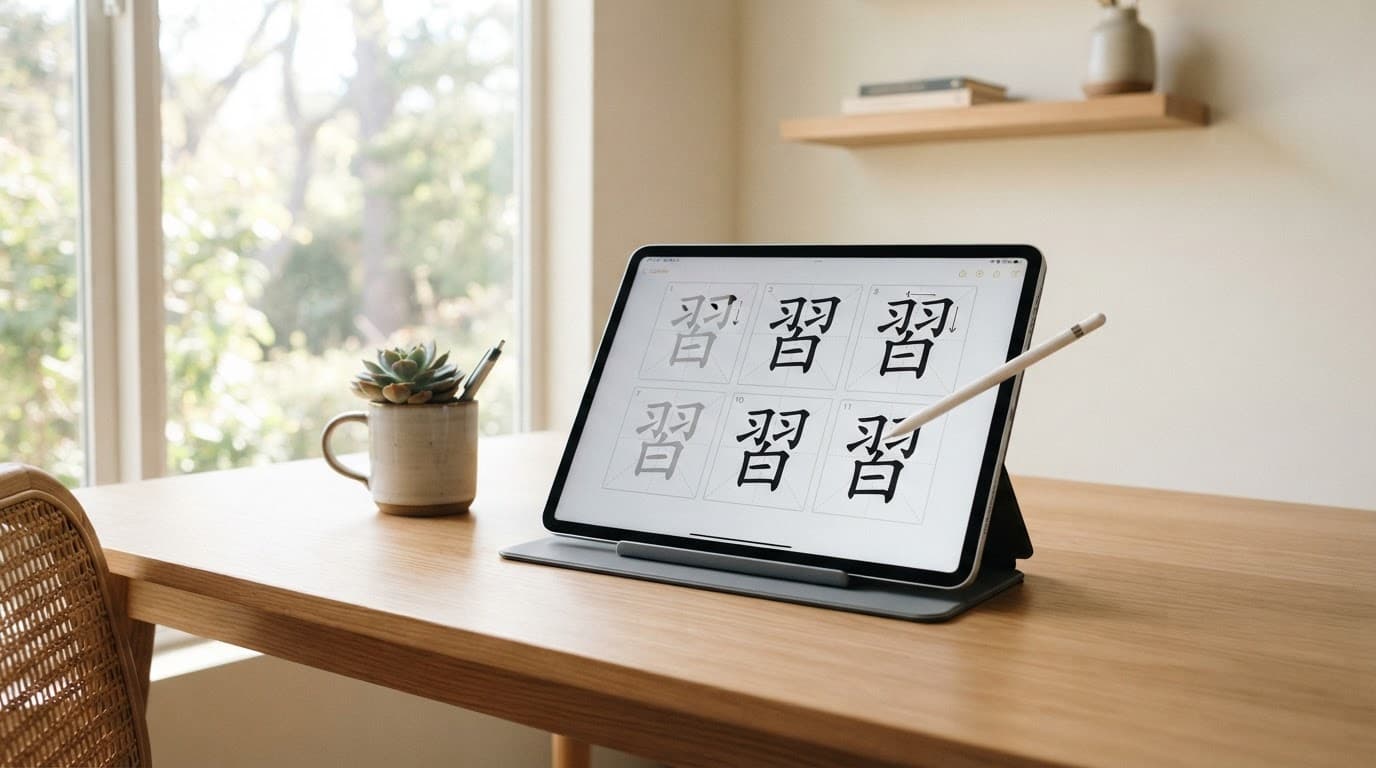
Skritter makes handwriting an active skill
Feedback on each stroke matters because it turns a vague memory into a physical sequence. If you draw a component incorrectly, Skritter can flag the problem instead of allowing a rough approximation to pass as correct.
The writing-first design also exposes weak characters quickly. You may recognize a character in a reading exercise but fail when asked to produce it. That gap is common, and Skritter focuses directly on closing it.
The tradeoff is friction. Handwriting reviews take longer, and some learners find repeated drawing tiring when their main goal is reading. Some bug reports mention occasional syncing or device issues, so it’s sensible to test the app before subscribing.
HanziHero builds memory before handwriting
HanziHero takes a component-first route. Its curriculum introduces characters in an optimal learning order, then connects them to visual character components, related vocabulary, and hand-crafted character mnemonics.
This can make unfamiliar characters easier to remember. Instead of treating each hanzi as an isolated picture, you learn recurring parts and the roles they play. Recognizing the water component 氵, for example, can give you a useful clue when you meet another character that contains it. These memory techniques make retrieval easier, but active recall still requires you to retrieve the character.
HanziHero is closer to a guided flashcard program than a handwriting simulator. Its current product information emphasizes curriculum content, components, sound mnemonics, and vocabulary. Hack Chinese offers a broader SRS-oriented review option, rather than a handwriting-first tool, while HanziHero stays more curriculum-led. If real-time handwriting recognition is your deciding feature, Skritter has the clearer specialization.
Skritter asks you to produce the character accurately. HanziHero first helps you understand how the character is built and remembered.
Feature comparison for Chinese character writing
The table clarifies how these study tools approach Chinese characters.
| Feature | Skritter | HanziHero |
|---|---|---|
| Primary focus | Handwriting, stroke order, and recall | Character components, sound links, and curriculum order |
| Writing feedback | Real-time handwriting recognition and stroke-level grading | Not positioned around the same handwriting-first feedback |
| Review system | spaced repetition with writing prompts | Spaced review linked to its character curriculum |
| Content and sequence | Textbook materials, custom content, and audio pronunciation | A built-in sequence with an optimal learning order, plus thousands of characters and words on paid plans |
| Memory support | Visual recall plus repeated production | Hand-crafted mnemonics for characters, components, and pronunciation |
| Free access | Seven-day trial on the monthly plan | Permanent free tier with about 90 characters and related content |
| Customization | Strong list and study-material support | Less setup, with more reliance on the built-in sequence |
| Access | Browser and phone access | Primarily web-based, with current device support worth checking |
| Script support | Check current coverage for traditional characters before choosing | Check current coverage for your target script |
Skritter gives you more direct practice producing written forms, while HanziHero gives you more explanation before and during review. The choice depends on whether your current problem is poor handwriting recall or weak character memory.
Try both with a short selection from graded readers to see whether recognition transfers beyond app reviews. If you need traditional characters, verify each product’s current coverage before committing.
spaced repetition appears in both tools, but the schedule alone doesn’t guarantee useful learning. Active recall happens when you produce an answer before seeing it. Skritter makes that production physical, while HanziHero builds recall into recognition, components, sounds, and vocabulary. Compared with Anki, which can make the active recall prompt more configurable, both tools provide a more guided path. Hack Chinese offers a useful benchmark for comparing spaced-review systems, but the key difference remains how each tool builds recall.
Pricing, free access, and long-term value
As of August 2026, Skritter’s public US pricing lists $14.99 for one month, $59.99 for six months, and $99.99 for one year. The monthly plan includes a seven-day free trial. Annual billing lowers the effective monthly cost, but the listed options still require a subscription plan.
HanziHero lists a $15 monthly plan, an annual plan billed at $120 per year, and a $349 lifetime option. Taxes may apply, and subscription prices can change at the end of a payment term. Its lifetime plan creates a different value calculation for learners who expect to study characters for several years. Subscription-based benchmarks such as Hack Chinese offer another way to assess long-term cost.
The free tiers also differ sharply. HanziHero lets users keep its starter content permanently, including roughly 90 characters, more than 100 components, sound mnemonics, and related words. Reviews for that free content remain available without a time limit. Permanent access makes these study tools easier to compare over time, especially when you follow a spaced repetition schedule.
Skritter’s trial is better for testing the complete writing workflow, while HanziHero’s free tier is better for slow evaluation without a deadline. Before paying, try the same beginner Chinese characters in both apps and use active recall during the trial. After two or three days, check whether retention carries into graded readers.
Which app fits your study habits?
Choose Skritter when handwriting is part of your target outcome. It suits learners who need to produce Chinese characters for handwritten assessments, fix persistent stroke order errors, or practice traditional characters. It also works well when learning Chinese includes turning textbook vocabulary lists or HSK lists into active writing practice.
Skritter may feel excessive if you mainly read, type with pinyin, or work through graded readers. Writing every answer can make reviews longer than necessary for reading-focused learners who need quick recognition instead.
Choose HanziHero when you want a prepared curriculum and dislike building decks. Its component explanations reduce the need to research radicals, organize vocabulary, and create mnemonics yourself. The sequence provides an optimal learning order, which can feel more structured than review-focused options such as Hack Chinese.
HanziHero is especially practical for learners who want to connect pinyin sounds with character structure. Its paid curriculum page lists over 3,000 characters, about 5,200 words, more than 500 components, and over 70 sound associations. Verify current coverage if you need traditional characters, since script support may vary.
Your device habits matter when choosing study tools. Skritter has established browser access and a mobile app. HanziHero is commonly accessed through its web app, so check the current mobile-browser experience before making it your only study option.
A community discussion comparing character apps shows how varied learner preferences can be. Some learners value daily handwriting practice, while others prefer Hack Chinese for faster reviews with less manual input. The right choice depends on the kind of active recall you need outside the app, such as producing characters by hand or following graded readers.
How Anki and Pleco compare
Anki remains the most flexible alternative, with Hack Chinese offering a focused vocabulary workflow. You can build a custom curriculum, import vocabulary lists and HSK lists, add audio, and include traditional characters. Shared decks can save time; cards can test recognition, typing, handwriting, or translation, supporting active recall and spaced repetition.
That flexibility creates setup work. You may need to choose among shared decks, adjust card templates, install add-ons, manage media, and troubleshoot synchronization. Their quality varies; some have poor formatting, incomplete stroke details, weak memory cues, or too many cards introduced at once. HanziHero provides an optimal learning order, while Skritter offers specialized handwriting tools without requiring you to design the entire system.
Pleco fills a different role. Its dictionary, handwriting input, OCR, and flashcard tools help you investigate unknown Chinese characters in books, menus, or screenshots. Support for traditional characters can also help with graded readers. A detailed Pleco app breakdown can help you decide whether you need a dictionary-centered tool alongside a dedicated character course.
Some learners combine these products. HanziHero can introduce and organize characters, Skritter can test handwritten production, Hack Chinese can support vocabulary review, and the dictionary can handle lookups. This combination costs more and may duplicate reviews, so it works best when each study tool has a clear job.
LanguaVibe’s guide to the best Chinese learning apps offers broader context on language learning apps beyond character writing. Listening, reading, pronunciation, and grammar still need separate practice when learning Chinese.
Frequently Asked Questions
Is Skritter better than HanziHero for learning Chinese characters?
Skritter is better if your main goal is handwriting, stroke order, and producing characters from memory. HanziHero may be better if you want mnemonics, components, and a structured sequence for remembering characters.
Can HanziHero teach handwriting?
HanziHero helps you understand and remember character structure, but it is not positioned around the same real-time handwriting feedback as Skritter. If you need detailed stroke-level grading, Skritter is the more specialized option.
Which app is better for reading Chinese?
Both apps can support reading by improving character recall, but HanziHero may suit learners who want to connect components, sounds, and vocabulary. Skritter can also help reading-focused learners, although its handwriting reviews may take more time than they need.
Do Skritter and HanziHero have free options?
HanziHero offers a permanent free tier with starter characters, components, mnemonics, and related words. Skritter offers a seven-day trial on its monthly plan, allowing you to test the complete handwriting workflow before subscribing.
Can I use both Skritter and HanziHero?
Yes. HanziHero can introduce and organize characters, while Skritter can provide additional practice producing them by hand. Using both may duplicate reviews, so each app should have a clearly defined role in your study routine.
Conclusion
Skritter is stronger for handwriting recognition and stroke order, making it a good fit for Chinese characters, including traditional characters. HanziHero is better for learners who want mnemonics and a clear path through character structure.
Choose Skritter if you forget how to write characters you can recognize. Choose HanziHero if characters feel unrelated and you want a clearer starting sequence. Match the app to your goals: active recall supports reading transfer with graded readers, while Hack Chinese suits broader vocabulary review.
Ready to Take Your Language Learning Further?
Your favorite language-learning app is a great place to start. Rocket Languages can help you go further with interactive audio lessons, pronunciation practice, real-world conversations, and structured learning.
Explore Rocket Languages →Affiliate disclosure: We may earn a commission if you purchase through this link, at no additional cost to you.