
Recognizing a Pashto word on a page doesn’t mean you’ll catch it in conversation. The most useful Pashto learning resources connect script, sound, and spoken recall, so you can understand a phrase and answer without reopening the lesson.
Start with one structured course, add focused reading practice, and build a regular speaking habit. Before choosing materials, decide which regional variety best matches the people you want to understand.
Key Takeaways
- Choose Southern (Kandahari) or Northern (Peshawari) Pashto according to your family, friends, or travel plans.
- Bhasaly and CatchWisdom describe dedicated script instruction, while Targumi emphasizes recorded vocabulary and sentence practice.
- Introductory textbooks provide structure; Forvo and Omniglot add pronunciation support rather than a complete curriculum.
- Combine short listening sessions with answers spoken from memory, then add correction from a tutor or conversation partner.
Choose Southern or Northern Pashto First
Your intended conversation partners should guide your pronunciation model. A course can teach useful vocabulary while sounding different from the speech you hear at home.
Southern Pashto for a Kandahari goal
If you’re learning to communicate with speakers whose variety is Kandahari, prioritize Southern Pashto recordings and speaking practice. For heritage learners, familiar family speech is a practical starting point.
Keep your early pronunciation practice consistent. Repeatedly hearing the same variety makes it easier to connect written words with familiar spoken forms.
However, don’t label a course “Kandahari” simply because it teaches Afghan Pashto. A national or regional description doesn’t establish a narrow dialect focus.
Northern Pashto for a Peshawari goal
If your main contacts use Peshawari Pashto, make Northern Pashto your initial listening model. Ask your conversation partner to use their normal speech when rehearsing everyday exchanges.
These two labels are useful starting points, rather than a complete map of Pashto speech. You can broaden your listening later.
For now, separate exposure from imitation. Hearing another variety is useful, but your first speaking exercises should follow a consistent model.
Pashto Learning Resources at a Glance
These resources address different gaps, so they work better together than as interchangeable courses.
| Resource | Main strength | Best role |
|---|---|---|
| Bhasaly | Letter-by-letter script teaching and recorded words | Main beginner course candidate |
| Learn Pashto by Sunzala | Alphabet letters and their sounds | Focused mobile supplement |
| CatchWisdom | Dedicated script-and-sounds topic | Introductory script instruction |
| Targumi | Word audio and adjustable sentence playback | Listening and reply practice |
| OER Commons introductory course | Student materials with a structured course focus | Textbook-based study |
| Peace Corps and CAL materials | Established lessons and conversation texts | Additional structured exercises |
| University of Iowa directory | Pronunciation and reference resource listings | Finding targeted support |
Choose one main sequence first. Add another resource only when it teaches a missing skill, such as reading, sentence-level listening, or spontaneous replies.
Catalog size alone isn’t a useful ranking. A smaller lesson you can understand and reuse is more valuable than several unfinished beginner courses.
Build Script Skills with Sound Attached

Script practice should help you read meaningful language, rather than leave you reciting an alphabet without recognizing words.
Bhasaly and Sunzala for repeated recognition
Bhasaly describes a browser-based course with 12 levels, 74 topics, and 370 lessons. Its published features include letter-by-letter script instruction, recorded audio for every word, and optional login.
That makes it a useful candidate for learners who want writing and sound within one sequence. Work through small groups, then revisit the same written words while listening.
The Learn Pashto Android listing also describes alphabet instruction covering letters and sounds. Use it as a focused supplement, rather than assuming alphabet coverage provides a full conversation course.
CatchWisdom for a defined script introduction
CatchWisdom lists a beginner course lasting six hours and 30 minutes, organized into 13 topics. Its course description includes a free 30-minute topic called “The Pashto Script: Letters and Sounds.”
Use an explanation like this to support active practice. After studying a word, cover the model and write it from memory. Then compare your attempt with the original.
Next, read the word aloud and place it in a sentence you’ve already learned. This connects recognition, writing, and meaning without adding another large course.
Use Textbooks for Structure and Explanation
Apps can make practice convenient, but written lessons give you something stable to revisit when a sentence pattern remains unclear.
OER Commons for an introductory course
OER Commons lists an introductory Pashto course with a Student’s Edition. Its description also identifies a Teacher’s Edition covering speaking, writing, listening, and reading.
Use the student material as a lesson sequence. Read an explanation, work through its examples, and return to the same pattern during speaking practice.
Teacher-oriented material can add context, but it doesn’t replace correction. When a sentence remains confusing, bring that exact passage into a tutoring session.
Peace Corps and CAL for additional exercises
The Pashto course resource directory lists Peace Corps’ Introduction to Pushto (Pashto) with PDF and audio materials. It also points toward Center for Applied Linguistics resources.
CAL’s materials include Beginning Pashto, Intermediate Pashto, and the Pashto Conversation Manual, associated with Habibullah Tegey and Barbara Robson.
These older materials are useful for organized practice and conversation texts. Their Afghan focus shouldn’t be treated as proof of a narrowly Kandahari pronunciation model.
Use them selectively. One useful dialogue or grammar explanation can support your main course without becoming a second full study program.
Turn Recorded Pashto into Listening Practice
Word recordings help with pronunciation, while sentence audio gives you more language to process at once. Both need an active task.
Targumi for word and sentence rehearsal
Targumi describes 310 lessons across 55 modules, with native-speaker audio for every word. It also advertises sentence playback with a slow-down option.
Its stated conversational focus includes Kandahar and Peshawar. However, broad regional coverage doesn’t identify the variety of every recording.
For each short exchange, listen before reading. Then use the text to resolve unfamiliar words and replay the difficult line. Finally, hide the text and produce an appropriate reply.
Slower playback can help you hear a difficult passage. Return to normal speed afterward so your listening practice includes the original rhythm.
Forvo and Omniglot for targeted support
The University of Iowa Pashto directory lists resources including Forvo, Omniglot, and Pashto: A Reference Grammar. It’s a resource directory, not an Iowa-run Pashto course.
Forvo supports pronunciation lookup, while the directory describes Omniglot’s useful phrases with MP3 pronunciation. These tools fit small tasks, such as hearing a troublesome word or rehearsing a familiar expression.
However, isolated recordings don’t teach an entire exchange. Return to dialogues for listening practice, and use the reference grammar when you need a fuller explanation.
Make Conversation Practice Specific
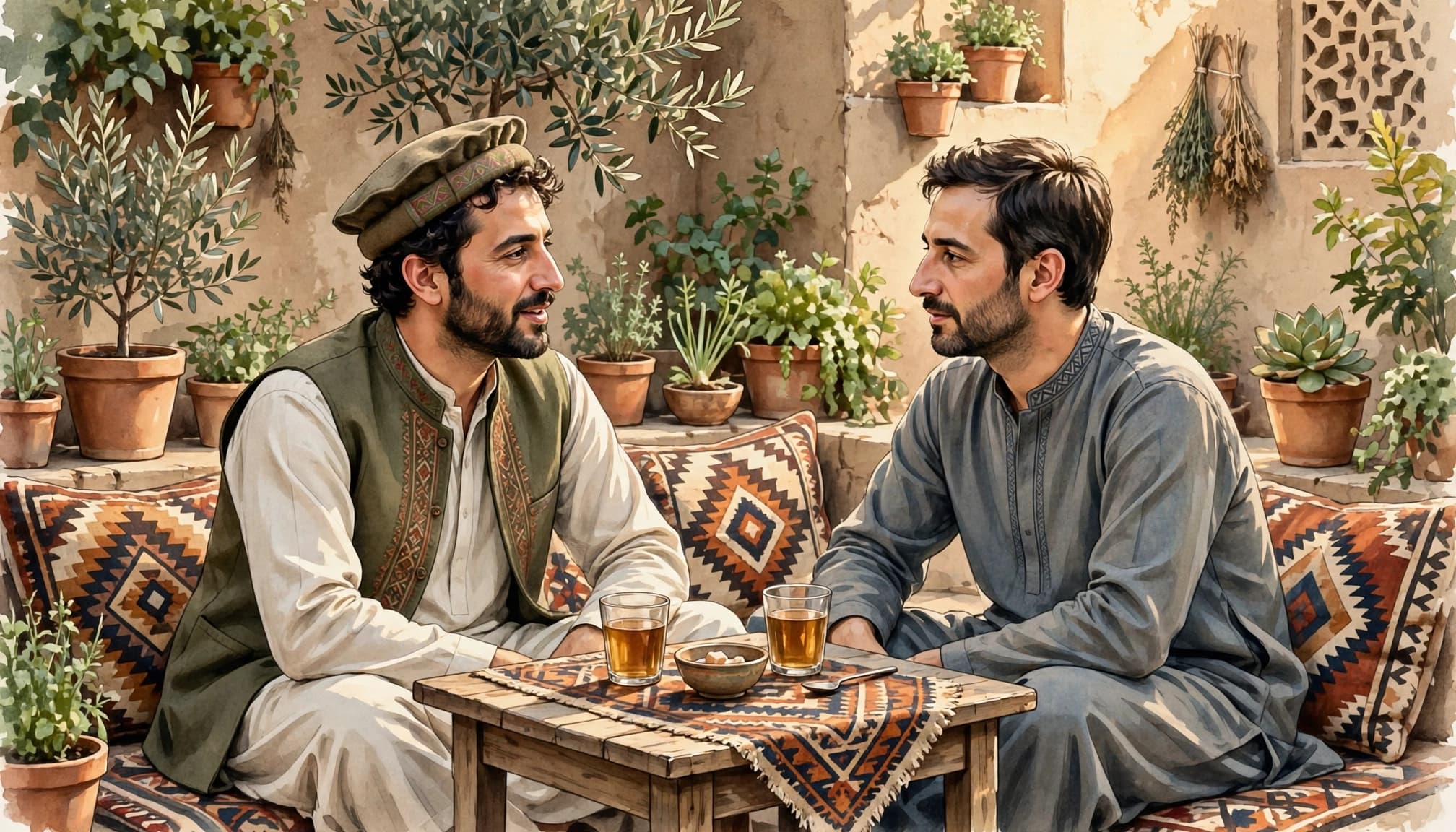
Speaking practice works best when it grows out of language you’ve studied. Bring a clear task instead of hoping conversation will happen.
Use a partner for replies and correction
A tutor, friend, or exchange partner can help you practise introductions, family updates, and everyday requests. Begin with a familiar exchange, then let the other person change a detail.
Our guide to language exchange apps for speaking compares tools for finding regular practice partners. The app provides a meeting place; your shared routine determines the practice.
Ask your partner to correct one recurring problem at a time. After correction, repeat the whole sentence and use it again later in the session.
Give heritage learners a different starting point
If you understand family conversations but struggle to answer, your priority is spoken retrieval. More beginner recognition exercises may repeat what you already know.
Choose a familiar topic and give a short spoken account without notes. Then use the words you couldn’t retrieve as your next review material.
If reading is the main gap, work with familiar spoken sentences in written form. This lets your existing vocabulary support script learning, rather than forcing you to relearn every word.
Build a 25-Minute Pashto Study Routine
Keep the setup small: one main course, one script supplement, and a reference tool when needed. Give each part of the session a clear purpose.
- Spend five minutes recognizing and writing words from your current lesson. Cover the model before writing, then compare your attempt.
- Use ten minutes for a short dialogue. Listen without text, read to resolve uncertainty, and replay difficult lines.
- Review for five minutes without romanization where possible. Recall whole phrases, rather than only matching words with translations.
- Finish with five minutes of spoken answers. Reply before the recording supplies the response, then change one familiar detail.
Anki can hold a small collection of useful sentences and recordings. Our AnkiMobile and AnkiDroid comparison explains the mobile options.
Keep review tied to current lessons. A growing pile of unrelated vocabulary adds work without necessarily helping your next conversation.
Once a week, replace some solo practice with a live exchange. Bring one recording or written passage that caused difficulty, so correction targets an actual gap.
Frequently Asked Questions
Can I learn Pashto conversation without learning the script?
You can begin with listening and spoken phrases. However, script study gives you access to written lessons and helps you review language beyond romanized prompts.
For travel-focused learning, give speaking more time initially. Still, attach a little reading practice to familiar audio instead of postponing script indefinitely.
Can these resources make me conversational?
They can build vocabulary, listening comprehension, and rehearsed responses. Conversation also requires understanding unexpected replies and producing sentences without a supplied answer.
Combine your main course with regular speaking and correction. Measure progress through practical tasks, such as understanding a familiar request and answering without notes, rather than lessons completed.
Choose Resources You Can Use in Conversation
The strongest Pashto learning resources give each skill a place: structured lessons for new material, script practice for reading, and audio for listening. Spoken recall connects that study with communication.
Choose a regional pronunciation model, keep your resource stack small, and revisit useful exchanges. A phrase becomes practical knowledge when you can recognize it, understand it in speech, and use it in your own reply.
Ready to Take Your Language Learning Further?
Your favorite language-learning app is a great place to start. Rocket Languages can help you go further with interactive audio lessons, pronunciation practice, real-world conversations, and structured learning.
Explore Rocket Languages →Affiliate disclosure: We may earn a commission if you purchase through this link, at no additional cost to you.