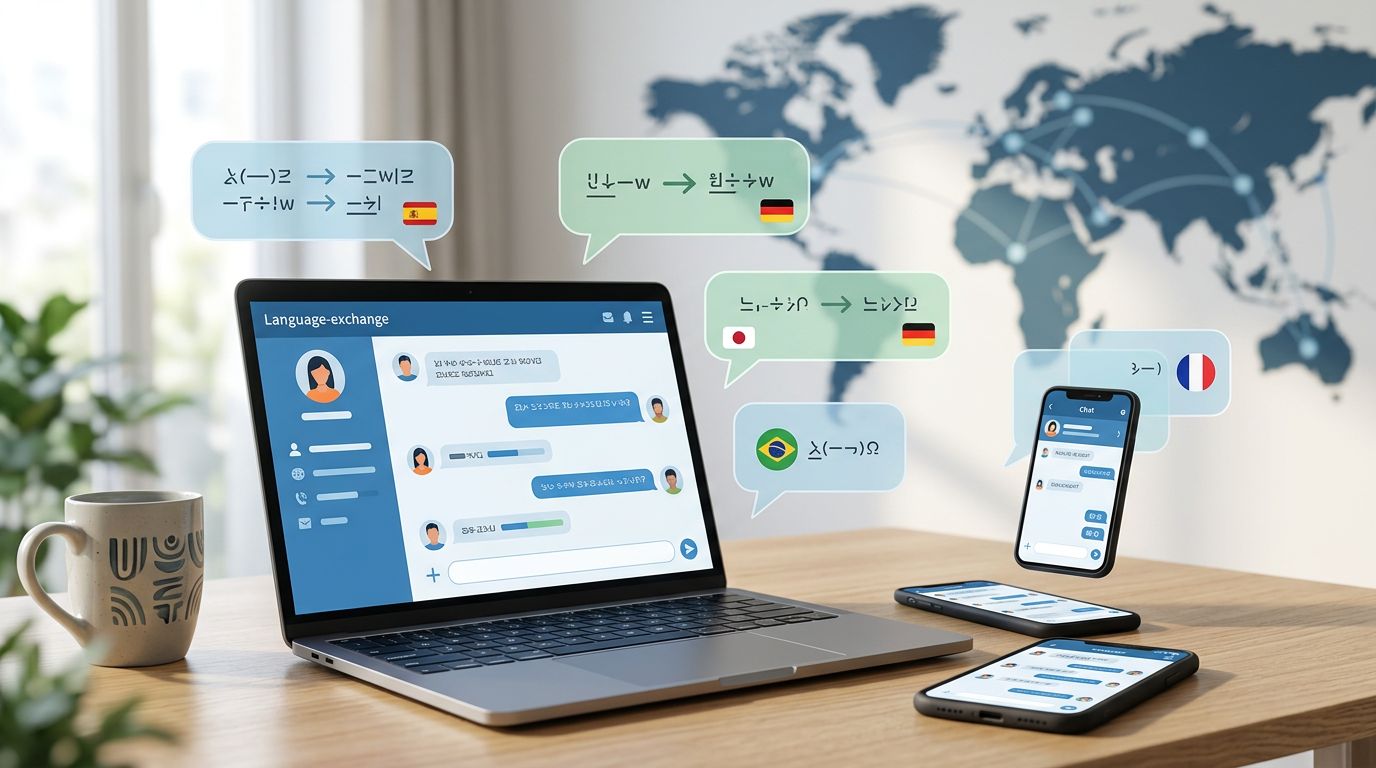
Serious language learners do not need more random chats. They need partners who reply, correct mistakes, and keep showing up.
The best language exchange apps in 2026 help you build speaking time without turning practice into a scroll session. Some apps are better for quick conversations. Others are better for long-term study and accountability.
If you want real progress, the app has to match your habits, not just your curiosity. The sections below separate the useful tools from the noisy ones.
A quick comparison of the strongest options
The table below gives the short version. It focuses on conversation quality, correction tools, and how well each app supports steady practice.
| App | Best for | Speaking | Writing corrections | Long-term consistency | Pricing note |
|---|---|---|---|---|---|
| Tandem | Serious long-term partners | Strong | Good | Strong | Free core, paid extras in some markets |
| HelloTalk | High-volume practice | Strong | Strong | Medium-strong | Free core, paid tier |
| The Mixxer | Low-noise study partners | Good | Fair | Strong | Free |
| Speaky | Quick partner matching | Good | Fair | Medium | Usually free or low-cost |
| Lingbe | Live speaking on demand | Very strong | Limited | Medium | Pricing can vary by plan |
| Preply | Guided speaking and correction | Very strong | Good | Very strong | Paid lessons, no flat exchange price |
Tandem and HelloTalk are the best all-around picks for most serious learners. The Mixxer and Preply are better when you want fewer distractions and more focus. Speaky and Lingbe help you get talking fast, but they work best when you already know how to study on your own.
If you want a deeper look at the paid tutoring path, the Preply platform review covers that option in more detail.
What serious learners should expect in 2026
A good exchange app does three jobs. It finds people who want the same language, it makes correction easy, and it keeps the relationship alive after the first conversation.
What good is a huge user base if nobody corrects your mistakes? That is the main trap. Many apps have plenty of profiles, but few of those profiles are ready for serious practice. You want someone who replies, stays on topic, and comes back next week.
Voice notes matter because they let you speak without scheduling a call. Video helps when you want pressure close to a real conversation. Writing corrections matter too, because they turn vague praise into visible progress.
For daily momentum, it also helps to pair exchange with a habit app or a course app. If you need that layer, Duolingo 2026 review covers the routine side, while Babbel pros and cons is useful if you want more structure alongside live practice.

Safety and filtering also matter. Look for apps that let you search by language, interests, and availability. A clear profile usually saves time. If someone only wants a one-off chat, move on.
A serious learner should think in terms of repeat contact, not endless browsing. One useful partner who corrects you is better than twenty silent matches.
Best language exchange apps for serious learners
Tandem
Tandem is the strongest all-around choice for learners who want one or two reliable partners. Its search tools make it easier to find people by language, location, interests, and practice style. On Tandem’s official platform, you can move from text to voice notes, audio calls, or video chats without much friction.
That flexibility matters because progress often starts in text and ends in speaking. Tandem handles both well. It also works for learners who want a long-term routine instead of a one-time chat.
The downside is that the user base is large, which means quality varies. You will still run into casual users, flaky replies, and people who vanish after two messages. The free version covers the basics, while paid extras mainly help with reach and convenience. Speaking use is strong, writing corrections are good, and consistency is strong when you settle into a routine. Tandem’s own 2026 app guide takes a similar view, and that lines up with how many serious learners use it.
HelloTalk
HelloTalk is best for learners who want a busy community and a lot of built-in feedback. Its official download page highlights text chat, voice messages, video, voice rooms, live sessions, and correction tools. That mix gives you many ways to practice in one place.
The app works well when you want lots of chances to talk and correct. It can also help you find active users quickly, which is useful if your target language is less common in your area.
The weakness is focus. HelloTalk can feel a bit like social media, so it is easy to drift into browsing instead of studying. The free version is useful, and paid features open more options. Speaking use is strong, writing corrections are strong, and consistency is medium to strong. It works best if you treat the feed as a tool, not a hangout.
The Mixxer
The Mixxer is one of the best picks for learners who want less noise. It feels more like a study space than a social app. That makes it useful for people who already know what they want to practice and do not need a flashy interface to stay engaged.
Its strength is the serious tone. The platform pushes you toward focused exchanges, which can make it easier to find people who want real language work instead of casual small talk. That matters if your main goal is steady improvement.
The tradeoff is polish. You do not get the same depth of features or the same modern feel as Tandem or HelloTalk. Still, the simplicity helps many learners stay on task. Pricing is a plus, because it is free. Speaking use is good, writing corrections are fair, and consistency is strong if you build a regular routine. Preply’s language exchange app roundup places The Mixxer on the more serious side of the spectrum, which matches the way many learners use it.
Speaky
Speaky is the clean answer if you want fast partner matching without extra features. It is best for learners who want direct exchanges and do not want to spend a lot of time learning the app first. If your main goal is to start conversations quickly, Speaky does that job well.
That speed comes with limits. Compared with Tandem or HelloTalk, you may see fewer correction tools and less structure around your practice. The app is useful, but it asks more from your own discipline.
Pricing is generally light, since the platform is known for being simple and accessible. Speaking use is good, writing corrections are fair, and consistency is medium. Speaky is a solid backup when your main app gets quiet or when you want a fast way to meet new partners.
Lingbe
Lingbe is built for people who want to speak now, not later. That makes it useful if hesitation is your biggest problem. Instead of long text exchanges, it pushes you toward live conversation more quickly.
That live-first design can be a strength. It gives you pressure, spontaneity, and a chance to react in real time. For many learners, that is exactly the part that is missing from their study routine.
The drawback is uneven depth. Partner quality can vary, and you may not get the same level of correction or follow-up that you find in a more study-focused community. Pricing can vary by plan and usage, so it is smart to check the current terms before you rely on it. Speaking use is very strong, writing corrections are limited, and consistency is medium. It works best as a speaking drill, not a full study base.
Preply
Preply is not a pure exchange app, but serious learners should keep it in the conversation. If you want accountability, correction, and guided speaking time, paid lessons often beat open chat. For a closer look at how it fits into a study plan, see the Preply platform review.
What makes Preply different is the teacher layer. You are not hoping a random partner notices your mistakes. You are paying someone to notice them. That raises the cost, but it also raises the quality of feedback.
Speaking use is very strong, and writing corrections are good when a tutor gives notes. Consistency is also very strong because scheduled lessons create a clear reason to show up. The downside is simple, it costs more, and it is not an equal-swap exchange in the usual sense. Even so, if measurable progress matters most, it deserves a place on this list.
How to turn an exchange app into steady progress
The app matters less than the system you build around it. Without a plan, even the best platform turns into a pile of half-finished chats.
Start with one clear goal for the month. One month can focus on travel talk, another on work vocabulary, and another on listening speed. That gives every conversation a purpose.
Then keep your partner list small. Two active partners are often enough. More than that, and it becomes easy to lose track of who is helping you, who is replying, and who is only collecting contacts.
A simple message also helps. Say what language you speak, what language you want, and how often you want to practice. Most people appreciate clarity.
Use a repeatable routine:
- Choose one main topic for each week.
- Mix text, voice notes, and live calls.
- Ask for corrections in one clear area.
- Save useful phrases in a notebook or app.
- Review your mistakes before the next session.
A reliable partner beats a perfect app.
That line matters because consistency creates progress. A ten-minute exchange every few days often beats a long burst of random activity. You do not need endless variety. You need repeat contact, useful correction, and enough structure to keep going.
The best learners also close the loop after each chat. They write down a few new phrases, one grammar point, and one thing they said well. That tiny review step makes the next conversation easier.
Which app fits which learner
If you want the strongest all-around community, Tandem is the safest place to start. It suits learners who want flexibility and a steady partner search. HelloTalk is better when you want more activity and more built-in feedback.
If you prefer fewer distractions, The Mixxer is a better fit. It suits learners who already know their goals and want a cleaner space for practice. Speaky sits in the same practical zone, but with faster matching and less depth.
Lingbe makes sense when speaking confidence is the main problem. It helps when you need more live pressure and less text chat. Preply is the right choice when you want guided correction, scheduled accountability, and faster progress that you can actually measure.
For casual chatting, Tandem and HelloTalk are the easiest on-ramp. For disciplined practice, The Mixxer and Preply are stronger. Speaky and Lingbe sit between those two worlds, which makes them useful in specific situations, but less complete as a full study plan.
The best app is the one that matches your patience. If you want structure, choose structure. If you want volume, choose volume. If you want both, keep your expectations clear and your goals narrow.
Conclusion
Serious learners in 2026 do not need the app with the loudest community. They need the one that gets them corrected, heard, and back in the conversation next week.
Tandem is the best all-around pick. HelloTalk gives you the most activity. The Mixxer and Preply are better when focus matters more than reach. Speaky and Lingbe are useful when speed or live speaking is the priority.
The right choice comes down to your habits, your budget, and how much structure you need. If an app helps you speak, fixes mistakes, and keeps you coming back, it has done its job.
Ready to Take Your Language Learning Further?
Your favorite language-learning app is a great place to start. Rocket Languages can help you go further with interactive audio lessons, pronunciation practice, real-world conversations, and structured learning.
Explore Rocket Languages →Affiliate disclosure: We may earn a commission if you purchase through this link, at no additional cost to you.