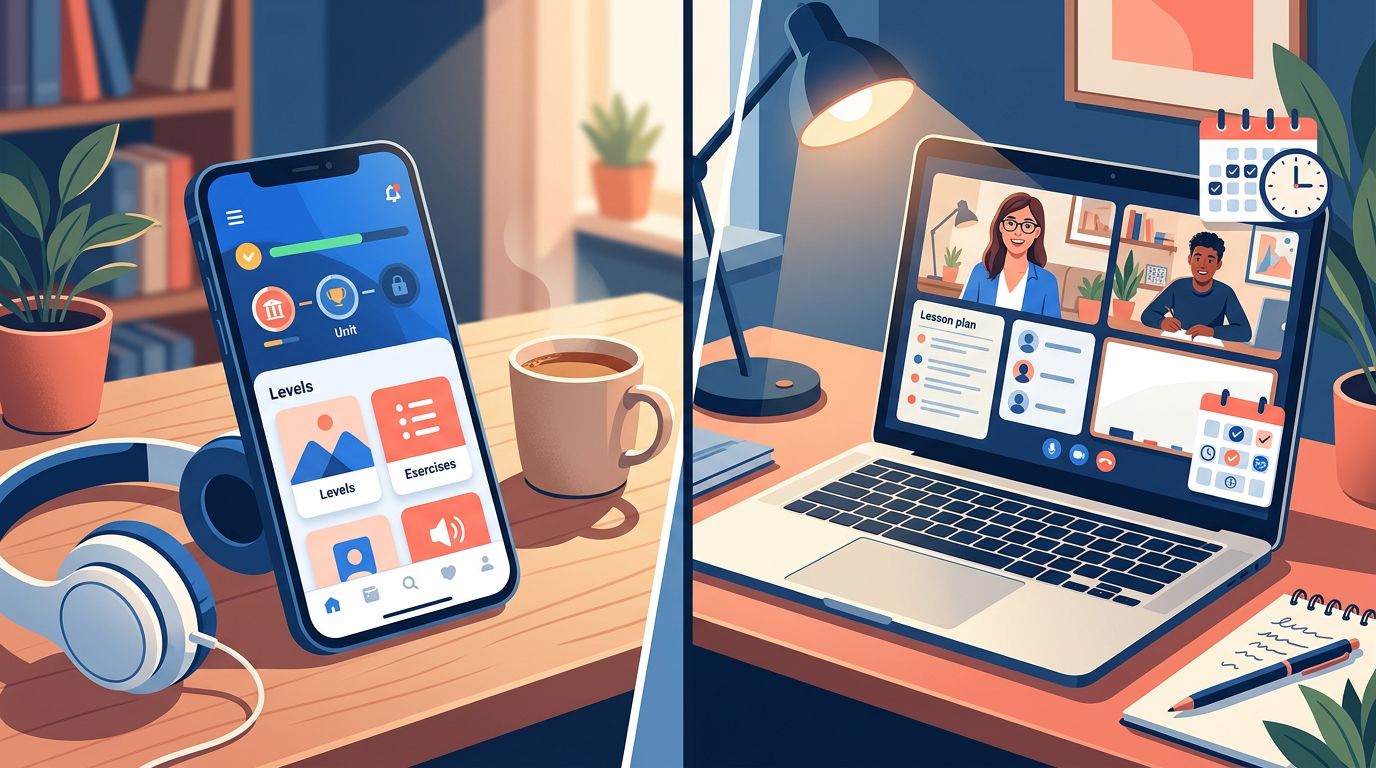
A language plan only works when it fits the way you actually live. If you study in short gaps between meetings, a live class at 7 p.m. may become a burden. If you keep avoiding conversation, another app streak won’t solve that problem.
The Busuu vs Lingoda decision comes down to format first. Busuu is primarily self-paced, app-based learning. Lingoda centers on scheduled live online group and private classes with teachers.
Both can support serious progress, but they ask different things of your calendar, attention, and budget. Start by choosing the learning routine you can repeat.
Busuu vs Lingoda: The Core Difference
Busuu gives you a course path you can open whenever you have time. Lessons combine vocabulary, grammar, listening, reading, and short speaking or writing activities. You move at your own pace, repeat difficult units, and fit study into 10 or 20 minutes.
Lingoda works more like an online language school. You book a class, join at a set time, and participate with a teacher and, in group sessions, other learners. The lesson keeps moving even when you feel unprepared, which creates useful pressure.
Busuu puts you in control of pace
With Busuu, you decide whether today’s study session lasts five minutes or an hour. That freedom suits commuters, shift workers, parents, and anyone whose week changes often.
The trade-off is simple: you must create your own routine. Skipping a day doesn’t affect anyone else, so consistency depends on your habits. The Busuu review for serious language learners explains where its course structure and review tools are strongest.
Busuu also has a free basic version, while Premium unlocks more lessons and features. Its official Premium information is the best place to check current plan details before subscribing.
Lingoda gives your week fixed appointments
A Lingoda class has a start time, a teacher, and a lesson topic. You need to listen, answer questions, and respond in real time. For learners who delay study until “later,” that appointment can make practice more regular.
However, fixed classes require more planning. Missing a booked class can feel costly, especially when your schedule is crowded. Lingoda describes its model as live online classes with certified teachers, rather than a self-study app with occasional live extras.
A self-paced course helps when time is unpredictable. A scheduled class helps when motivation is unpredictable.
How Their Course Structure Feels Day to Day
Both platforms use structured language levels, but the experience of moving through those levels differs. Busuu feels like a guided independent course. Lingoda feels like a school curriculum delivered lesson by lesson.
Neither format automatically creates fluency. Progress still requires repeated exposure, active recall, listening outside lessons, and regular use of the language.
Busuu is built for short, repeatable lessons
Busuu courses organize learning around practical themes and grammar points. You may work through introductions, travel, food, work, or daily routines while building the language needed for each topic.
That approach works well for beginners who want direction without arranging lessons. It also suits returning learners who need to repair gaps in basic grammar. Busuu says Premium includes lessons across its available levels and languages, but course depth can vary by language.
The strongest path is usually to complete lessons in order, then revisit weak units rather than racing through new content. An app can show that you finished an exercise. It can’t always show that you can retrieve the phrase during a conversation.
Lingoda follows a teacher-led syllabus
Lingoda uses the Common European Framework of Reference for Languages, or CEFR, with levels from A1 through C1 shown on its language-school overview. Classes follow prepared materials, so you don’t need to decide what grammar topic comes next.
This is helpful when you want a visible syllabus and someone else to keep the session focused. Teachers can clarify a point when confusion appears, while classmates may expose you to different accents and answers.
Still, group lessons can’t pause for every individual weakness. If you need extra work on verb forms or pronunciation, you may need to review the lesson materials afterward and bring questions to your next class.
Speaking Practice and Accountability
Speaking is the widest practical gap between these options. Busuu includes output activities and community-based feedback. Lingoda gives you live conversation practice as the central part of the service.
Your current confidence level matters here. A shy beginner may prefer rehearsing alone first. An intermediate learner who understands plenty but freezes aloud may gain more from regular live sessions.
Busuu offers lower-pressure output
Busuu can ask you to record a response or write a short answer. Other users may correct submissions, which adds human input beyond automated exercises. That can be useful for spotting an unnatural phrase or a basic grammar error.
Yet community feedback isn’t the same as a conversation. You can re-record an answer until it feels comfortable, and there is no need to react instantly to a follow-up question.
For pronunciation, build a separate practice loop. Listen to a model sentence, record your own version, notice one problem sound, and repeat it the next day. This pronunciation coaching review offers a useful companion option for learners who need focused spoken feedback.
Lingoda requires real-time responses
In a live Lingoda session, you can’t rely on multiple-choice recognition. You need to understand the teacher’s prompt, form an answer, and speak before the topic changes. That creates practice many independent learners don’t get enough of.
Private lessons provide more speaking time and targeted correction. Group classes cost less per session and add peer interaction, but your individual talking time is naturally shared.
Live instruction also doesn’t mean every minute is speaking. Some classes include reading, grammar explanation, and group exercises. Attend consistently, prepare the vocabulary in advance, and write down corrections afterward to get more value from each session.
Cost, Plans, and the Time You Can Commit
Busuu usually costs less because software can serve learners without reserving a teacher’s time. Lingoda costs more because each class includes a live instructor and scheduled teaching.
Exact prices, discounts, available plans, and billing terms can change by country and promotion. Check the official checkout pages before paying, rather than relying on a price quoted in an old review.
Busuu is the lower-cost structured option
Busuu lets you start with its free version, which makes it easier to test the lesson style before committing. A paid plan is usually most sensible when you will study often enough to use the extra content and tools.
Annual plans commonly lower the monthly equivalent, but only pay upfront if you already know you enjoy the course. A cheap subscription you stop opening after two weeks is still poor value.
Busuu’s terms state that Premium purchases have a 14-day cancellation and refund window in eligible circumstances. Trial offers may also have their own billing date, so read the terms shown at purchase.
Lingoda asks for a larger financial commitment
Lingoda’s current offer includes a seven-day trial with three group classes or one private class. It is a practical test because you experience the real scheduling, teacher interaction, and class pace before the first monthly charge.
Group classes are the more budget-conscious route. Private classes cost more, but they may be worthwhile for a job interview, relocation, exam preparation, or a learner who needs frequent correction.
Monthly-plan cancellation rules also matter. Lingoda states that some class credits can be returned when you cancel far enough ahead, while late cancellations may not qualify. Treat each credit like a booked appointment, not a video you can watch later.
Choosing for Your Schedule and Learning Style
The best platform is the one that removes your biggest obstacle. Don’t choose Lingoda because live teaching sounds more serious if you can’t reliably attend. Don’t choose Busuu because it is flexible if flexibility usually becomes procrastination.
Use this comparison as a practical starting point.
| Your main need | Better first choice | Why |
|---|---|---|
| Low monthly cost and daily study | Busuu | You can study independently in short sessions. |
| Regular conversation practice | Lingoda | Live classes require listening and spoken responses. |
| An unpredictable work schedule | Busuu | Lessons are available whenever you have time. |
| External accountability | Lingoda | Booked classes create a defined study commitment. |
| Grammar review at your own speed | Busuu | You can repeat units without holding up a class. |
| Personal correction for a specific goal | Lingoda private classes | The teacher can focus on your needs. |
The table points to fit, not a promise of results. A dedicated Busuu learner can progress faster than someone who repeatedly misses Lingoda classes. Likewise, a learner who attends two prepared Lingoda sessions every week may speak more confidently than someone who only taps through app exercises.
A useful test before you buy
First, list the hours you can protect each week. Then choose a format that uses those hours realistically. A busy professional with 15 minutes most mornings may get more consistent practice from Busuu. Someone free on two evenings may benefit more from recurring live classes.
Next, identify the skill you avoid. If you avoid speaking because it feels uncomfortable, Lingoda makes avoidance harder. If you avoid studying because you lack a clear starting point, Busuu gives you an immediate lesson path.
Finally, test the experience before committing. Use Busuu’s free access for several days. Take Lingoda’s trial classes at the times you would normally study, not during an unusually quiet week.
Pros, Cons, and a Concise Verdict
Busuu and Lingoda can complement each other, but most learners should start with one primary platform. Splitting money and attention too early often produces scattered study rather than stronger results.
Busuu is a better fit when you want:
- A lower-cost, self-paced course you can use daily.
- Short lessons that fit around work, travel, or family commitments.
- Time to repeat grammar and vocabulary without a class moving ahead.
- Low-pressure writing and speaking tasks before live conversation.
Lingoda is a better fit when you want:
- Scheduled teacher-led classes that create accountability.
- Frequent real-time speaking and listening practice.
- A CEFR-aligned curriculum with live explanation.
- Group interaction or private lessons for a focused goal.
Busuu’s main limitation is that independent learners can mistake completed lessons for conversational ability. Lingoda’s main limitation is cost and scheduling pressure. The Lingoda review for live language classes gives a closer look at that trade-off.
For most beginners on a limited budget, Busuu is the sensible starting point. For intermediate learners who already know the basics but need speaking pressure, Lingoda is usually the stronger choice. The official Lingoda and Busuu comparison also reflects their different delivery models, though it comes from Lingoda and should be read with that perspective in mind.
Final Thoughts
The strongest Busuu vs Lingoda choice is the one that matches your real barriers to study. Busuu gives you affordable structure and freedom. Lingoda gives you scheduled instruction and spoken accountability.
Choose Busuu if daily self-study is realistic for you. Choose Lingoda if a live class will make you show up and speak. Consistent practice, not the platform name, determines what you can use outside the lesson.
Ready to Take Your Language Learning Further?
Your favorite language-learning app is a great place to start. Rocket Languages can help you go further with interactive audio lessons, pronunciation practice, real-world conversations, and structured learning.
Explore Rocket Languages →Affiliate disclosure: We may earn a commission if you purchase through this link, at no additional cost to you.