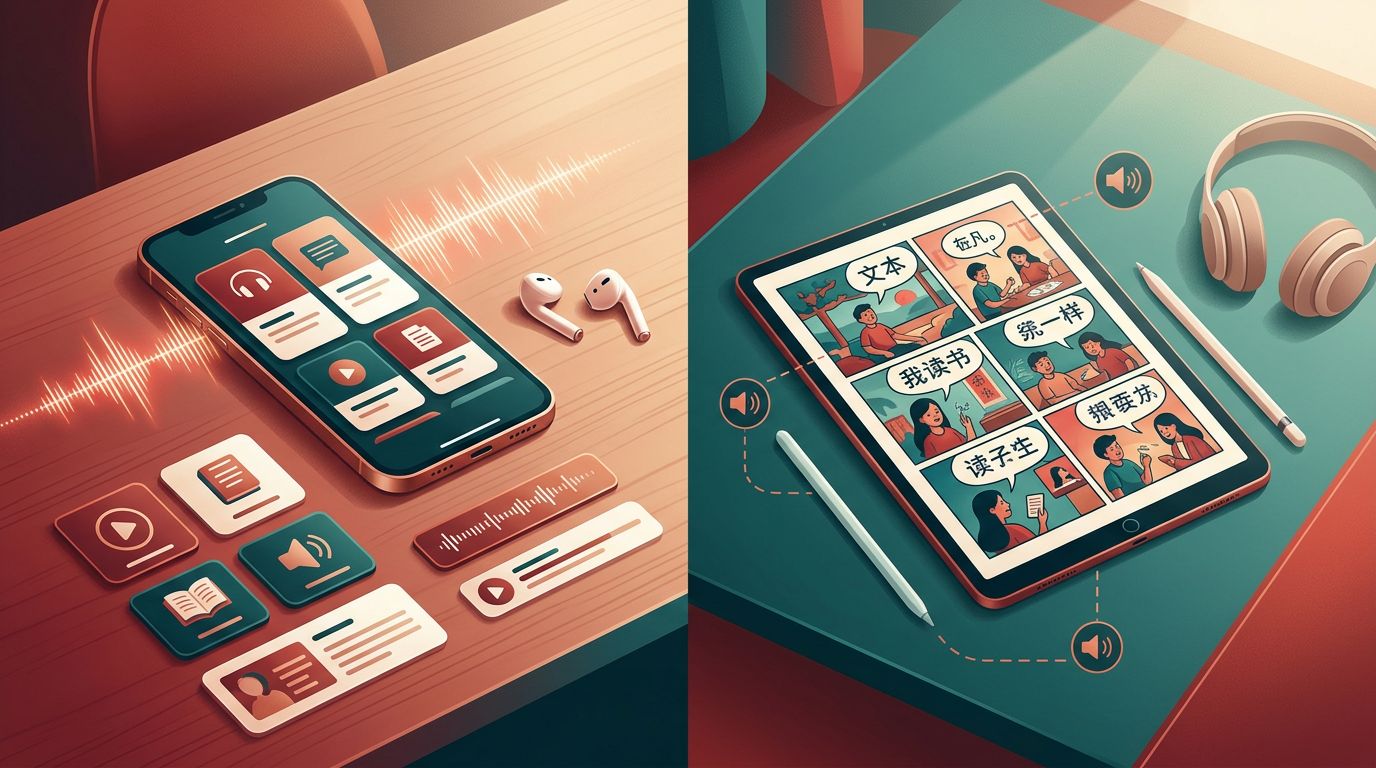
A learner can spend months studying Mandarin and still freeze when a native speaker talks at normal speed. The ChinesePod vs Du Chinese decision matters because the apps train listening through very different routes.
ChinesePod puts structured audio lessons, dialogues, transcripts, and exercises at the center. Du Chinese uses graded stories with synchronized native audio, making it easier to connect spoken Mandarin with words you can already read. The faster choice depends on whether you need raw listening practice or supported comprehension.
Key Takeaways
- ChinesePod is the stronger choice for direct listening training, especially with dialogue-only audio, dictation, and replay exercises.
- Du Chinese can improve comprehension efficiently when you learn best through short stories and written context.
- Du Chinese often builds reading fluency and vocabulary alongside listening, while ChinesePod gives listening a more central role.
- Neither app provides enough speaking correction on its own.
- A consistent 20 to 30 minutes, five days per week matters more than switching between tools.
ChinesePod vs Du Chinese: Two Different Listening Paths
Listening comprehension means understanding spoken Mandarin without depending on subtitles, pinyin, or a translation. Both apps can help, but they reduce difficulty in different ways.
ChinesePod follows a lesson-based format. A typical lesson centers on a dialogue, followed by explanations of vocabulary, grammar, pronunciation, and usage. Learners can study the transcript, listen to the dialogue alone, download audio, and complete exercises such as dictation, sentence ordering, matching, and fill-in-the-blank activities.
Du Chinese is a reading-first app. Its lessons are graded stories with native audio, pinyin, translations, and quick dictionary lookups. The written text gives you a clear path through the audio, which helps when every sentence feels too fast or unfamiliar.
That difference affects the type of progress you notice. ChinesePod is more likely to expose gaps in your ability to identify words from sound alone. Du Chinese may help you understand more content sooner because the story, text, and vocabulary support work together.
| Factor | ChinesePod | Du Chinese |
|---|---|---|
| Main format | Audio and video lessons | Graded stories |
| Listening support | Dialogue replay, transcripts, exercises | Synced audio, pinyin, translations |
| Reading role | Supports the lesson | Central to the experience |
| Vocabulary work | Lesson vocabulary and review tools | Dictionary, flashcards, story repetition |
| Best for | Focused listening practice | Read-and-listen comprehension |
| Speaking practice | Limited, with tutoring options on higher plans | Limited, with no full speaking course |
A useful comparison from DigMandarin’s Chinese app roundup also separates story-based tools from more structured audio courses. That distinction helps clarify why one app may feel easier while the other produces tougher listening tests.
Why ChinesePod May Improve Pure Listening Faster
ChinesePod gives you more ways to remove written support and test your ear. You can listen to a dialogue first, check the transcript afterward, and then repeat difficult lines until the sound becomes familiar.
Its library contains more than 3,700 lessons, with other current reviews reporting over 4,000. The content is arranged across six broad levels: Newbie, Elementary, Pre-Intermediate, Intermediate, Upper-Intermediate, and Advanced. That range makes it easier to keep increasing the difficulty without leaving the same platform.

ChinesePod also has more explicit listening drills than Du Chinese. Dialogue-only playback lets you hear the target exchange without the lesson commentary. Dictation and gap-fill tasks force you to identify sounds rather than recognize familiar characters on a screen.
The “Say It Right” video course adds pronunciation guidance. It won’t replace feedback from a teacher, but it can help you notice tones, initials, finals, and sound distinctions that affect listening accuracy.
ChinesePod’s large lesson archive is useful when you want a narrow topic, such as ordering food, discussing work, making travel plans, or handling a medical appointment. A structured overview from Elite Asia’s Chinese learning guide describes ChinesePod as a program with episodes for beginner through advanced learners.
The main limitation is choice overload. Thousands of lessons can make study feel scattered unless you follow a level or topic path. Some episodes may also feel dated in presentation or vocabulary. You need to select material carefully and revisit it instead of collecting lessons without mastering them.
For direct listening gains, use one ChinesePod dialogue for several days:
- Listen once without the transcript and write the main idea.
- Study the transcript and look up only essential unknown words.
- Replay each line and shadow the speaker.
- Complete the dictation or gap-fill activity.
- Listen again during a walk or commute.
That process trains sound recognition, vocabulary, and pronunciation together.
Why Du Chinese Can Feel Faster for Beginners
Du Chinese reduces the frustration that often blocks listening practice. Each story has a controlled difficulty level, and the text stays synchronized with the audio. You can tap unfamiliar words, check pinyin or translations, and return to the sentence without opening another app.
The library includes more than 3,000 stories according to current 2026 review coverage, with new material added regularly. Stories are organized by difficulty and include both Simplified and Traditional Chinese options. The short format also suits learners who struggle to maintain attention during long lessons.
Du Chinese is especially useful when you recognize written words but can’t hear them in speech. Seeing a word while listening helps connect its character form, pronunciation, meaning, and position in a sentence. Over time, that connection can make familiar vocabulary easier to catch in new audio.
Paid features may include offline study, audiobook mode, study goals, spaced-repetition flashcards, and progress tracking. The app also supports integrations with tools such as Pleco, Skritter, and Hack Chinese, depending on the current plan and platform.
The tradeoff is important. If you always read along, your reading-supported comprehension may improve faster than your independent listening. You may understand a story perfectly with text visible, then lose most of it when the transcript disappears.
If text stays visible during every replay, Du Chinese may measure reading comfort more than raw listening.
To make Du Chinese a stronger listening tool, change the order of study. Start with the audio, then read the story, and finish with audio-only replay. Hide pinyin whenever possible. Afterward, give a short spoken summary in English or Mandarin.
The app’s story focus also gives vocabulary a strong context. You may remember a word because it appeared in a news item, conversation, or recurring character’s situation. However, Du Chinese offers less direct grammar teaching and fewer listening-specific drills than ChinesePod.
Which App Fits Your Level and Weekly Routine?
The better tool depends on the kind of difficulty you need to practice. Beginners often benefit from Du Chinese because the written support prevents every listening session from becoming a guessing exercise. Lower-intermediate learners may prefer it for building speed with short, manageable stories.
ChinesePod becomes more attractive when you can handle basic sentence patterns and need tougher audio work. Its dialogue analysis helps you understand why a sentence sounds the way it does, while its replay and dictation tools expose weak points.
Use this simple decision guide:
- Choose ChinesePod if you want dialogue-based lessons, audio-only practice, grammar explanations, and varied everyday topics.
- Choose Du Chinese if you prefer short stories, built-in definitions, reading support, and a low-friction daily routine.
- Use both if you want ChinesePod for focused listening and Du Chinese for extensive read-and-listen exposure.
A fair test requires the same study schedule. Spend 20 to 30 minutes per session, five days each week, for four weeks. Don’t judge either app after a few casual sessions.
With ChinesePod, spend about half your time listening without text. Use the rest for transcript study, exercises, and repeated playback. With Du Chinese, listen without reading first, then read for meaning, and finish with another audio-only pass.
Track progress with a short recording at the start and end of the month. Write down how much you understand without help. Measure the main idea, key details, and number of missed words. This gives you better evidence than judging an app by how comfortable a lesson feels.
Pricing also affects the choice. ChinesePod plans are commonly reported around $14 per month for Basic and $29 per month for Premium, with annual prices often listed near $124 and $249. A higher Premium+ tier may include one-on-one tutoring and can cost roughly $99 to $299 per month.
Du Chinese is commonly listed at about $14.99 per month. Six-month, annual, and lifetime prices have appeared at different amounts across current listings. Plans, promotions, taxes, and regional pricing can change, so check the final price inside the app or on the official checkout page.
For a wider comparison with other tools, LanguaVibe’s guide to the best Chinese learning apps places ChinesePod among listening-focused options and Du Chinese among stronger intermediate reading tools.
The Clearer Choice for Faster Listening Progress
If the question is pure listening speed, ChinesePod has the advantage. It gives you more structured ways to hear dialogue without text, repeat individual lines, complete dictation, and move through progressively harder audio.
Du Chinese may produce faster early gains for learners who need context. Its stories make spoken Mandarin less intimidating, and the combination of text, audio, and dictionary support can build a strong base. Those gains include reading fluency and vocabulary, not listening alone.
Speaking requires separate practice in both cases. Shadowing helps, but it doesn’t tell you whether your tones and word choices work in conversation. Add tutoring, a language exchange, or recorded speaking feedback if oral communication is part of your goal. ChinesePod’s tutoring tier may help, while Du Chinese should be treated mainly as an input tool.
Conclusion
The ChinesePod vs Du Chinese choice comes down to the type of listening you need. ChinesePod is the better primary tool for testing your ear and practicing dialogue without written help. Du Chinese is the better fit for supported comprehension through graded stories.
Choose one app, set a repeatable weekly schedule, and measure audio-only understanding after four weeks. The learner who listens actively and revisits material will usually progress faster than the learner who changes apps every few days.
Ready to Take Your Language Learning Further?
Your favorite language-learning app is a great place to start. Rocket Languages can help you go further with interactive audio lessons, pronunciation practice, real-world conversations, and structured learning.
Explore Rocket Languages →Affiliate disclosure: We may earn a commission if you purchase through this link, at no additional cost to you.