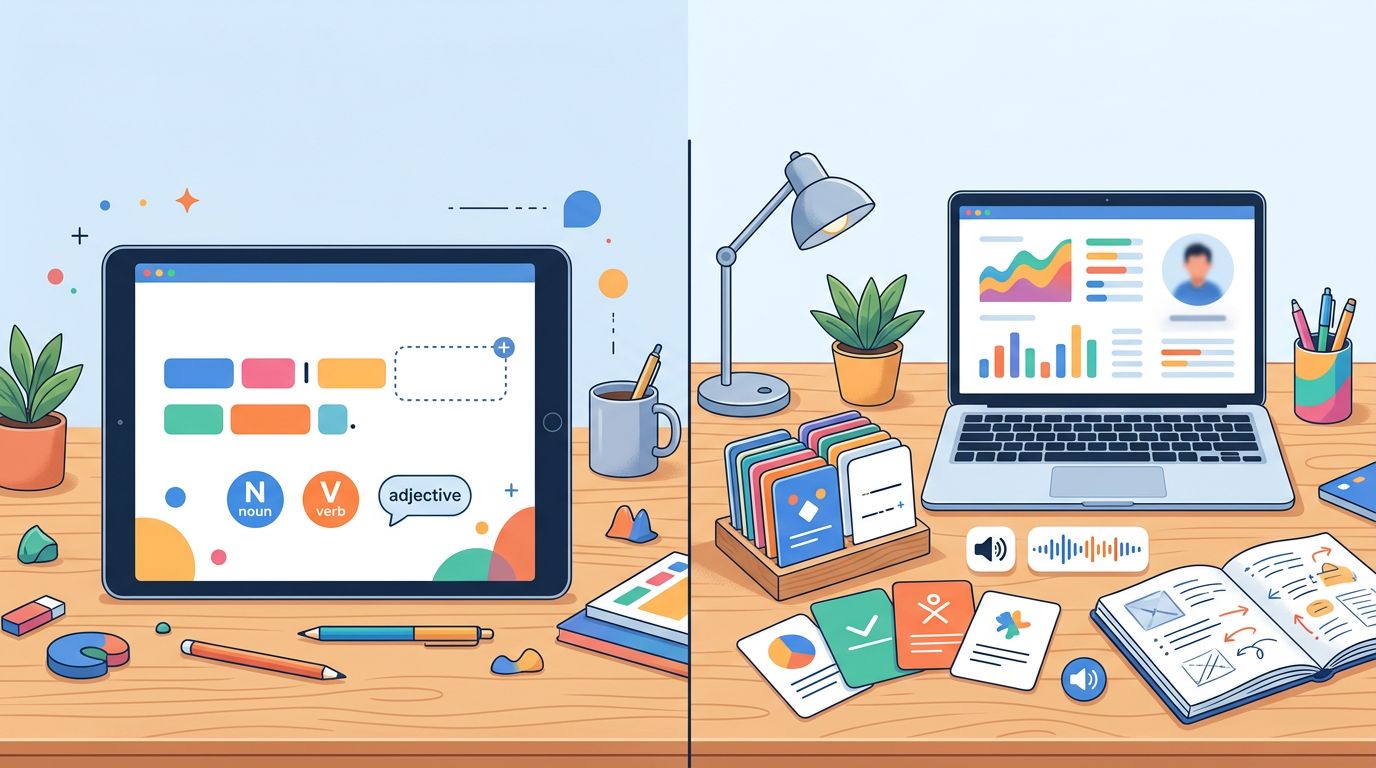
Recognizing a word in a list is easy. Retrieving it inside a sentence, while meaning and grammar compete for attention, is a harder test.
In Clozemaster vs Anki, the real choice isn’t about which app holds more vocabulary. It is about whether you want ready-made sentence practice or flashcards built around your own materials. Both can strengthen recall, yet results depend on content quality and a review habit you can sustain.
The difference becomes clearer when you separate context supplied by an app from context you create yourself.
Clozemaster vs Anki: The Core Difference
Both tools use active recall and spaced review. However, they give that recall a different shape.
Clozemaster presents a sentence with a missing word or phrase. You retrieve the answer inside a small piece of language that already has grammar, word order, and a communicative setting. Anki is a flashcard system. It can test a single word, a full sentence, audio, an image, or a cloze deletion, depending on the cards you use.
| Question | Clozemaster | Anki |
|---|---|---|
| Main study unit | A ready-made sentence with a missing word or phrase | A card you create, edit, or import |
| Context | Included in most prompts | Present only if the card creator adds it |
| Content source | Language-pair sentence libraries | Your own cards or shared decks |
| Main strength | Fast practice with varied sentence exposure | Precise control over what and how you review |
| Main tradeoff | Less control over sentence selection and wording | More time spent building and maintaining cards |
Clozemaster makes it easy to start. Anki makes it possible to build exactly the study system you need. That distinction affects the time you spend before studying, the quality of each prompt, and the type of progress you can expect.
How Each App Uses Context
Context helps learners connect a word to its usual neighbors. A word learned beside common verbs, prepositions, and sentence patterns becomes easier to recognize later in reading and listening.
Clozemaster puts vocabulary in a sentence
Clozemaster’s catalog centers on thousands of fill-in-the-blank sentences across more than 50 languages, according to its official language-learning catalog. When the prompt is useful, you review more than a translation. You also see where the word sits in the sentence.
For example, a learner may meet a French verb with its required preposition or see a German noun in a familiar case pattern. Repeated encounters can build a feel for collocations and word order. This is why Clozemaster often works best after learners can already understand basic sentence structures.
Still, a sentence is only helpful when you can mostly understand it. If a prompt contains several unknown words, guessing the blank can feel like a puzzle rather than language practice. A detailed Clozemaster review helps put its strengths in context, including where it fits after beginner lessons.
Anki lets you create useful context
Anki does not provide context automatically. A front-and-back card such as “to go -> aller” tests a translation, yet it does little for sentence use. You decide whether the card tests a word alone, a phrase, a spoken prompt, or a sentence with one blank.
A stronger card might show “Je ___ au travail a huit heures” on the front and “vais” on the back, with the full sentence and audio. That card tests a target word while preserving the surrounding grammar. You can also make cards from a teacher’s correction, a graded reader, a podcast transcript, or a conversation you want to remember.
The Anki flashcard review explains why sentence cards, audio cards, and cloze deletions often work better for language learners than isolated translation pairs.
A correct cloze answer can come from lucky guessing. Keep a sentence in long-term review only when you understand the whole sentence and know why the answer fits.
Features, Platforms, and Pricing in 2026
As of August 2026, both apps run on web and mobile devices. Their payment models differ sharply, which matters if you study across an iPhone, Android tablet, and computer.
Clozemaster offers a freemium sentence system
Clozemaster is available in a browser and through mobile apps. Its iOS app listing confirms iPhone and iPad availability, while Android users can also study through the official app.
Free access lets you try the core sentence-based approach. Clozemaster Pro adds features such as unlimited sentence access, more statistics, sentence favoriting, custom game settings, and listening-focused practice. The Clozemaster Pro plan uses recurring billing and allows cancellation through account settings.
The U.S. App Store listed Pro at $12.99 per month or $79.99 per year in August 2026. Prices can differ by storefront, currency, and tax. Annual plans include a 30-day money-back guarantee, while monthly plans have different refund terms.
Anki is free almost everywhere except iOS
Anki’s desktop program is free for Windows, macOS, and Linux. AnkiWeb is also free and handles syncing between devices. The official Anki download page lists AnkiDroid as the free Android option and AnkiMobile as the official iPhone and iPad app.
AnkiMobile costs $24.99 in the U.S. as a one-time purchase, rather than a subscription. The paid iOS app helps fund development of Anki’s free desktop, web, and Android ecosystem.
For learners who only use a laptop or Android phone, Anki has almost no direct financial barrier. iPhone users should factor in the upfront app cost, although it may still cost less than a recurring subscription over time.
The Less Obvious Cost Is Study Maintenance
Subscription prices are easy to compare. The time needed to prepare and review material is often more important.
Clozemaster starts quickly
Choose a language pair, select a collection, and begin completing sentences. That low setup burden is useful when you want a daily vocabulary habit without researching decks or writing cards.
However, quick access does not remove the need for judgment. Skip sentences that seem unnatural, too easy, or too difficult for your current level. Check unfamiliar grammar before marking an answer as learned. The app provides repetition, but it cannot explain every construction.
Anki requires ongoing card decisions
Anki rewards careful card design. You choose the language direction, prompt type, audio, images, notes, tags, and scheduling settings. That flexibility suits independent learners, but it can turn into a time sink.
Public decks can offer a starting point, yet their quality varies. Some contain vague translations, duplicate notes, missing audio, or prompts that test the wrong thing. Cards made from your own reading and listening are often more memorable because they already connect to a real moment of learning.
Keep the daily workload realistic. If reviews pile up, reduce new cards before increasing study time. A smaller deck reviewed consistently beats a huge collection you avoid opening.
Which Learner Fits Each App Best?
No universal winner exists in Clozemaster vs Anki. The better choice depends on your current level, your tolerance for setup, and the source of the vocabulary you want to retain.
Clozemaster suits post-beginner learners
Clozemaster is a strong fit if you have finished basic lessons and need more exposure to everyday vocabulary in sentences. It also suits learners who enjoy a guided daily drill and don’t want to write cards.
Use it when you want to notice common patterns across many prompts. It can work well beside a structured course, graded reading, tutoring, or listening practice. Learners of French, Spanish, German, and other widely supported languages often have a large pool of material to work through.
Absolute beginners may find many prompts difficult without a foundation in high-frequency words and basic grammar. Start with a beginner-friendly course, then bring Clozemaster in when short sentences feel understandable.
Anki suits self-directed and specialized study
Anki fits learners who collect vocabulary from personal sources. It is especially useful when you need exact prompts for Mandarin tones, Japanese readings, Korean honorific forms, technical work terms, or exam vocabulary.
It also works well for multilingual learners because one account can hold separate decks for every language. You can make cards that test recognition, production, listening, spelling, or a sentence’s missing word.
Anki becomes less appealing when you dislike managing details. If writing and editing cards feels like homework, the system may sit unused. Its flexibility only helps when your cards are clear and your reviews remain regular.
Using Clozemaster and Anki Together
The two apps can complement each other without duplicating every review. Clozemaster can supply broad sentence exposure, while Anki can preserve vocabulary that matters to your own life.
Give each app a separate job
Use Clozemaster for quick daily practice with words you need to recognize in context. Then add only selected items to Anki, such as words from a book you are reading, phrases you want to say, or mistakes a tutor corrected.
When you make an Anki card, keep the source sentence. Add audio when pronunciation matters, and write a short meaning note if the translation changes by context. This turns Anki into a personal record of language you have actually encountered.
Avoid importing an enormous shared deck while also reviewing every Clozemaster sentence. Two full queues create review pressure without improving focus. Let Clozemaster handle breadth, and let Anki handle the items you want to retain with precision.
What Neither App Replaces
Clozemaster does not provide a full grammar course or detailed feedback on your writing. Anki does not supply meaningful input unless your cards come from meaningful input.
Neither app can assess spontaneous speaking or correct your pronunciation in conversation. Sentence review supports those skills, but it does not replace listening to real speech, reading connected texts, or using the language with people.
Treat both as memory tools. The strongest results come when the words you review also appear in material you understand and care about.
Choose the Tool You Will Keep Using
A familiar word becomes useful when you can retrieve it in the right situation, not when you have seen it on the most cards. Clozemaster gives you fast, built-in sentence practice. Anki gives you control over the exact language you want to remember.
Choose Clozemaster when ready-made context will keep you studying. Choose Anki when personal material and custom prompts will make reviews more relevant.
A sustainable routine, built around clear sentences and manageable reviews, matters more than either app’s feature list.
Ready to Take Your Language Learning Further?
Your favorite language-learning app is a great place to start. Rocket Languages can help you go further with interactive audio lessons, pronunciation practice, real-world conversations, and structured learning.
Explore Rocket Languages →Affiliate disclosure: We may earn a commission if you purchase through this link, at no additional cost to you.