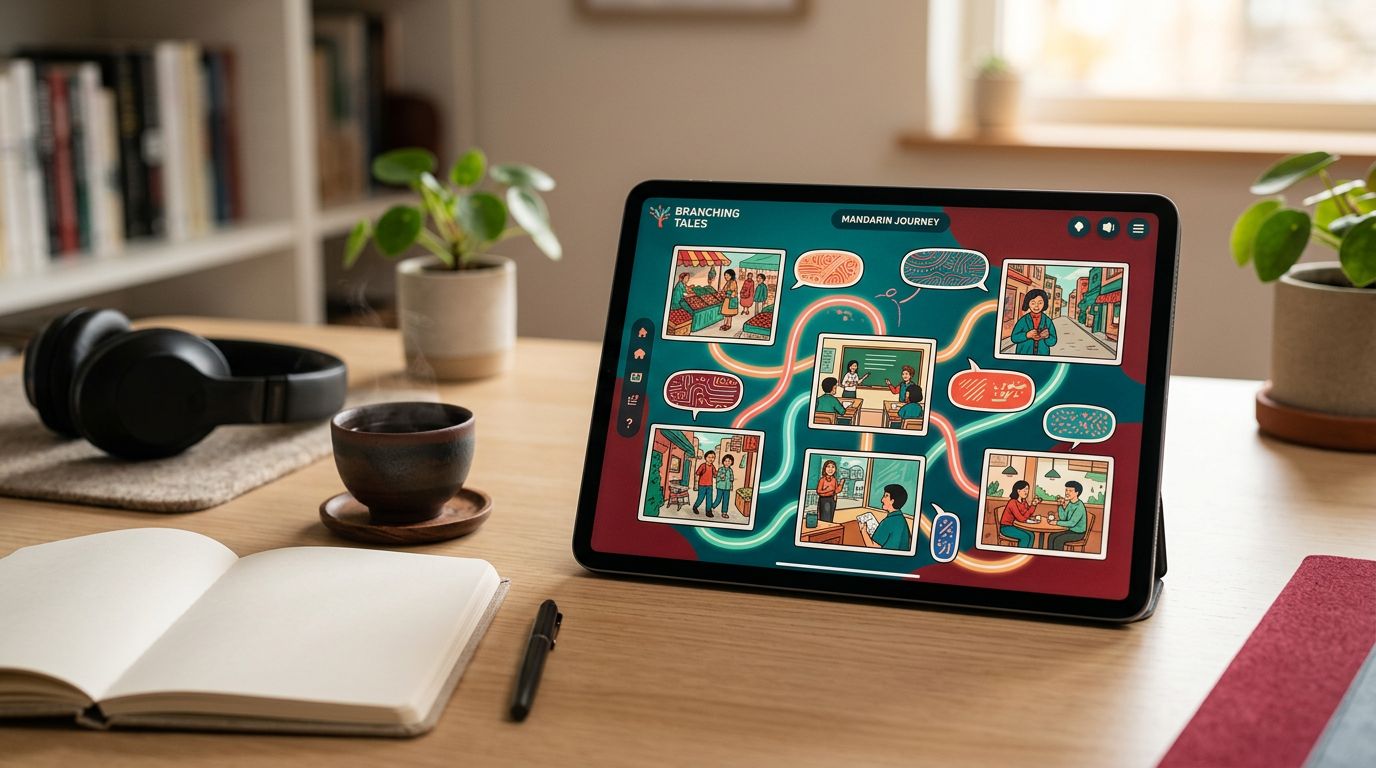
Many Mandarin apps teach a word, test it, and move on before that word has any reason to stick. WordSwing takes a different route, putting Chinese inside branching stories where one choice can change the next scene.
This WordSwing review finds a focused reading-practice app for learners past the early basics, rather than a complete Mandarin course. Its stories give repeated vocabulary a purpose, but they won’t teach pinyin from zero or correct spoken tones.
If you can already read short Chinese sentences, WordSwing’s unusual format may fill an important gap in your study routine.
WordSwing Review: The Short Verdict for 2026
WordSwing is worth trying if ordinary graded readers feel flat and you already understand common Mandarin sentence patterns. Text adventures, comics, and word activities give you a more engaging reason to read than a bare vocabulary review. Because choices influence a scene, recurring words can feel easier to remember.
However, this WordSwing review treats it as a supplementary tool, not a one-app solution. It doesn’t provide a staged pinyin course, a full grammar syllabus, or meaningful conversational practice. Learners who expect one subscription to cover every Mandarin skill will outgrow it quickly.
| Learning goal | WordSwing fit | Why |
|---|---|---|
| Building reading confidence | Strong | Stories provide context and repeated vocabulary |
| Starting Mandarin from scratch | Weak | There is no guided foundation in pinyin and basic grammar |
| Improving spoken fluency | Limited | The app focuses on comprehension, not open conversation |
The strongest value comes from making Chinese reading feel active. You aren’t simply finishing an exercise. You are trying to understand enough Chinese to continue a story.
How WordSwing Turns Reading Into a Game
Most vocabulary apps reward correct answers, then move on. WordSwing keeps words tied to scenes, characters, and decisions. That connection can make a common phrase more memorable than seeing it on a translation card.
Branching text adventures create useful context
Text adventures are WordSwing’s main feature. You read Chinese, select responses, and follow a story that can branch according to your choices. The content sits somewhere between a graded reader and a choose-your-own-adventure game.
This format encourages extensive reading, but it remains controlled reading. You choose from available options rather than composing your own replies. As a result, it can improve recognition of grammar and vocabulary without doing much for spontaneous sentence building.
An independent WordSwing assessment also describes the app as a mix of graded reading and branching gameplay. That description fits the experience well.
Comics and review activities extend the stories
WordSwing also includes comics and activities beyond its games. The newest comic episode is available free, which gives prospective users a low-pressure way to test the reading style before subscribing.
A free account can track words you have discovered and mastered. The app also includes “Written Word,” a spaced-repetition character activity. That is useful for recognition practice, although it is not the same as a flexible, user-built flashcard system.
New stories and activities add variety. Still, learners who want to build their own HSK lists or mine vocabulary from podcasts may prefer a dedicated flashcard app alongside WordSwing.
Chinese Level, Audio, and Lesson Quality
WordSwing describes its Chinese material as suitable for intermediate and advanced learners. That positioning matters, because the app is much more enjoyable when you can follow a scene without translating every line.
Most learners need an intermediate base
Independent estimates place much of the content around HSK 3 to HSK 5. HSK levels are only rough guides, since reading comfort depends on vocabulary, character recognition, and your tolerance for unknown words.
Before paying, try a game and judge the reading load yourself. If you understand the main point of most sentences, occasional lookups will feel productive. If every line requires a dictionary, the story can turn into slow decoding.
WordSwing works especially well for learners who have finished a beginner course but haven’t yet built a steady reading habit. It gives them material that is more interesting than textbook dialogues without forcing them into native-level novels.
Audio helps, but speaking remains outside the app
Audio accompanies much of the Chinese content, so learners can connect characters and vocabulary with pronunciation. Listen before reading a scene, then replay key lines after you understand them. That small habit can improve recognition during real conversations.
For focused tone work, WordSwing also provides a free tone-training course developed with Hacking Chinese. You can access it after creating a free WordSwing account.
The core app does not advertise speech recognition or detailed pronunciation feedback. Therefore, learners who struggle with tones should add tutor feedback, language exchanges, or a pronunciation-focused course. Audio exposure helps, but it can’t tell you when your third tone or vowel length is off.
Pricing, Free Access, and Platform Support
WordSwing Chinese remains free to download, with paid access available through the WordSwing Complete subscription. The free tier is useful for testing the format, but it is intentionally limited.
What the free trial includes
You can play the beginning of each text adventure for up to 10 turns. The most recent comic episode is also free. Creating an account is optional, although an account lets you save progress and track vocabulary.
WordSwing Complete unlocks all games and activities. Official subscription wording confirms a monthly auto-renewing plan, while independent pricing references list about $8 per month or $72 per year. Check the purchase screen before subscribing, because prices and annual-plan availability can vary by country.
A 10-turn trial shows the interface and story style. It cannot tell you whether the library will hold your attention for months.
Device access needs a quick check
As checked in August 2026, iPhone and iPad access is easy to verify through the active WordSwing Chinese App Store page, which lists the app as free with in-app purchases and designed for iPad.
WordSwing’s current descriptions also list web, iOS, and Android access. Still, Android availability can differ by region and store. If you depend on an Android phone or browser access, test installation or sign-in before committing to a longer plan.
Where WordSwing Falls Short
WordSwing has a clear purpose, but its limits matter as much as its strengths. It can make reading more enjoyable, yet it cannot replace structured instruction.
It is not a first Mandarin course
Beginners need a guided path through pinyin, tones, basic word order, common grammar patterns, and high-frequency vocabulary. WordSwing assumes too much of that groundwork is already in place.
It also doesn’t offer a complete writing curriculum. Character recognition activities can support your study, but they don’t replace deliberate handwriting practice or systematic character learning.
For a more structured app path, this ChineseSkill review explains how mini lessons can cover listening, speaking, reading, and writing in a more organized sequence. WordSwing makes more sense after you have that foundation.
The app cannot provide real speaking feedback
Selecting a correct story response is comprehension practice. It may help you recognize useful phrases, but it doesn’t require you to create an original response under pressure.
The lack of speech recognition is a larger limitation for learners who want better tones or smoother conversation. Reading dialogue aloud helps, yet you still need another person, a teacher, or a speaking tool to catch persistent errors.
When a story introduces a useful phrase, say it aloud several times. Then write two original sentences with it and use one in a chat or tutoring session. That turns passive recognition into language you can produce.
A Practical WordSwing Study Plan
Treat WordSwing as a reading slot inside a wider Mandarin routine. Three short sessions each week are usually enough to gain value without letting the app replace other skills.
Use stories in two passes
First, read a scene without stopping for every unknown word. Focus on the plot and only look up words that block your understanding. On the second pass, replay the audio and notice phrases that appeared more than once.
After each session, save five to 10 useful words or expressions in your usual review system. Choose phrases you expect to hear or use, rather than collecting every unfamiliar character. Then spend separate time on a core course, listening practice, and speaking.
Match the subscription to your current needs
- Buy WordSwing Complete if you are an intermediate reader who enjoys stories and wants more Chinese input than standard flashcards provide.
- Stay with the free material if you are unsure about the writing style, study irregularly, or only want occasional reading practice.
- Choose a structured beginner course first if you still need pinyin, basic grammar, and guided pronunciation. Yoyo Chinese advertises more than 1,000 video lessons and is built around a clearer lesson sequence.
- Look beyond WordSwing if your main goal is conversation. Speaking practice, corrective feedback, and live interaction need a different tool or a human partner.
For broader comparisons, see these best Chinese learning apps for serious learners. The right choice depends on the skill you need next, not on which app has the most entertaining format.
Final Thoughts
WordSwing makes Chinese reading less abstract because words affect a story instead of sitting on an isolated card. That benefit becomes most useful once you can understand enough Mandarin to keep a scene moving.
For early-intermediate and reading-focused learners, WordSwing deserves a place beside a core course, vocabulary review, and regular speaking practice. Beginners and learners seeking pronunciation feedback should spend their subscription money on a more structured option first.
Ready to Take Your Language Learning Further?
Your favorite language-learning app is a great place to start. Rocket Languages can help you go further with interactive audio lessons, pronunciation practice, real-world conversations, and structured learning.
Explore Rocket Languages →Affiliate disclosure: We may earn a commission if you purchase through this link, at no additional cost to you.