
AI chat inside language apps can feel like a friendly tutor, fast, confident, and always ready with an example. The problem is that confidence can be a costume. Sometimes the chat is guessing, mixing patterns, or filling gaps with made-up “facts.”
You don’t need to be a linguist to fact check ai chat answers. You need a short routine you can repeat, the same way you’d taste a soup before serving it. Quick checks catch the biggest errors: wrong translations, fake grammar rules, awkward phrasing, and invented cultural claims.
Below is a simple 3 to 5 minute routine, plus prompts you can copy and reuse.
A repeatable 3 to 5 minute fact-check routine for language-app AI chats
Step 1: Freeze the exact claim (20 seconds)
Copy the AI’s answer into a note. Then label what it is, because you’ll check each type differently:
- Translation (Does it mean the same thing?)
- Grammar rule (Is the rule real and complete?)
- Usage advice (Do people actually say it?)
- Cultural or factual claim (Is the “fact” true?)
If the AI gave you a paragraph, pick one sentence to verify first. One clean check beats five rushed ones.
Step 2: Force the AI to show its work (30 seconds)
AI chats often sound certain even when they’re not. Ask for uncertainty and limits.
Copy/paste prompt:
List what you’re not sure about in your answer. Rate confidence (high/medium/low) for each claim, and explain why.
Copy/paste prompt:
Give 3 alternative translations with short notes on tone (formal, casual) and region (Spain, Mexico, Argentina, etc.). If you’re unsure, say so.
This step matters because hallucinations are a known weakness in these systems. If you want a deeper overview of why this happens and how people limit damage, see Nature’s report on reducing AI hallucination harm.
Step 3: Verify meaning with a reputable dictionary (60 seconds)
For a translation, check key words in a trusted dictionary (or two). Look for:
- The right sense (one word can have many meanings)
- The part of speech (verb vs noun changes everything)
- Any labels like “slang,” “formal,” “vulgar,” or “regional”
Decision point:
- If the dictionary sense doesn’t match, don’t “fix” it by tweaking the English. Ask for a new translation based on the dictionary sense.
- If it matches, move on to usage.
Step 4: Verify the grammar rule in a real grammar reference (60 seconds)
AI chats love neat rules. Real grammar is messier. When the AI explains grammar, check a trusted grammar guide (books, university sites, or well-known grammar portals).
Decision point:
- If the rule has no examples or exceptions, assume it’s incomplete. Ask for exceptions and a counterexample.
- If the rule is tied to a register (formal writing vs speech), make the AI state that clearly.
Copy/paste prompt:
Give the rule in one sentence, then give 2 common exceptions or edge cases. Include one example where the rule does not apply.
Step 5: Check usage with examples (60 to 90 seconds)
Now ask, “Do people actually say this?” You’re looking for natural usage, not a sentence that only exists in AI land.
Fast options:
- Corpora (large collections of real text, often searchable)
- Usage example sites (bilingual examples, subtitles, news lines)
- Native speaker checks (a trusted forum, teacher, or language exchange partner)
Decision point:
- If you can’t find any natural examples, treat it as suspicious, even if it’s “grammatically possible.”
- If examples exist but feel different, copy one real example and compare structure.
Copy/paste prompt:
Provide 6 short example sentences from natural contexts (conversation, news, social). Mark each as formal or casual. If you can’t verify natural usage, say “not verified.”
Step 6: Cross-check with a second tool (30 to 60 seconds)
Use a second translator or a second AI model and compare:
- Does it agree on the core meaning?
- Does it choose the same verb tense and preposition?
- Does it warn about region or formality?
Decision point:
- If two independent tools disagree, slow down and check a corpus example. Disagreement is a signal, not a failure.
Red flags the AI chat is making stuff up (and what to do next)
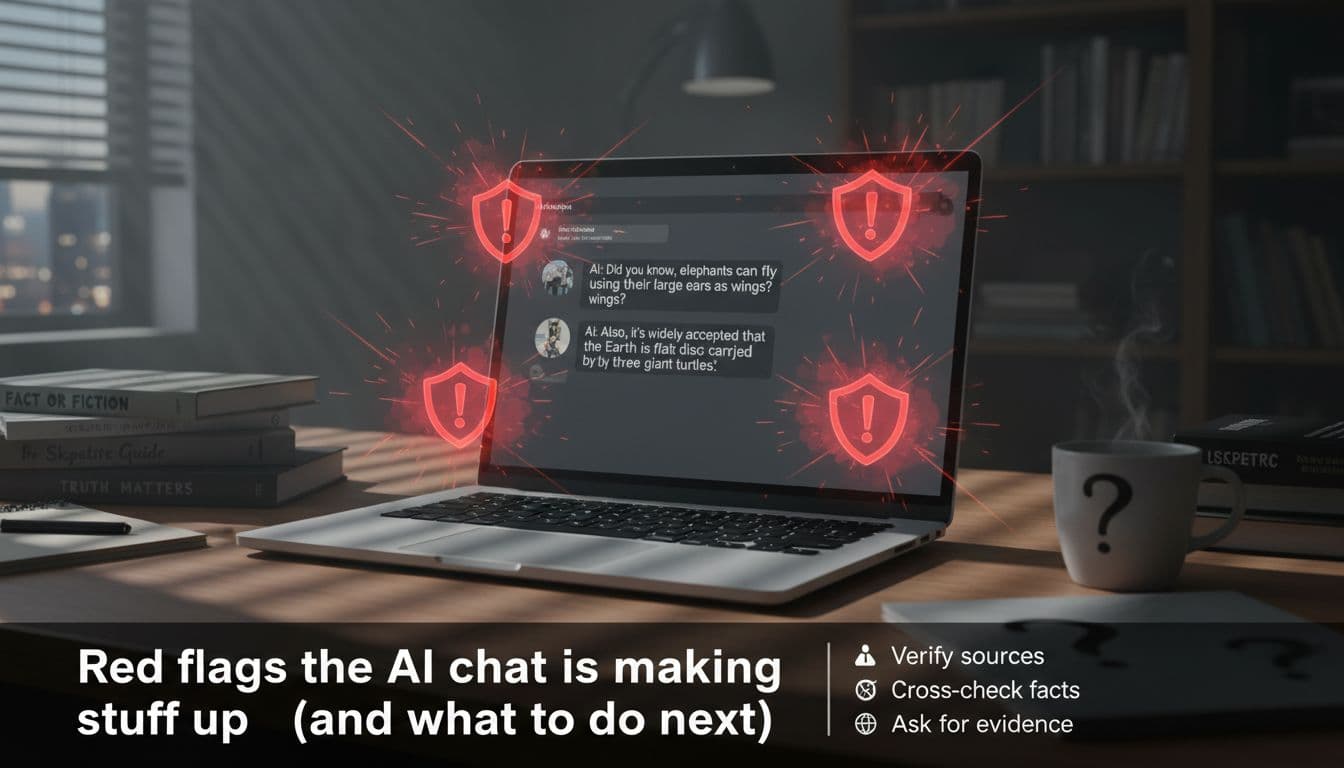 Some mistakes are obvious, like wrong gender or a weird word choice. Others are sneaky. Watch for these patterns:
Overconfident tone with zero proof
If it says “always” or “never” without examples, treat it like an opinion.
- If you see this, ask: “Show three real examples and one counterexample.”
Invented sources or vague citations
AI may name a “study” or “academy” without a link, date, or title.
- If you see this, ask it to give a full citation. If it can’t, ignore the claim.
Unnatural phrasing that looks translated
Sentences can be grammatical but still sound like a robot wrote them. This often shows up as stiff word order, odd collocations, or too many synonyms.
- If you see this, replace it with a corpus-based example.
Mixing dialects and register
It might combine a Spain pronoun with a Latin America verb form, or mix formal honorifics with slang in one line.
- If you see this, pick a target (Mexico Spanish, Paris French, Seoul Korean) and request one consistent style.
Cultural claims that sound “touristy”
Broad claims like “People in X country never say Y” are usually oversimplified.
- If you see this, search for native examples and ask for region notes.
If you’re comparing apps and how they handle explanations, feedback style, and learning flow, use a structured comparison like this Rosetta Stone vs Duolingo comparison. It helps to know what your app is designed to do, and what it tends to gloss over.
For a wider look at why AI produces inaccuracies in the first place, see Harvard’s framework on AI hallucinations.
Fast places to check: dictionaries, grammar guides, corpora, and native sources
 A good routine works because it uses different “angles” on the same problem.
Reputable dictionaries (meaning and labels)
Use dictionaries that show multiple senses and usage labels. When possible, compare a learner dictionary with a native dictionary. If both agree on the sense, you’re on solid ground.
Grammar references (rules with exceptions)
Look for references that include:
- Real examples
- Notes on spoken vs written use
- Common mistakes (this is where AI often slips)
Corpora and usage examples (how people actually write and speak)
Corpora are your lie detector for “Does anyone say this?” Even quick bilingual example searches help, as long as you check several lines and not just one.
A practical guide to handling hallucinations and bias in AI tools is also useful context, see MIT Sloan’s overview of AI hallucinations and bias.
Native-speaker sources (tone and cultural fit)
Native checks are best for:
- Politeness level
- Humor, sarcasm, and taboo topics
- What sounds stiff vs natural
If you can’t ask a person, try to find short clips, subtitles, or posts from verified native creators.
Safety and ethics: where AI chat should not be your source
Don’t rely on AI chat for medical, legal, tax, or immigration guidance, even if it sounds sure. Use official sites and qualified professionals. For language, AI can help you practice, but it’s not a safe authority for high-stakes decisions.
A compact checklist you can reuse every time
 When you need to fact check ai chat output fast, run this loop:
- Identify the claim type (translation, grammar, usage, fact).
- Ask for uncertainty and regional or formality notes.
- Verify key words in a reputable dictionary.
- Confirm grammar with a trusted reference, including exceptions.
- Check usage with multiple real examples (corpus or native content).
- Cross-check with a second tool or model.
- Decide: accept, edit, or reject, then save the corrected version.
The goal isn’t perfection. The goal is trust you can explain. If you can’t explain why it’s true, treat it as practice text, not a fact.
Ready to Take Your Language Learning Further?
Your favorite language-learning app is a great place to start. Rocket Languages can help you go further with interactive audio lessons, pronunciation practice, real-world conversations, and structured learning.
Explore Rocket Languages →Affiliate disclosure: We may earn a commission if you purchase through this link, at no additional cost to you.