
French can sound clear in a vocabulary app yet fall apart when words connect in a real sentence. The strongest French pronunciation apps help you hear sound patterns, repeat full phrases, and identify errors that spelling hides.
Liaison needs special attention because a normally silent final consonant may be pronounced before a following vowel sound. You need phrase-level audio, not a pile of isolated word recordings, to make that connection feel natural. The options below separate useful sound practice from broad language courses that only touch pronunciation.
Key takeaways
- TV5MONDE is the strongest verified free resource for focused liaison practice. Its French-learning materials include a dedicated liaison exercise and connected-speech lessons.
- Speechling is the clearest choice for learners who need feedback on recordings and want to compare their voice with native-speaker models.
- Forvo helps you check how individual French words are pronounced, but it cannot teach liaison or assess your speech.
- Pimsleur builds spoken recall through audio lessons. It supports rhythm and response speed, although it is not a dedicated liaison course.
- Babbel and Busuu can support a wider French study plan, but their documented pricing is easier to verify than their liaison-specific tools.
A speech score can prompt useful repetition, but it cannot reliably judge whether your rhythm, vowel quality, or linking sounds natural to a French listener.
What French pronunciation apps need to teach
A useful app gives you more than a microphone icon and a green checkmark. It should let you hear a phrase repeatedly, slow down your own response, and compare your recording against a consistent native model.
Native audio and direct comparison
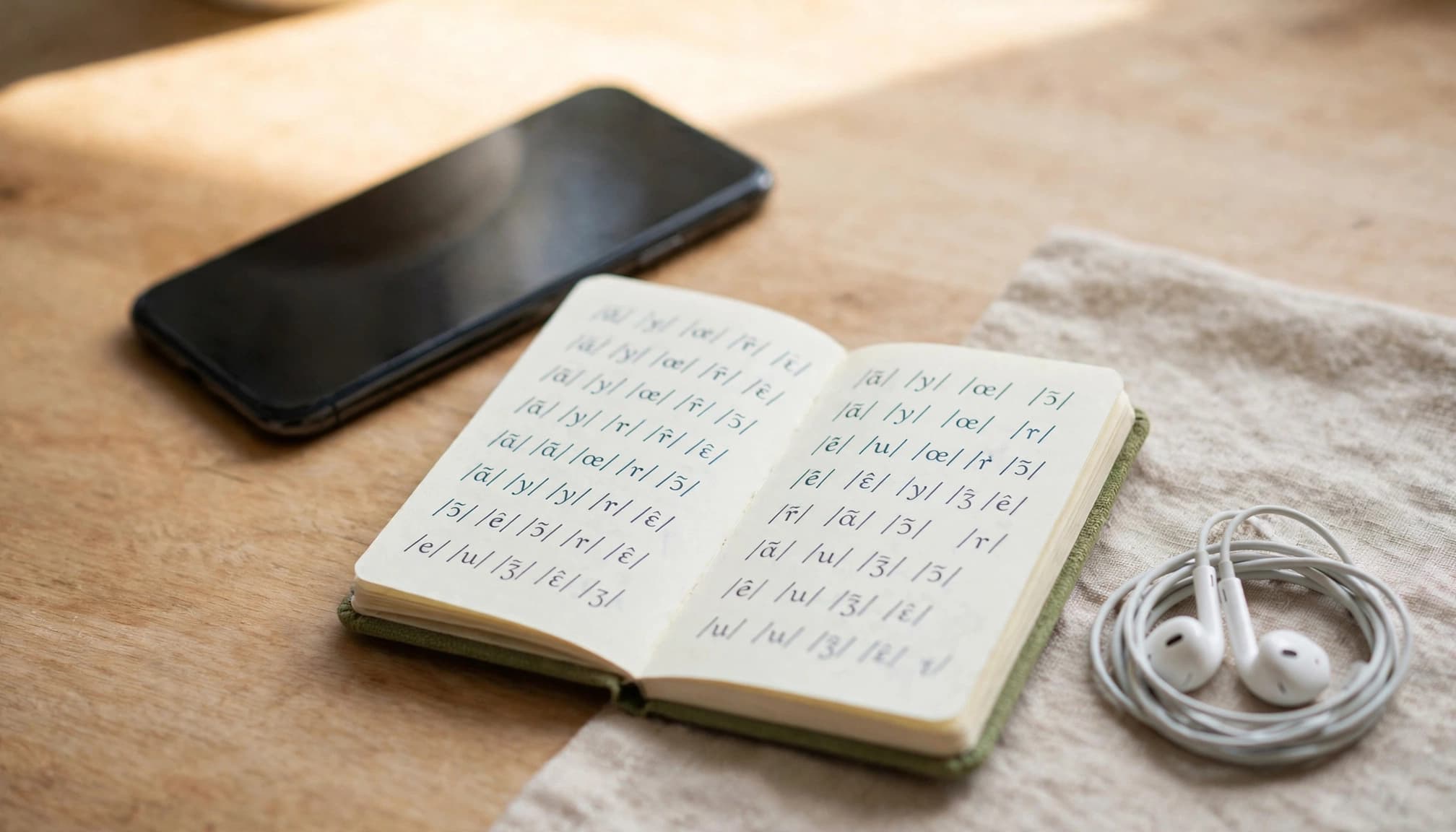
Native-speaker recordings give you a reference for French vowels, nasal sounds, final consonants, and sentence rhythm. However, passive listening rarely changes how you speak. Record the same line, then compare the two versions several times.
Listen for where syllables join, where the speaker pauses, and which endings disappear. A short recording loop is more useful than repeating ten unrelated words once each.
Speech recognition can help beginners speak aloud instead of silently tapping through lessons. Still, treat it as a practice prompt rather than a final verdict. Some systems accept an approximation that remains hard to understand in conversation.
Full phrases matter more than word lists
A dictionary recording can settle the pronunciation of bonjour, fille, or oeil. Yet French speech changes when those words sit beside others. Intonation shifts, vowels influence nearby sounds, and word boundaries become harder to hear.
Choose material with short dialogues, replay controls, and transcripts you can check after your first listen. Two speakers are also better than one because French sounds different across voices, speeds, and speaking styles.
For intermediate learners, Glossika sentence-based language practice can complement a pronunciation tool because its repetition work uses complete sentences rather than disconnected vocabulary.
Best French pronunciation apps for 2026
The best French pronunciation apps each solve a different problem. One gives feedback, another teaches a specific connected-speech rule, and another offers quick reference audio.
Speechling for recording and feedback
Speechling is the best fit when you want to submit spoken sentences and compare your delivery with professional voice recordings. Its free “Forever Free” tier includes the full curriculum, native voice talent, side-by-side voice comparison, and Android and iOS access.
Its Unlimited plan starts at $19.99 per month, according to Speechling’s current pricing page. Paid access includes coaching, although the provider lists different coaching conditions for French, English, Chinese, and German. Check your plan details before assuming a set number of French coaching submissions.
Speechling does not offer a verified liaison course. Still, its sentence-recording format makes it useful after you study a liaison pattern elsewhere. Record vous avez or les enfants, compare your /z/ linking sound with the model, then repeat at a normal pace.
TV5MONDE for verified liaison exercises
TV5MONDE EDU is the most convincing free choice for liaison because it addresses the subject directly. The app is available worldwide on iPhone and Android, and its official materials describe more than 4,000 exercises.
Its French-learning site includes pronunciation material on liaisons and enchainements, with attention to how sounds move across word groups. Start with TV5MONDE’s pronunciation guidance, then replay each example until you can hear the word boundary disappear.
The content is especially helpful for beginners and lower-intermediate learners who need an explanation before repetition. It is less suited to learners seeking personal correction. Use it to understand and hear the rule, then record yourself in another app or ask a tutor to review difficult lines.
Forvo for individual words, not connected speech
Forvo’s French pronunciation dictionary gives you access to recordings submitted by native speakers. It is useful when a course has introduced an unfamiliar word and you want a quick sound model.
Compare more than one recording when possible. Regional variation, recording quality, and speaking speed differ between contributors. Keep one main model for active pronunciation, even while listening widely for comprehension.
Forvo does not analyze your recordings, provide a structured French course, or teach liaison in context. Use it for fast checks, then place the word into a sentence from your main course. That extra step turns a lookup into speaking practice.
Audio-first and broad course options
Some learners don’t need a separate pronunciation app at first. They need many chances to hear a sentence, recall it under light pressure, and say it aloud before seeing the answer.
Pimsleur for spoken recall and rhythm
Pimsleur’s French course has five levels, 150 lessons, and roughly 75 hours of audio, according to current secondary reviews. The core 30-minute lessons ask you to listen, retrieve a response, and say it before the model supplies it.
That rhythm can build confidence with common phrases and make you less dependent on reading. Its Voice Coach feature is often mentioned as pronunciation support, but it should not be mistaken for detailed liaison instruction or human assessment.
A secondary 2026 pricing source lists French Premium at $19.95 per month and All Access at $20.95 per month, with a seven-day free trial for eligible new users. Prices can vary by market and checkout method. Read the full Pimsleur pronunciation practice review before subscribing if audio-led study is your main plan.
Babbel and Busuu for a structured course base
Babbel and Busuu make sense when pronunciation is one part of a broader goal involving vocabulary, grammar, listening, and short speaking tasks. Neither should be chosen solely for liaison practice, because a dedicated liaison course was not verified for either app.
The US iOS App Store lists Babbel French at $17.99 for one month and $45.99 for three months. It also shows an all-languages annual option at $107.99. Web prices can differ, so compare the offer on your device with the provider’s checkout page. This Babbel review for serious learners explains where guided lessons help and where controlled audio reaches its limits.
Busuu’s US iOS listing shows multiple subscription products, including $6.99 monthly, $79.99 annually, and higher Premium and Premium Plus tiers. It also lists a 14-day Premium Plus trial offer. Because plan names and prices vary, check the exact French plan before paying. Busuu pronunciation and speaking practice works best as preparation for real listening and conversation, not as a replacement for them.
Liaison needs more than a rule chart
Liaison occurs when a usually silent final consonant is pronounced because the next word begins with a vowel sound or a silent h. In les amis, the final s becomes a /z/ sound: lez amis. In un enfant, the final n links to the vowel that follows.
Learn required patterns first
Start with high-frequency groups such as les enfants, vous avez, un ami, and petit ami. These phrases appear often enough that repeated listening pays off quickly.
Focus on the sound rather than the spelling. The listener hears a linked sequence, not two carefully separated written words. A clear guide to French liaison can help you sort common required patterns from optional ones.
Avoid inserting liaison everywhere
French speakers do not pronounce every possible final consonant. Some liaisons are prohibited, while others depend on formality, pace, and region. For example, learners should not force a liaison after et.
That is why imitation matters. Learn a few reliable phrases from native audio before trying to apply a rule to every sentence. A forced liaison can sound less natural than leaving an optional one out.
A 10-minute liaison practice routine
Short, repeated sessions work better than a long weekly pronunciation binge. Give each session one narrow sound pattern and one short phrase set.
Listen before you repeat
Choose three phrases with the same linking sound. Listen once without reading, then write what you think you heard. Check the transcript only after your attempt.
Next, play each phrase three times. Notice whether the speaker links the words smoothly or uses a pause. If the boundary remains unclear to your ear, keep listening before speeding up.
Record, compare, and reuse the phrase
Record yourself saying each phrase slowly, then at normal speed. Compare the beginning of the phrase, the liaison consonant, and the final word ending. Do not judge the recording only by whether an app accepts it.
Save one difficult sentence for later review. A flashcard with a short audio clip and a full sentence is more valuable than a large deck of single-word recordings. Revisit it after two days, then use the phrase during a tutor session, language exchange, or self-recorded monologue.
Which app fits your learning style?
Use one main app and one supporting tool. Several overlapping subscriptions usually create duplicate drills and neglected renewals.
| Learner need | Best starting option | Why it fits |
|---|---|---|
| Beginner who needs liaison explained | TV5MONDE | Free exercises directly address liaison and connected speech. |
| Learner who wants correction on recordings | Speechling | Voice comparison and coaching focus on spoken sentences. |
| Busy learner who prefers hands-free audio | Pimsleur | Prompted recall develops spoken response habits. |
| Learner checking unfamiliar words | Forvo | Native-speaker word recordings provide a quick reference. |
| Student needing a full French course | Babbel or Busuu | Both add structured lessons beyond pronunciation work. |
The strongest choice depends on the weakness you can name. If you cannot hear links, start with TV5MONDE. If you hear them but cannot produce them, add Speechling or record yourself regularly. If you freeze during basic exchanges, Pimsleur can build faster recall.
Frequently asked questions
Can an app teach French liaison accurately?
An app can teach common liaison patterns and provide examples, especially when it uses native audio in complete phrases. TV5MONDE is the clearest verified option for that task.
However, an app cannot fully judge whether your speech sounds natural in spontaneous conversation. A teacher, tutor, or capable language partner can catch rhythm problems and overused liaisons that automated tools may miss.
Are free French pronunciation apps enough?
Free resources can take you far when you use them consistently. TV5MONDE offers extensive free exercises, and Forvo is useful for quick word checks. Speechling also has a free tier with core practice material.
Paid tools become worthwhile when they replace work you would otherwise struggle to do alone, such as receiving feedback on recordings or maintaining an audio-first speaking routine. Test the free tier or trial before committing to an annual plan.
Should advanced learners still practice liaison?
Yes, although advanced learners should move beyond rule drills. At B2 and above, use interviews, podcasts, dramas, and unscripted conversations to hear how liaison changes with speed and register.
Record a short passage from real media, then compare your version with the original. The goal is not perfect imitation of one speaker. It is clearer connected speech and better listening under normal conditions.
Build a pronunciation routine that reaches real speech
Liaison improves when you connect three actions: hear a native phrase, imitate it carefully, and compare your recording with the model. French pronunciation apps can make that loop easy to repeat, but no single app covers every need.
Start with TV5MONDE for the pattern, use Speechling when feedback matters, and keep Forvo nearby for uncertain words. Then bring those sounds into real French conversations, where connected speech stops being an exercise and becomes part of how you listen and respond.
Ready to Take Your Language Learning Further?
Your favorite language-learning app is a great place to start. Rocket Languages can help you go further with interactive audio lessons, pronunciation practice, real-world conversations, and structured learning.
Explore Rocket Languages →Affiliate disclosure: We may earn a commission if you purchase through this link, at no additional cost to you.