
Kanji study can make Japanese reading easier, but the right system depends on what you want to read. JPDB connects vocabulary study to real Japanese media, while WaniKani offers a structured course built around kanji, mnemonics, and spaced repetition.
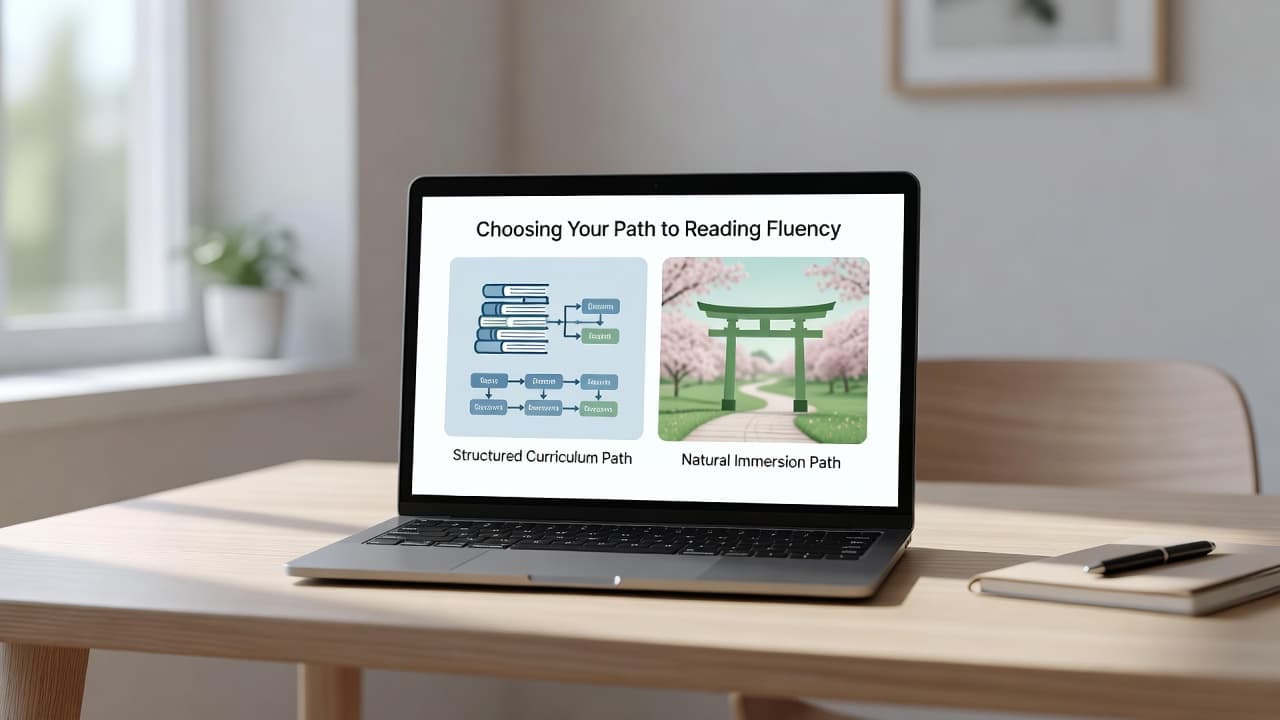
If you want a guided foundation, WaniKani is easier to follow. If you already have specific anime, manga, novels, or games in mind, JPDB can connect your reviews to those materials. Your choice also depends on grammar, vocabulary, and reading exposure, because kanji knowledge alone won’t create fluency.
Key Takeaways
- WaniKani teaches about 2,000 kanji and roughly 6,000 vocabulary words through a fixed course.
- JPDB focuses on vocabulary SRS and lets you choose study material connected to Japanese media.
- WaniKani suits beginners who want structure and built-in mnemonics.
- JPDB suits learners who want vocabulary that matches manga, games, anime, or novels.
- Neither system teaches enough grammar or reading practice by itself.
How JPDB and WaniKani Teach Kanji Differently
WaniKani is a pre-built course. It introduces radicals, then kanji, then vocabulary that reinforces the kanji readings. The system controls when new lessons become available, so you follow a set path instead of choosing every item yourself.
Its mnemonic stories give each radical, kanji, and vocabulary item a memory aid. Some learners enjoy these stories, while others replace them with personal associations. Either way, the course gives you a consistent method for connecting shape, meaning, and reading.
WaniKani’s spaced-repetition system uses stages such as Apprentice, Guru, Master, Enlightened, and Burned. Mistakes move items back to earlier stages. That schedule can feel strict, but it prevents learners from avoiding difficult cards.
JPDB takes a different route. It is a free web-based SRS platform with a Japanese vocabulary database, dictionary tools, and decks connected to native content. You select or create decks, then arrange study by factors such as frequency or the material you want to understand.
JPDB doesn’t provide a dedicated kanji course with separate kanji reviews. Instead, you learn kanji through the vocabulary that contains them. This reflects how kanji appears in real reading, but it requires you to notice patterns across words.
| Feature | JPDB | WaniKani |
|---|---|---|
| Main focus | Vocabulary and native media | Kanji and reinforcing vocabulary |
| Course structure | Flexible, learner-controlled | Fixed, progressive path |
| Mnemonics | No built-in mnemonic system | Premade mnemonics |
| Kanji reviews | No separate kanji review queue | Core part of the course |
| Content selection | Chosen by the learner | Curated by the platform |
| Price in the US, July 2026 | Free | $9 monthly, $89 yearly, or $299 lifetime |
The central difference is control. WaniKani tells you what to study next. JPDB gives you more responsibility for deciding what matters.
For a broader look at other study tools, LanguaVibe’s guide to Japanese kanji apps that support recognition and retention offers useful alternatives and study combinations.
Which System Fits Manga, Anime, Games, and Novels?
Your target content should influence your choice more than a feature checklist.
Manga readers
JPDB is often the better match if you want to read a particular manga series. Its material-based approach can help you study vocabulary that appears in the titles and genres you care about. A learner reading slice-of-life manga may need different words from someone reading historical fantasy or sports manga.
However, JPDB won’t remove the need to look up grammar and unfamiliar expressions. Manga also uses contractions, sound effects, casual speech, and character-specific language. Vocabulary reviews help, but you still need repeated reading to understand how those words work in context.
WaniKani gives you a stronger general foundation before you tackle native manga. Its common vocabulary can improve recognition across many titles, although it won’t be tailored to one series.
Anime subtitles
Anime subtitles create a mixed case. JPDB can help if you want to study words from shows you already watch. The connection between a deck and familiar content may keep your study relevant.
Still, subtitle reading requires speed. You need to recognize words quickly while processing grammar, sound, and scene changes. WaniKani can build kanji recognition, but it doesn’t train subtitle timing. JPDB can add relevant vocabulary, but it doesn’t replace listening practice.
Watch with Japanese subtitles when possible, pause short scenes, and review sentences you struggled to understand. Neither SRS platform provides enough exposure by itself.
Games
JPDB has a clear advantage for games with specialized vocabulary. Role-playing games may repeat terms for equipment, abilities, quests, menus, and combat. Studying words connected to the game can reduce the number of interruptions during play.
WaniKani remains useful for building the general kanji base needed to read menus and dialogue. Yet some game vocabulary may not appear in its curated course. JPDB gives you a way to target those gaps.
Novels
Novels demand broad vocabulary, grammar knowledge, and stamina. WaniKani is usually the better starting point for a beginner because its progression gives you a reliable base. JPDB becomes more useful once you can identify the vocabulary that blocks your reading.
Learners comparing both tools often reach a similar conclusion: JPDB can complement a structured course, but it requires more self-management. A community discussion about JPDB and WaniKani alternatives shows how study preferences affect that decision.
WaniKani Is Better for a Guided Kanji Foundation
Choose WaniKani if you want a clear daily routine with minimal setup. You won’t need to search for decks, decide which kanji to introduce, or build mnemonic explanations from scratch.
The course also handles a common beginner problem: learning a kanji without knowing how it appears in words. WaniKani introduces vocabulary after kanji, so readings gain support from examples such as common compounds and everyday terms.
That structure works well when you have no specific reading project yet. You can spend your energy reviewing rather than designing a curriculum. The tradeoff is a slower, less flexible path. You can’t freely skip to every word you want, and the review load grows if you add lessons faster than you can maintain.
WaniKani also doesn’t teach grammar, listening, speaking, or sustained reading. It can prepare you to recognize more written Japanese, but you’ll need a separate grammar resource and actual texts. LanguaVibe’s WaniKani review for kanji retention covers its pacing, mnemonic system, and long-term review demands in more detail.
WaniKani is a strong choice when:
- You are a beginner who wants a fixed sequence.
- You remember information well through stories and visual associations.
- You prefer a curated course over building your own deck.
- JLPT kanji coverage is a major part of your plan.
- You can maintain regular reviews for months or years.
The subscription cost matters, but so does the cost of an abandoned system. A paid course that you use consistently may be more useful than a free tool that leaves every decision to you.
JPDB Is Better for Content-Driven Reading
JPDB fits learners who study Japanese because they want to consume Japanese media. Its strongest feature is the connection between vocabulary review and material you may actually read or watch.
Instead of working through a general list alone, you can focus on words that appear in selected decks or media. That approach is useful when your goal is concrete: finish a manga volume, understand a game, or read a novel with fewer dictionary stops.
JPDB also gives you greater control over review order. Frequency-based study can help you learn common words first, while a material-based deck can target the vocabulary that matters for your current project.
The cost of that freedom is setup and judgment. JPDB doesn’t give you WaniKani-style mnemonic stories for every item. You need to create your own associations or rely on repeated encounters. It also won’t lead you through radicals and kanji in a carefully staged sequence.
JPDB is a strong choice when:
- You already know kana and basic Japanese grammar.
- You have a specific manga, game, anime, or novel as a target.
- You want to study vocabulary outside WaniKani’s curated list.
- You prefer flexible review queues.
- You can manage decks and choose realistic lesson limits.
A discussion on the WaniKani community about using JPDB for reading progress also highlights an important practical issue: faster card entry and review can help, but speed only matters if you retain what you study.
JLPT Study, Cost, and Combining Both Tools
For JLPT preparation, WaniKani offers a more obvious path. Its core kanji and vocabulary coverage can support early reading practice, particularly around N5 through N2 material. However, no SRS platform guarantees a JLPT result. The exam also tests grammar, reading comprehension, listening, and vocabulary that may not match one app’s order.
JPDB can support JLPT study when you use frequency or level-appropriate decks. It may also expose you to words that appear in native material but receive less attention in a general course. You will need to check the deck’s content and avoid adding more material than your schedule can handle.
The platforms also differ sharply in cost. JPDB is free to use, with Patreon support available for development. WaniKani lists a $9 monthly plan, an $89 annual plan, and a $299 lifetime option in the United States as of July 2026.
You can combine them, but duplication needs control. One practical setup is to use WaniKani for its structured kanji sequence, then use JPDB for vocabulary from a current reading project. Mark words you already know and keep the second system focused on gaps.
Reading ability still depends on more than recognizing characters. You need grammar to identify relationships between words, vocabulary to understand meaning, and repeated exposure to build speed. Read graded material or easy native content alongside either platform, and look up complete sentences rather than isolated kanji whenever possible.
The Better Choice Depends on Your Study Habit
Pick WaniKani when your main problem is building and retaining a kanji foundation. Its fixed sequence, mnemonic stories, and review schedule reduce the number of decisions you must make.
Pick JPDB when your main problem is understanding the content you want to read. Its vocabulary-centered system can target the words that appear in your chosen media, but it asks you to manage the course yourself.
If you’re unsure, start with the system that matches your immediate reading goal. A beginner with no target material will usually benefit from WaniKani’s structure. An intermediate learner who keeps meeting the same unknown words in a game or novel may gain more from JPDB.
Conclusion
The JPDB versus WaniKani decision comes down to structure versus content targeting. WaniKani builds a broad, guided kanji base, while JPDB connects vocabulary study to the Japanese you want to consume.
Neither tool can replace grammar study or regular reading. Choose WaniKani for a dependable foundation, JPDB for flexible material-based vocabulary, or combine them when each system has a separate job. The best choice is the one that keeps your reviews manageable and moves you toward the pages, subtitles, or game dialogue you actually want to understand.
Ready to Take Your Language Learning Further?
Your favorite language-learning app is a great place to start. Rocket Languages can help you go further with interactive audio lessons, pronunciation practice, real-world conversations, and structured learning.
Explore Rocket Languages →Affiliate disclosure: We may earn a commission if you purchase through this link, at no additional cost to you.