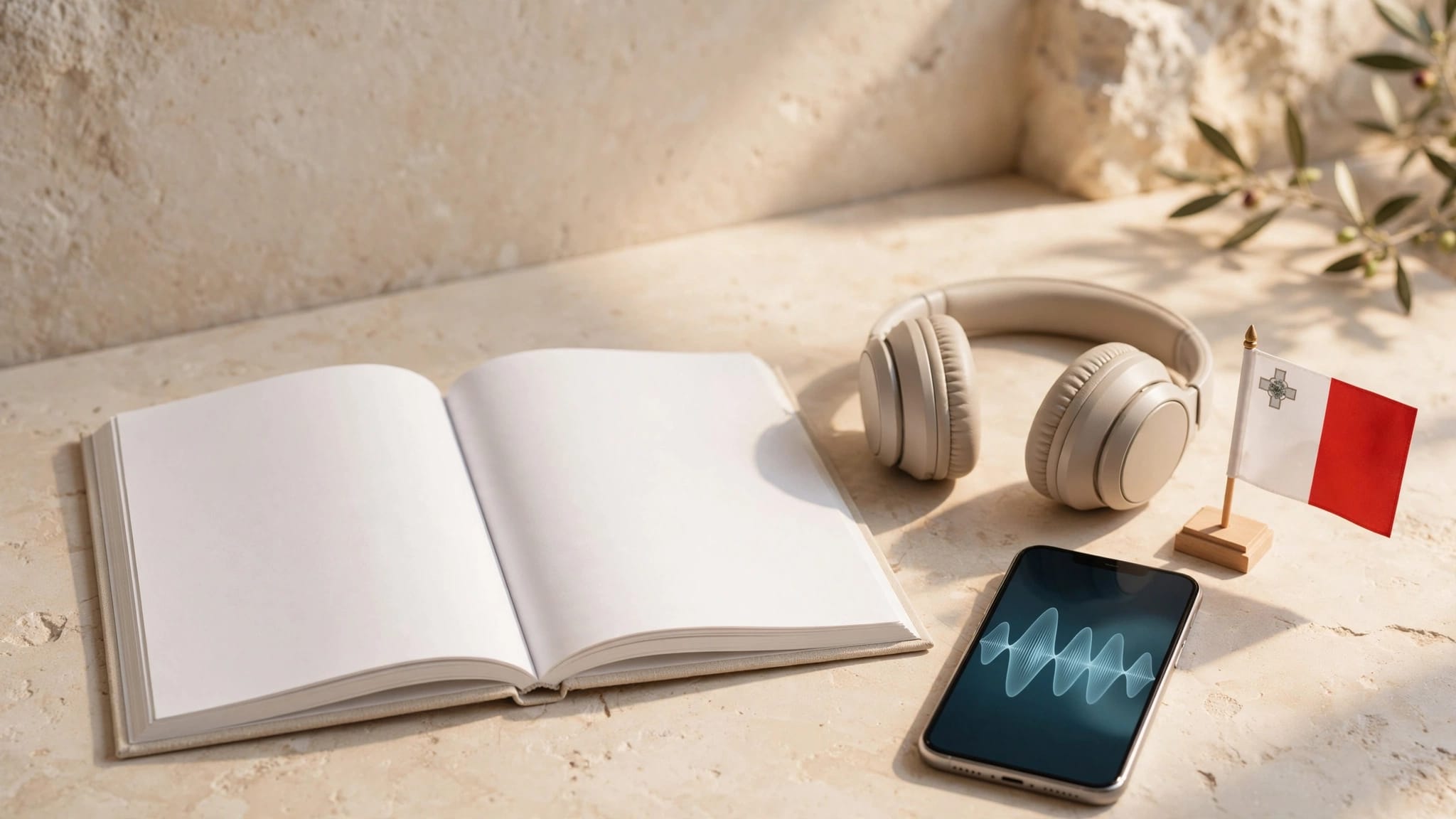
You can memorize a Maltese greeting and still struggle with the Maltese language when someone answers with an unfamiliar sentence. Useful Maltese learning resources need to teach you how sentences work, alongside vocabulary and pronunciation.
For adult beginners, the strongest educational resources combine one learning sequence with reference tools and short listening practice. Phrasebooks can help with immediate travel needs, but they rarely provide enough explanation for independent conversation.
Start by separating resources that teach new patterns from tools that help you practise them.
Which Maltese learning resources should you start with?
These online resources serve different purposes, so choosing one overall winner would hide their limitations.
| Resource | Best use | Main limitation |
|---|---|---|
| Polyglot Club’s Maltese 0-to-A1 course | A beginner study outline | Community material needs checking |
| University of Malta verb resources | Understanding verb forms | Reference material needs guided practice |
| Digital Dialects | Basic vocabulary review | Games don’t provide a complete course |
| Bluebird Maltese | Repeating short audio lessons | Check lesson depth and access terms |
| Lexilogos | Finding dictionaries and IATE, the European Union’s specialist terminology reference | A directory doesn’t teach a sequence |
| TVM, listed by Lexilogos | Finding authentic broadcast material | Ordinary broadcasts can overwhelm beginners |
For most learners, a sensible starting combination is a beginner syllabus, the games, and a short audio lesson. Add verb references when your lessons introduce forms you don’t understand.
Don’t collect every resource immediately. First, test whether your main material helps you produce a sentence without copying it. That reveals more than completing another recognition exercise.
Use a syllabus to move beyond memorized phrases
Polyglot Club offers a starting outline
For adult beginners looking to learn Maltese, the Maltese 0-to-A1 course gives a public course outline, not a complete, authoritative curriculum. Its course description includes listening, speaking, reading, and writing.
Use it to organize your study and identify the next topic. However, treat its community-written explanations as material to check, rather than an officially endorsed curriculum.
After each topic, write a few sentences using the pattern. If you can only repeat the example, you need more practice before moving on. Keep unresolved questions for a teacher or a reliable reference.
Judge courses by what follows the greetings
A useful beginner course explains how to change a sentence. Look for work on questions, negation, noun forms, and common verbs, followed by exercises that require your own answers.
Phrasebooks mainly supply finished expressions for situations such as restaurants and transport. Those expressions are useful, but they don’t necessarily explain why a word changes.
Before paying for any multilingual app, inspect its actual Maltese lessons. A large language catalog doesn’t establish course depth. Check audio samples, later units, and whether explanations go beyond translations.
Learn Maltese grammar through verbs and sentences
Use the university’s verb-learning resources
The University of Malta’s Maltese verbs resource announcement introduces Il-Verbi Maltin Onlajn, a booklet explaining the related verb website.
The 2025 announcement describes the website as freely accessible teaching material for classroom use and independent study, including for international learners. The project involved the University’s education and artificial intelligence departments.
This is a stronger grammar companion than another collection of travel phrases. Consult it when you meet an unfamiliar verb form, then return to the sentence where you found it. Understanding the form matters more than browsing a large conjugation table.
Keep morphology connected to meaning
Maltese verb study involves roots, patterns, and changes that express grammatical information. You don’t need to master the entire system before speaking.
Instead, choose a common verb from your lesson. Compare a small set of forms, then write sentences that change the subject or time reference. Ask a Maltese speaker to check them.
For deeper reference, the University’s Maltese Lexical Resources collection lists Michael Spagnol’s database of verbal roots and patterns. Treat that database as a lookup tool, not a beginner course.
A verb table becomes useful practice when you can choose the correct form in a new sentence without copying the table.
Choose dictionaries for learning, not automatic translation
Use Lexilogos to find reference tools
Lexilogos is a directory that helps readers find online dictionaries. The Lexilogos dictionaries page lists Ġabra among its Maltese dictionary links. It also points to specialist resources, including a financial dictionary and the European Union’s IATE terminology database.
That makes Lexilogos useful for discovering references, but the destination matters more than the directory. Inspect each entry for meaning, grammatical information, and examples where available.
Record the spelling carefully, including Maltese letters and diacritics. Also save the sentence where you encountered the word. A translation alone won’t tell you whether a noun or verb form fits your intended sentence.
Separate general vocabulary from specialist terminology
IATE is useful when a text concerns European institutions, law, or technical terminology. It isn’t a substitute for a beginner dictionary or grammar lesson.
For general study, prefer entries you can connect to everyday sentences. Institutional support can help you assess a project’s background. The Malta Communications Authority’s dictionary project description identifies continued support for the online Maltese dictionary from the University of Malta and the National Council for the Maltese Language.
That background doesn’t guarantee that every service remains accessible or suits beginners. Check the actual lookup function before making it part of your routine. Use Google Translation or other translation tools for an initial clue, then verify important wording.
Build vocabulary and pronunciation together
Digital Dialects makes basic review manageable
The Digital Dialects Maltese vocabulary games offer a straightforward way to practise beginner words. They’re useful when you need repeated exposure to a small vocabulary set.
Matching a word with its meaning mainly tests recognition. After playing, close the activity and recall the words yourself. Then use a few in sentences based on patterns you’ve already studied.
If you keep flashcards, choose words you repeatedly meet or forget. Add the original sentence instead of collecting isolated translations. This keeps review connected to language you’re likely to use.
Bluebird adds short audio practice
The Android listing for Bluebird’s Maltese audio lessons advertises free daily lessons and interactive video lessons. It’s worth sampling if you want material you can hear and repeat.
Check the lesson sequence and any upgrade terms before committing. Audio availability alone doesn’t establish detailed grammar teaching or a complete beginner-to-advanced course.
Practise pronunciation and phonetics alongside Maltese spelling. Letters such as ċ, ġ, ħ, and ż need deliberate attention, while għ is best learned in context. Repeat complete words and short sentences rather than relying on English-style pronunciation approximations.
Record yourself occasionally, then compare your version with the lesson audio.
Add real Maltese listening and reading
Choose replayable listening over background noise
Lexilogos lists TVM as a source of online Maltese radio and television. When choosing audio and podcasts, look for Maltese-language items you can access and replay, rather than assuming every broadcast or service will suit you.
Start with a short section on a topic you recognize. Listen once for the overall meaning, then replay it to build listening comprehension by identifying familiar expressions. If you understand almost nothing, return to clearer lesson audio.
Radio can provide exposure, and authentic broadcasts offer cultural resources. But continuous background listening makes detailed review difficult. Check that podcasts are replayable and clearly identified as Maltese before adding a series.
Read Maltese, not simply news about Malta
A publication’s location doesn’t establish its language. Times of Malta is primarily English-language, so it shouldn’t be your default choice for Maltese reading practice.
Maltese-language newspapers and magazines include In-Nazzjon and Il-Mument. However, ordinary news articles aren’t graded beginner texts. Begin with a headline and a short paragraph about a familiar subject.
Build reading comprehension by first identifying the main message. Next, check only the words that block understanding. Copy one useful sentence and examine its structure.
You can also read an English-language report to understand an event before reading about it in Maltese, such as a story about European Union policy. That reduces the burden of learning new facts and unfamiliar language simultaneously.
A practical beginner study routine
A repeatable language learning routine helps you study Maltese with a clear purpose for each session. A manageable 30-minute session could follow this order:
- Spend 10 minutes on one syllabus topic, including its explanation and examples.
- Use another 10 minutes for vocabulary review and a small amount of replayable audio.
- Finish with 10 minutes of output: write sentences, answer prompts aloud, or review corrections from a speaker.
During audio practice, pause before the answer and respond yourself. LanguaVibe’s Pimsleur speaking and pronunciation review discusses the value of spoken recall. That study principle is useful here, but the review doesn’t establish a Maltese course.
Once a week, test your learning without prompts. Describe your day or answer questions using material you’ve covered. If you know the vocabulary but can’t form sentences, spend more time on grammar and output.
Stay with one main sequence long enough to identify its limits. Switching repeatedly between opening lessons mostly rehearses introductions.
Key takeaways
- Start with a syllabus that explains sentence patterns, then use verb references to answer grammar questions.
- Pair vocabulary games with audio and unprompted recall, since recognition alone won’t prepare you for conversation.
- Add authentic Maltese material in short sections, and check language coverage before paying for a course.
Frequently asked questions
Can I learn Maltese using only free resources?
You can build a useful beginner routine around public course material, the vocabulary games, and the University’s freely accessible verb resource. However, free online resources don’t make each tool a complete course.
You still need feedback on sentences and pronunciation. A conversation partner can help, while a teacher can explain recurring mistakes and organize material around your goals. Paid instruction is an option, not a requirement for beginning.
What should I check before buying a Maltese app?
Inspect the Maltese course itself, rather than relying on the company’s reputation or another language’s reviews. Try a lesson beyond greetings and check whether you can hear full sentences.
Also examine grammar explanations, review activities, device access, and subscription terms. Then attempt a related response without prompts. If the material only teaches fixed expressions, budget for a separate grammar resource and conversation practice.
Build a system that produces sentences
The strongest Maltese learning resources help you understand forms, hear language, and use it without copying. A syllabus provides direction; references and practice tools address particular gaps.
Keep active recall at the center of your routine. When you can change a learned sentence and respond to an unfamiliar answer, you’ve begun moving beyond the phrasebook.
Ready to Take Your Language Learning Further?
Your favorite language-learning app is a great place to start. Rocket Languages can help you go further with interactive audio lessons, pronunciation practice, real-world conversations, and structured learning.
Explore Rocket Languages →Affiliate disclosure: We may earn a commission if you purchase through this link, at no additional cost to you.