A lot of language apps say they teach writing. Then they ask you to describe your family, your house, and your weekend for the tenth time. Writing prompt variety is easy to promise and hard to spot.
This quick test helps you tell whether an app builds real writing range or keeps you in a narrow loop. In 15 minutes, you can judge the prompts, try two yourself, and score what you saw.
What good writing prompt variety looks like
Variety doesn’t mean random topics thrown in a bag. It means the app asks you to write for different reasons, in different tones, and at the right level. One prompt might ask for a polite request. Another might ask for a short opinion, a complaint, a plan, or a message to a friend.
That range matters because writing is not one muscle. If an app only asks for self-introductions and diary entries, you get familiar with one safe script. You don’t learn how to refuse, compare, explain, or ask for help. This is also why prompt quality pairs well with a sentence variety test for apps, since weak prompt banks often sit on top of weak example banks.
A strong prompt library also fits the level. Beginners need clear support and real situations. Advanced learners need choice, tone shifts, and room for longer thought. If you want a wider benchmark for topic spread, FluentU’s writing prompts for learners show how the same skill can stretch across many everyday themes.
If a prompt can be answered by copying one model sentence, it checks memory, not writing.
How to run the 15-minute test
Pick one app, one target level, and one writing area. Avoid word lists. Choose a lesson, review set, chat tool, or writing tab where the app claims to support written output.
Use this simple schedule:
- In minutes 0 to 5, collect 8 prompts without cherry-picking. Take the next ones the app gives you.
- In minutes 6 to 10, label each prompt by topic, task type, and expected length.
- In minutes 11 to 13, answer two prompts yourself, with no hints if possible.
- In minutes 14 to 15, score the set.
As you sample, look for spread. Are the prompts all about personal facts, or do they include requests, stories, opinions, comparisons, and problem-solving? Also check whether the app pushes you to produce full sentences. If it mostly asks you to rearrange tiles or fill one blank, it may fail as a writing tool even if it feels busy. For a deeper look at that issue, pair this with LanguaVibe’s language app output test.
Keep your sample honest. Don’t search for the app’s best demo prompt. The point is to see what normal use feels like on a normal day.
Spotting strong and weak prompts fast
Weak prompts usually have one of three problems. They repeat the same personal topic, they ignore the learner’s level, or they reward copying. Strong prompts do the opposite. They create a clear situation, ask for a real choice, and leave room for original language.
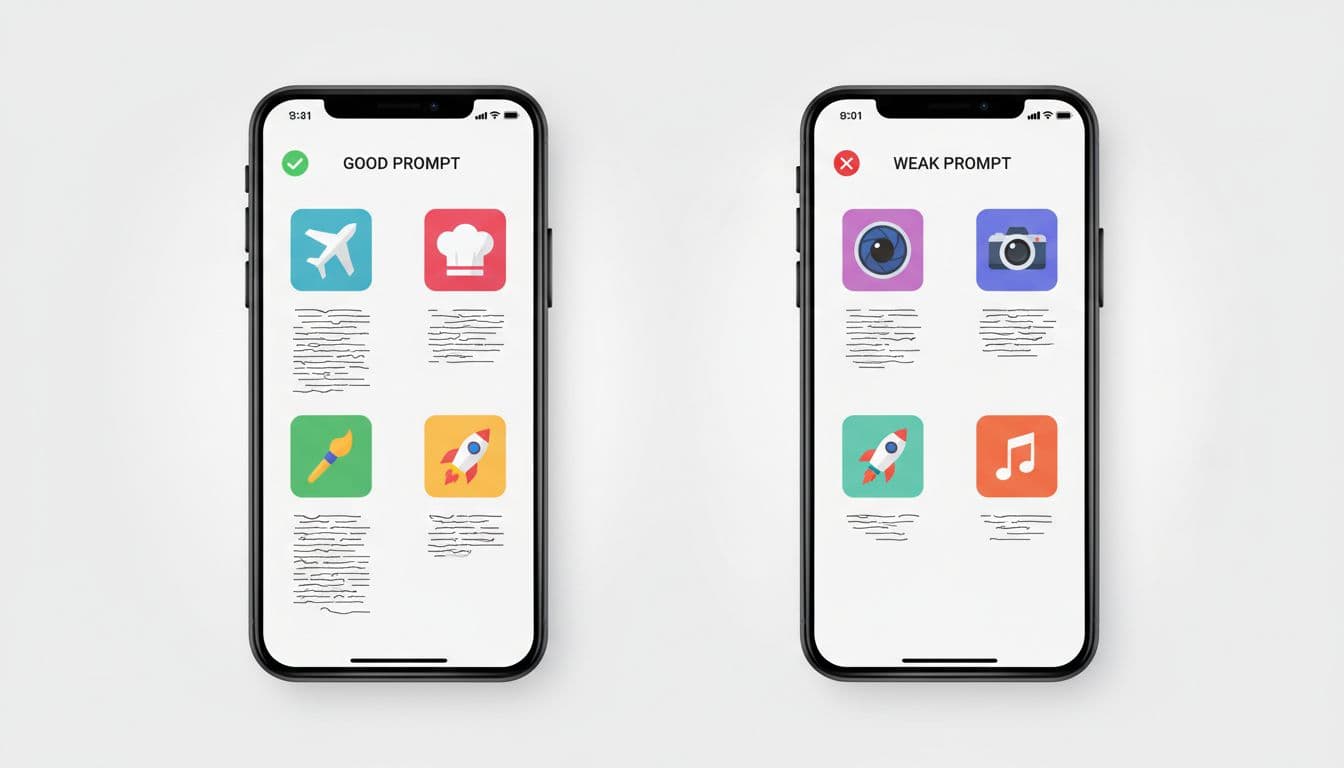
Here are a few quick examples.
| Weak prompt | Stronger prompt |
|---|---|
| Describe your family. | Write a short message introducing two family members to a host family before your trip. |
| What did you do today? | Tell a friend why your day went wrong, then say what you will do tomorrow to fix it. |
| Write about food you like. | Compare two lunch options for school and explain which one is cheaper and healthier. |
Notice what changes. The stronger versions add purpose, audience, and choice. That makes the learner retrieve language, not recycle a memorized paragraph.
Cultural fit matters too. A prompt about tipping, school lunch, greetings, or apartment hunting should fit real contexts in the target language, or at least explain the setting. If prompts feel translated from one culture into another without care, the writing may sound correct but odd. For ideas on how creative prompts can push deeper thinking without becoming childish, see this piece on creative writing prompts in language learning.
Repeatability is the last filter. Good prompts stay useful on day 20, not only day 1. A prompt like “Describe your room” expires fast. A prompt like “Explain a problem, make a request, and suggest a solution” works in new settings again and again.
A simple scorecard you can reuse
Score each row from 0 to 2. Use 0 for weak, 1 for mixed, and 2 for strong.
| Criterion | What to look for |
|---|---|
| Topic range | More than hobbies and family, with daily life, opinions, tasks, and problems |
| Originality | Prompts ask for choices or ideas, not copied model answers |
| Level fit | The task matches the learner’s current grammar and word range |
| Cultural sense | Situations feel believable in the target language |
| Repeatability | The prompt pattern works in fresh contexts later |
| Real output | The app expects full sentences or short paragraphs |
A quick reading guide helps. A total of 0 to 4 means the prompt bank is narrow. A 5 to 8 means the app has some range but still leans on safe templates. A 9 to 12 means the prompts likely support real written growth.
If the app scores low, that doesn’t make it useless. It may still be good for review, reading, or short drills. But if writing is one of your goals, the prompt bank should make you think a little, not only copy fast. If you’re testing AI-based tools, Learn Prompting’s language learning guide is a useful outside reference for prompt types that invite adaptation, correction, and role-play.
A good writing test feels a bit like a conversation on paper. You should have to choose words, not only recognize them.
A language app can look polished and still give you stale writing practice. This 15-minute check cuts through that fast by asking one simple question: do the prompts make you produce fresh language?
Run the test on two apps, keep the better scorecard, and save the weaker one for lighter practice. Writing prompt variety doesn’t need to be perfect, but it does need to be wide enough to prepare you for real life.