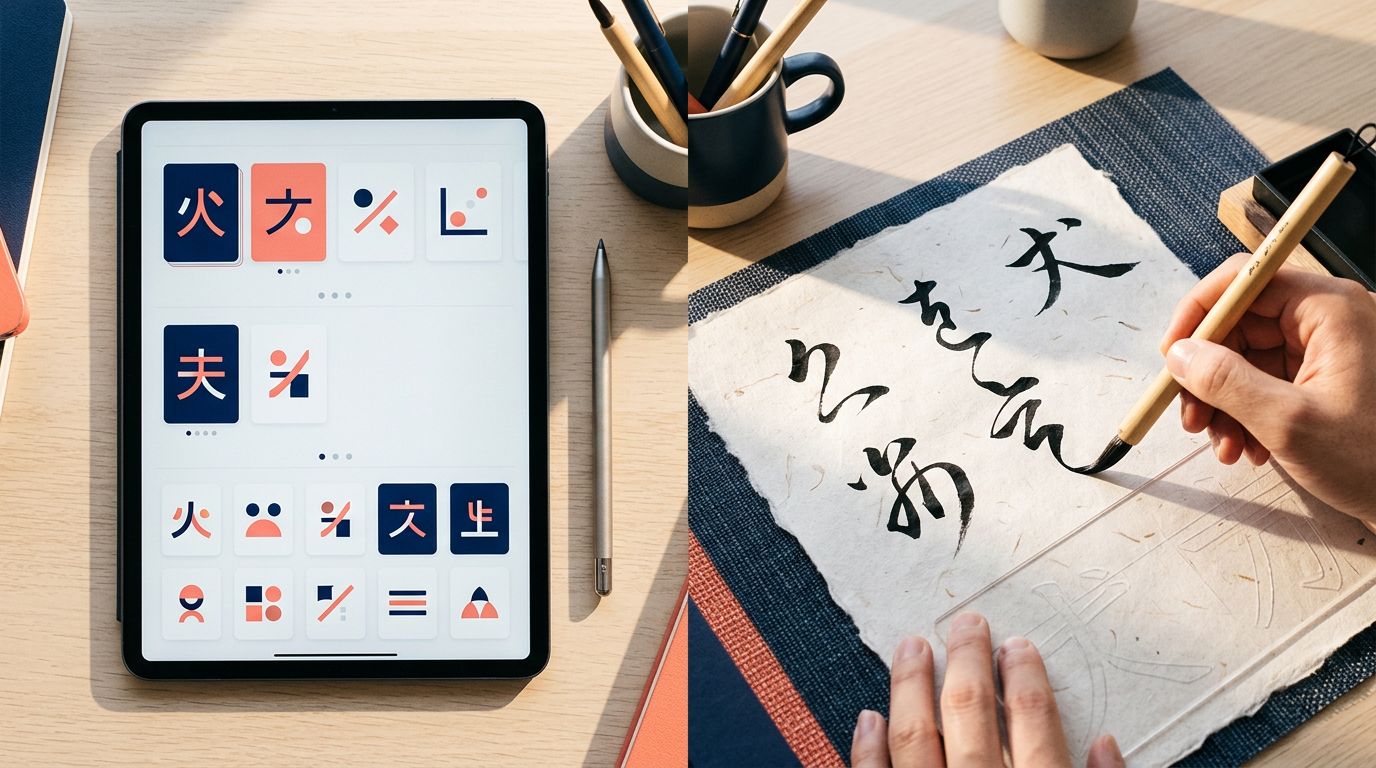
Kanji recognition can improve quickly while handwriting remains weak. If you are comparing Kanji Study vs WaniKani, the better choice depends on whether you need a guided recognition system, direct writing practice, or both.
Kanji Study gives you more control over stroke order, tracing, readings, and custom review. WaniKani provides a fixed curriculum built around radicals, mnemonics, vocabulary, and spaced repetition. Neither tool guarantees fluent Japanese writing on its own, so your study method matters as much as the app.
Key Takeaways
- Choose Kanji Study if handwritten production and stroke order are your main goals.
- Choose WaniKani if you need a structured path for kanji recognition and reading.
- WaniKani has a larger guided curriculum, while Kanji Study offers more flexible practice.
- Digital reviews should support regular handwriting with paper and a pen.
- Many learners will benefit from using WaniKani for recall and Kanji Study for targeted writing drills.
What Each App Is Designed to Do
Kanji Study focuses on active practice
Kanji Study is an Android app built for learners who want to examine and practice individual characters. It includes stroke-order demonstrations, writing exercises, flashcards, reading practice, radical breakdowns, and customizable study sets.
That flexibility makes it useful when you already know what you need to study. You can create a set for a JLPT level, textbook chapter, confusing kanji group, or vocabulary list from your current lessons. You aren’t required to follow a fixed sequence.
The writing feature is its clearest advantage. You can trace or reproduce characters while the app checks your strokes. This helps you notice errors such as writing a component in the wrong order or placing a horizontal stroke too high.
Kanji Study also works well as a reference tool. When you meet a character in a news article or textbook, you can look up its meanings, readings, related words, and stroke order without waiting for it to appear in a course.
However, flexibility creates more responsibility. The app won’t always decide what you should study next. You need to choose sets, manage review frequency, and balance recognition with production. Learners who prefer a ready-made schedule may spend too much time adjusting the app instead of studying.
For more options in this category, LanguaVibe’s guide to top Japanese kanji apps compares Kanji Study with other tools that support character practice.
WaniKani builds a fixed recognition system
WaniKani, created by Tofugu, follows a defined path through 60 levels. Its lessons introduce radicals first, then kanji, then vocabulary. Mnemonics connect the character’s meaning and reading to a memorable story, while spaced repetition schedules later reviews.
The system is designed to reduce decision-making. You complete lessons, answer reviews, and move through the levels at WaniKani’s pace. Its review stages include Apprentice, Guru, Master, Enlightened, and Burned.
That structure suits learners who struggle to maintain a routine. WaniKani also links kanji to vocabulary, which helps you see how characters behave in real Japanese words rather than memorizing isolated symbols.
The tradeoff is limited control. You can’t freely redesign the course around a textbook or move through every level immediately. WaniKani also focuses on kanji and vocabulary, not grammar, listening, speaking, or handwriting production.
WaniKani is therefore stronger for remembering what a kanji means and how it is read. It is weaker as a direct writing workbook because its standard reviews test recognition and recall rather than sustained pen-and-paper output.
Kanji Study vs WaniKani: Side-by-Side Comparison
The main differences become clearer when the two tools are compared by study task.
| Study factor | Kanji Study | WaniKani |
|---|---|---|
| Main purpose | Writing, lookup, readings, and custom review | Guided kanji recognition and vocabulary |
| Curriculum | Flexible, user-selected sets | Fixed 60-level path |
| Handwriting support | Stroke order and writing practice | Little direct handwriting practice |
| Recall method | Customizable drills and flashcards | Built-in spaced repetition and mnemonics |
| Vocabulary | Searchable examples and related words | Integrated vocabulary course |
| Best for | Learners who want control and writing practice | Learners who want structure and consistency |
| Cost model | Device and region dependent, with user-reported one-time options | $9 monthly, $89 yearly, or $299 lifetime as of July 2026 |
| Free access | Depends on the app version and purchases | Early levels are available for free |
The strongest difference is not the number of kanji. It is the type of memory each app trains. WaniKani asks you to retrieve a meaning, reading, or vocabulary item. Kanji Study can ask you to produce the character’s strokes.
A WaniKani user discussing the two tools on the WaniKani community forum described using Kanji Study to work on stroke order after learning characters through WaniKani. That combination matches the practical strengths of both platforms.
Which App Is Better for Japanese Writing Practice?
Kanji Study is the better choice if writing means producing characters accurately by hand. Its stroke-order exercises give you repeated contact with the physical sequence of a character, which recognition-based flashcards cannot provide.
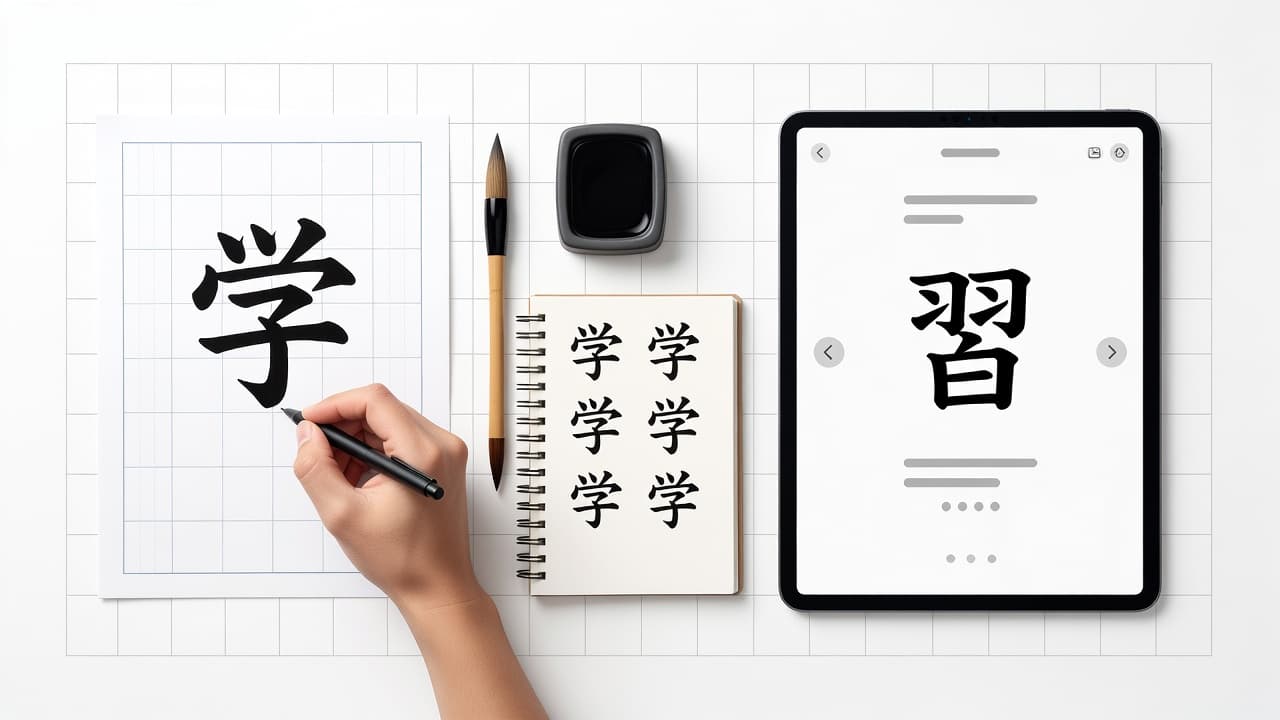
Still, tracing a character on a phone isn’t identical to writing it with a pen. A touchscreen can guide your movements, but paper forces you to control size, spacing, balance, and pressure without visual outlines. Those skills matter when you write notes, fill out forms, or take a handwritten test.
Use Kanji Study as a short drill, then transfer the same characters to paper. For each study session, select five to ten characters. Look at each one, say its meaning and reading, cover the model, and write it several times from memory. Compare your result with the correct form afterward.
An app can show whether your stroke order is correct, but paper reveals whether you can produce the whole character without support.
WaniKani still has value for writing learners because recognition supports production. If you don’t know a character’s meaning or reading, writing it repeatedly may become a mechanical copying exercise. WaniKani can build the vocabulary base that gives your handwriting practice context.
The best choice also depends on your study stage. Beginners often benefit from WaniKani’s order because radicals reduce the apparent complexity of unfamiliar characters. Intermediate learners may prefer Kanji Study because they can target characters encountered in reading, coursework, or JLPT preparation.
Cost, Platform, and Daily Commitment
WaniKani has a predictable subscription model. Its first three levels are free, giving new users a meaningful trial. Premium access costs $9 per month, $89 per year, or $299 for a lifetime membership, before any applicable tax or VAT.
The lifetime plan makes more sense for learners who expect to use WaniKani for several years. Annual billing costs less than paying monthly for a full year, but it still requires a long-term commitment. You also need to keep up with reviews, since skipped sessions can create a large queue.
Kanji Study’s price depends on the version, platform, and optional content available when you purchase it. Community reports often describe it as a lower-cost or one-time-purchase option, but prices can change. Check the current listing on your device before deciding based on cost alone.
The larger cost difference is time. WaniKani asks you to follow its lesson and review cycle. Kanji Study asks you to plan more of your own routine. A lower purchase price won’t help if you rarely open the app, while a subscription won’t be useful if its fixed pace conflicts with your schedule.
How to Combine Digital Reviews With Handwriting
You don’t need to choose one app for every part of kanji study. A practical routine can assign each tool a clear job.
Use WaniKani when you want a steady sequence of new characters and vocabulary. Complete its reviews before adding large amounts of extra material. This keeps the SRS queue manageable and gives each new kanji time to settle.
Use Kanji Study for characters that you confuse, forget, or need to write. Build small custom sets rather than drilling hundreds of items at once. Include visually similar pairs such as 未 and 末, 土 and 士, or 待 and 持 when those distinctions cause problems.
Then add deliberate paper practice two or three times each week. Write a character from memory, use it in a short word, and check the stroke order afterward. Copying a model has a place, but recall writing should be the central test.
A simple weekly pattern might look like this:
- WaniKani reviews on most days for meaning, readings, and vocabulary.
- Kanji Study drills for weak characters and stroke-order checks.
- Paper practice for a small group of characters without tracing.
- Short reading sessions to see those kanji in sentences.
This approach also prevents a common mistake: assuming that recognizing a character means you can write it. Recognition and production overlap, but they are separate skills.
Final Verdict by Learner Profile
Choose WaniKani if you are a beginner who needs structure. Its fixed sequence, mnemonics, vocabulary, and review scheduling reduce setup. It is a strong option for learners whose main problem is remembering kanji and readings.
Choose Kanji Study if handwriting is your priority. It offers more direct support for stroke order, custom sets, and targeted production practice. It suits learners who study with a textbook, prepare for a writing-heavy exam, or want to review characters from their own reading.
Choose both if you want recognition and writing. Let WaniKani provide the course and memory system. Use Kanji Study to investigate difficult characters and practice their strokes, then write them on paper without a screen.
Choose neither as a complete Japanese course. Both tools need support from grammar study, listening, reading, and real vocabulary use. A kanji app can strengthen one part of Japanese literacy, but it cannot replace broader language practice.
For a closer look at WaniKani’s retention system and limits, read this WaniKani review. It provides useful context if you are considering a paid subscription.
Conclusion
The better choice in Kanji Study vs WaniKani depends on the skill you want to improve first. WaniKani is the stronger guided system for kanji recognition, readings, and vocabulary retention. Kanji Study is more useful for stroke order, flexible review, and direct writing practice.
If writing matters, add pen-and-paper recall to whichever app you choose. Digital reviews build memory, while deliberate handwriting tests production. Together, they give you a more realistic path toward reading and writing Japanese.
Ready to Take Your Language Learning Further?
Your favorite language-learning app is a great place to start. Rocket Languages can help you go further with interactive audio lessons, pronunciation practice, real-world conversations, and structured learning.
Explore Rocket Languages →Affiliate disclosure: We may earn a commission if you purchase through this link, at no additional cost to you.