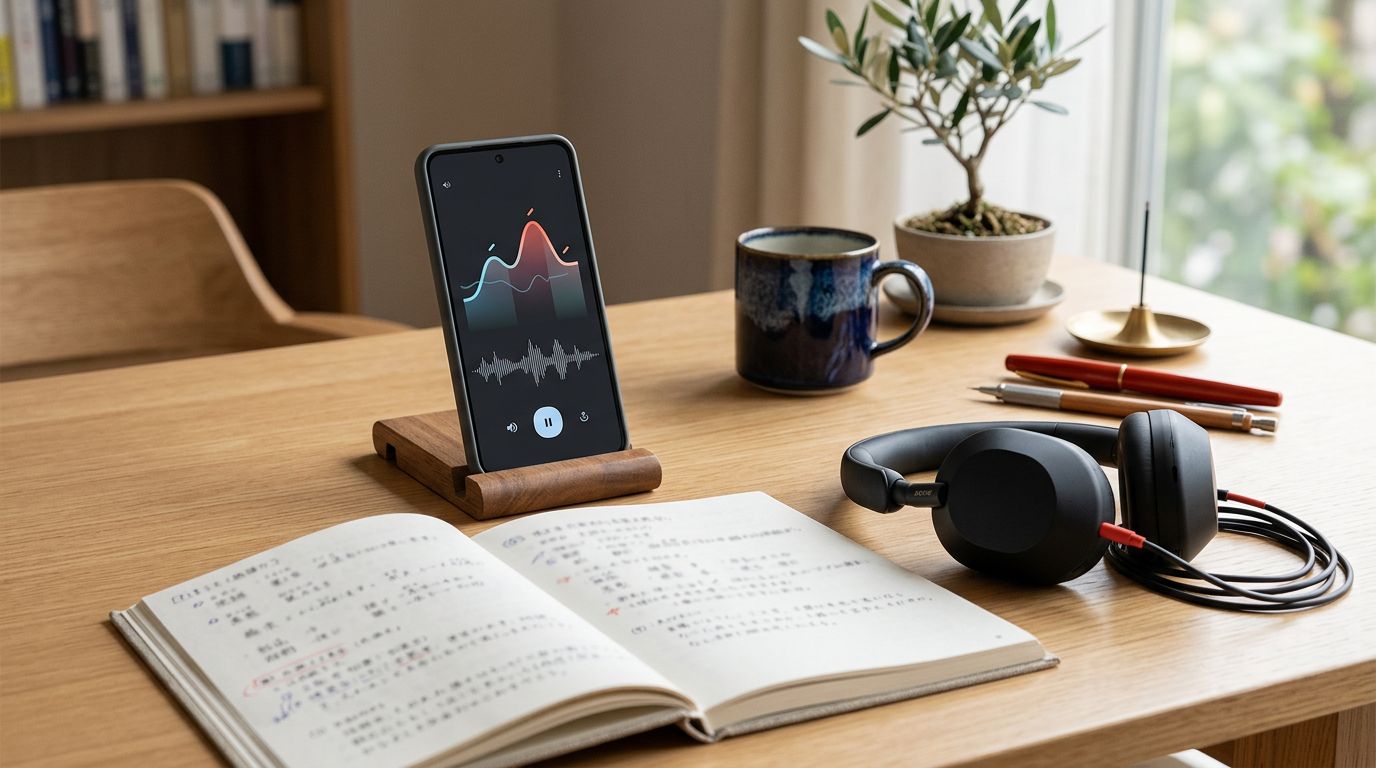
A word can have the right vowels and consonants yet still sound unfamiliar because its pitch pattern is wrong. Japanese pitch accent apps help you see that pattern, hear it in native audio, and review it before the mistake becomes automatic.
For serious learners, no single app covers every need. The strongest setup combines a reliable accent dictionary, repeated listening, shadowing, and occasional feedback from a proficient speaker. Start by understanding what these tools can measure, then choose one that fits your study routine.
How Japanese pitch accent apps fit serious study
Japanese pitch accent describes changes in pitch across morae, the timing units that shape Japanese pronunciation. It differs from English stress, where one syllable often receives extra force. In Japanese, a word may rise, stay high, and then fall after a particular mora.
Pitch accent affects meaning and rhythm
The contrast between 雨 (あめ, rain) and 飴 (あめ, candy) is often taught through their different Tokyo Japanese pitch patterns. The sounds are the same, but the pitch movement helps listeners identify the intended word.
Pitch also affects the shape of phrases. A learner may memorize a word’s downstep correctly but place too much stress on it, stretch a vowel, or pause in an unnatural position. Japanese pitch accent apps can show the lexical pattern, but they usually provide less help with the full rhythm of spontaneous speech.
This distinction matters at an intermediate level. You aren’t only asking, “Where does the pitch fall?” You also need to ask whether the word sounds natural inside a sentence, beside a particle, or in a longer conversation.
Tokyo Japanese is a reference variety
Most learning materials use Tokyo Japanese, often called standard Japanese, as their reference variety. That choice gives learners a consistent model. It doesn’t mean every speaker across Japan uses the same system.
Kansai Japanese has pitch patterns that can differ from Tokyo Japanese. Some regional varieties also have weaker or different lexical pitch contrasts. A speaker from Osaka isn’t using “bad” Japanese when their pitch differs from a Tokyo-based dictionary.
Use Tokyo patterns when your goal is broadly understood speech, media comprehension, or study with mainstream resources. If you plan to live in a particular region, listen to local speakers and ask how their pronunciation differs.

OJAD is the best free starting point
The Online Japanese Accent Dictionary, or OJAD, is one of the most useful free resources for serious learners. It runs in a browser rather than as a typical mobile app, but its pronunciation tools are more specialized than those in many general Japanese study apps.
Use word lookup and Suzuki-kun together
OJAD provides pitch accent information for vocabulary and conjugated forms. Its “accent above text” display helps you connect a written word with the location of its pitch movement.
The site also includes Suzuki-kun, a prosody tutor designed to help learners work with sentences and longer utterances. You can examine how words behave in connected speech instead of memorizing isolated dictionary entries.
The best workflow is simple. Look up a target word, listen to the reference audio, check its pattern, then place it inside a sentence. The official OJAD pronunciation resource is especially useful when a general dictionary gives you a reading but no clear accent information.
OJAD has limits
OJAD can feel less convenient than a polished commercial app. Its interface takes time to understand, and some read-aloud or pitch-editor behavior depends on the settings you select.
It also doesn’t replace broad listening. A generated prosody model can help you inspect a sentence, but real speakers vary with emphasis, speed, personality, and regional background. Treat OJAD as a reference and practice aid, not as an automatic judge of everything you say.
JAccent and the NHK dictionary suit lookup-heavy learners
Learners who check dozens of words each week may prefer a dedicated dictionary on their phone or tablet. JAccent and the NHK Japanese pronunciation dictionary offer different approaches.
JAccent is convenient for mobile searches
JAccent is an AI-assisted Japanese accent dictionary listed for Apple devices. The app is free to download, with paid options in the US storefront. The publicly listed prices include Basic at $3.99 per month or $12.99 per year, and Premium at $9.99 per month or $29.99 per year. Weekly plans and a remove-ads purchase also appear, and prices can vary by country.
Its main value is speed. You can check a word during reading, add it to a review list, and keep your pronunciation reference close to the rest of your study tools. The Apple App Store dictionary listing is the appropriate place to confirm current device support and purchase details before subscribing.
JAccent shouldn’t be treated as proof that an AI system has evaluated your speech accurately. A dictionary lookup can tell you what pattern the app records. It doesn’t guarantee that your production, phrasing, or intonation matches a native speaker.
The NHK dictionary is a stronger reference purchase
The NHK 日本語発音アクセント新辞典 is a professional reference work available through Monokakido’s dictionary ecosystem. The publisher describes it as containing roughly 75,000 headwords and the accent information used in Japanese broadcasting.
Monokakido’s 2025 sale page listed the dictionary at ¥3,900, compared with a regular price of ¥5,600. Those figures may change in 2026, so check the official Monokakido dictionary catalog for the current price and supported platforms.
This option makes sense when accuracy and coverage matter more than gamification. It is less attractive if you want speaking drills, streaks, or automatic production feedback. You are buying a serious reference dictionary, not a complete pronunciation course.
Dogen helps learners understand the system
Dogen is better understood as a pronunciation teacher and course creator than as a standard pitch accent app. His materials are useful for learners who want explanations of pitch patterns, intonation, and common pronunciation problems rather than another isolated word list.
Choose Dogen for guided concepts
A structured course can answer questions that a dictionary cannot. Why does a pitch pattern sound different in a phrase? How do particles affect the contour? When does a learner confuse lexical pitch with sentence emphasis?
Dogen’s Japanese phonetics index is a useful starting point for reviewing his current materials. The page also references Emurse, a companion tool associated with some patron access, but learners should check the current Patreon terms before paying.
As of August 2026, no official standalone Dogen pitch accent app listing was verified in the available developer materials. That makes his resources a course supplement, not a direct substitute for OJAD or a dictionary app.
Pair explanations with active recall
Watching or reading a pronunciation explanation can create a strong sense of understanding without changing your speech. After each lesson, select a small set of words and phrases. Look them up, listen repeatedly, shadow them, and record yourself.
The explanation gives you a model for noticing errors. The actual improvement comes from repeated perception and production. Keep those two stages connected rather than collecting pronunciation lessons without speaking practice.
Companion tools improve recall, but they aren’t accent specialists
A broad Japanese app can help you encounter the same words repeatedly. It may also place them in sentences, which is essential for hearing phrase rhythm. Still, general vocabulary and grammar tools vary widely in their pitch accent support.
Renshuu adds useful review
Renshuu’s free core includes vocabulary, kanji, grammar, audio, and reading practice. Its Pro features include additional listening, writing, and pitch-accent questions. That makes it a practical companion for learners who want pitch review inside a broader study system.
The Renshuu listening and pitch-accent practice comparison can help you judge whether its review structure fits your current routine. Renshuu works best when you already have a dependable pronunciation reference. Its questions can reinforce recognition, but they won’t replace extended shadowing or live correction.
Bunpro is also useful for grammar review, yet it shouldn’t be selected as a dedicated pitch accent tool. Its main purpose is spaced grammar practice. Use its sentence audio as input, then verify important words with OJAD, the NHK dictionary, or another specialized source.
Yomichan and Yomitan make reading-based lookup faster
Yomichan turns a browser into a popup Japanese dictionary. Its value depends on the dictionaries you install, so pitch accent coverage comes from the selected dictionary files rather than from the extension alone.
You can find the original Yomichan browser extension project on GitHub. Learners who use Yomitan-compatible dictionaries can also review Japanese and Chinese dictionary files for Yomitan, including entries marked for pitch information.
This setup suits advanced learners who read online and create Anki cards. It requires more technical setup than a phone app, and dictionary quality varies. Check the audio and accent source before treating a popup entry as your final reference.
Compare tools by your actual bottleneck
The right choice depends on whether you need fast lookup, structured explanation, or repeated production practice.
| Tool | Best use | Cost shape | Main limitation |
|---|---|---|---|
| OJAD | Free word and prosody lookup | Free web tool | Less convenient than a native app |
| JAccent | Quick mobile accent searches | Free download with paid tiers | Storefront and feature details can change |
| NHK dictionary | Detailed reference work | Paid dictionary content | Platform and purchase dependent |
| Dogen | Guided pronunciation concepts | Patreon or course access | Not a verified standalone accent app |
| Renshuu | Spaced review with pitch questions | Free core, paid additions | Limited as a production coach |
| Yomichan or Yomitan | Reading-based popup lookup | Extension plus dictionary files | Setup and coverage depend on dictionaries |
A learner who wants the lowest-cost setup can begin with OJAD and native audio from regular study materials. Someone who reads Japanese for hours each day may value Yomichan or Yomitan more than a separate mobile subscription. A learner who wants a polished phone experience should compare JAccent’s current pricing with the one-time cost of the NHK dictionary.
Don’t pay for several overlapping lookup tools before building a routine. One dependable reference, one review system, and regular speech practice usually produce more progress than a crowded app folder.
Build a 20-minute pitch accent routine
Pitch accent study works best when each session moves through perception, controlled speaking, and recall. A short routine also makes it easier to maintain practice when your main Japanese studies are busy.
First, verify a small set of words
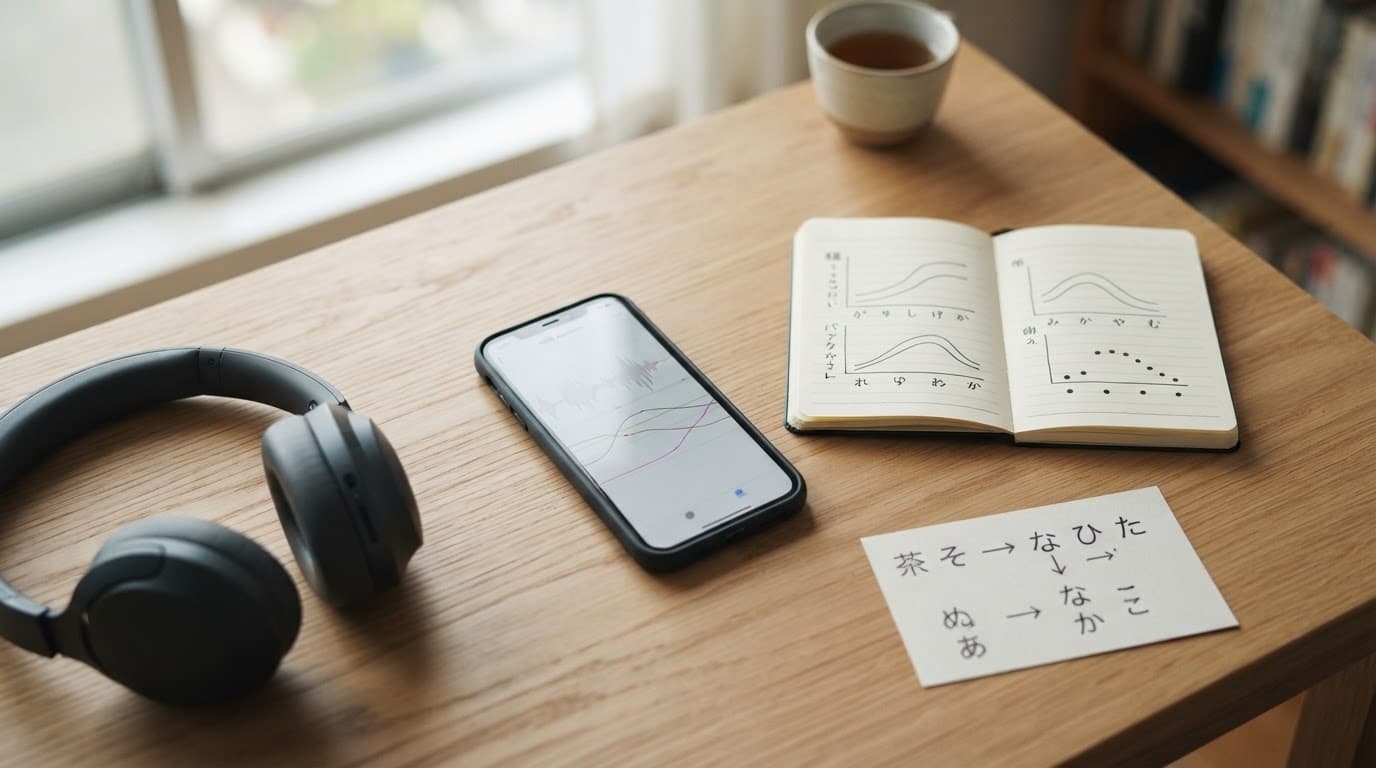
Choose five to eight words from material you’re already reading or listening to. Look up each word in OJAD, the NHK dictionary, or JAccent. Write the kanji, reading, pitch pattern, and one short sentence.
Listen to the word several times before repeating it. Notice where the pitch rises and where a downstep occurs. Don’t focus only on the visual line. Your ear needs to connect the contour with the actual timing and sound of the word.
If two sources disagree, check whether they show different readings, inflected forms, compound behavior, or regional information. A disagreement isn’t always an error.
Shadow phrases, not isolated entries
Once you understand the word, use a sentence with native audio. Listen once for overall meaning, then listen again for pitch and rhythm. Shadow the phrase at a slower speed, keeping your voice close to the recording’s timing.
The Japanese speaking apps for pronunciation practice can help you find tools for guided shadowing, voice messages, or live lessons. Select material with natural sentences rather than repeating disconnected vocabulary for every session.
A correct lexical pattern can still sound unnatural if you place the wrong pitch on a particle or give every word equal prominence. Sentence-level practice exposes those problems earlier.
Record yourself before checking the answer
Record one attempt without looking at the contour. Then compare it with the native recording. Ask yourself three questions:
- Did the pitch rise and fall in the expected places?
- Did I add English-style stress or extra volume?
- Did the phrase keep a natural pace?
Automated pronunciation scores can provide a rough signal, but they shouldn’t be treated as objective accuracy ratings. Microphone quality, speaking speed, background noise, and the system’s training data can affect the result. Your own comparison and a proficient speaker’s feedback remain more reliable.
Turn app practice into real speech
A reference tool becomes useful when it changes what you notice during conversation. That transfer takes deliberate practice because controlled repetition is easier than spontaneous speech.
Track recognition and production separately
Keep two small records. In the first, note words whose pitch pattern you can identify when listening. In the second, mark words you can produce correctly inside a sentence without checking a screen.
These lists will differ. Many advanced learners recognize a Tokyo pattern but lose it while speaking quickly. Others reproduce a familiar phrase accurately yet cannot identify the same pattern in an unfamiliar voice.
Review the production list more often. Use short recordings, not long speeches. A ten-second clip gives you enough material to repeat without hiding the target word inside a large amount of audio.
Ask for targeted feedback
A tutor or proficient speaker doesn’t need to correct every sound in every conversation. Give them a short list of words or phrases and ask whether your pitch, rhythm, and sentence intonation sound natural.
Ask for a model recording when possible. Then repeat the item several times and request a second check. This approach turns vague feedback, such as “your accent sounds a little off,” into something you can practice.
Audio-rich resources can also support independent listening. For example, a JapanesePod101 pronunciation guide provides dictionary audio and explanations, but its recordings should still be treated as input rather than a complete evaluation of your speech.
Avoid the mistakes that limit pitch accent progress
Serious learners often study the right materials but use them in ways that produce weak results.
Don’t treat a contour diagram as a score
A pitch line is a representation of movement, not a grade for your voice. Two native speakers may produce the same word with small differences in pitch range, speed, or voice quality.
Use diagrams to identify the important relationship between high and low morae. Don’t force your voice to imitate every tiny movement in a recording. Japanese pitch accent depends on contrast, and natural speech includes variation.
Don’t confuse lexical pitch with sentence intonation
A word’s dictionary pattern is only one part of a spoken phrase. Questions, contrast, surprise, politeness, and focus can change the larger intonation contour.
For example, a word may keep its lexical downstep while the speaker raises the end of the sentence for a question. If you try to reproduce every sentence with the same flat contour, your speech may sound studied even when the word accent is correct.
A correct word pattern can still sound unnatural when the phrase rhythm, particle pitch, or sentence focus is wrong.
Don’t erase regional variation
Tokyo Japanese is a useful common reference, especially for self-study and broad comprehension. It isn’t the only legitimate pronunciation system.
When you hear a Kansai speaker use a different pattern, record the difference rather than labeling one version incorrect. If your goal is a Tokyo-based standard, keep the Tokyo form as your active target. At the same time, learn to recognize other regional patterns through real listening.
Conclusion
Japanese pitch accent apps are most useful when they connect a reliable reference with repeated listening and spoken practice. OJAD is an excellent free starting point, while JAccent and the NHK dictionary offer convenient or detailed lookup options. Dogen, Renshuu, and browser dictionary tools can add explanation and review.
The strongest routine is small and consistent: verify a few words, shadow them in phrases, record yourself, and seek targeted feedback. Use Tokyo Japanese as your working reference while remembering that regional patterns differ. An app can show you where to listen, but extensive input and real conversation are what make the pattern usable.
Ready to Take Your Language Learning Further?
Your favorite language-learning app is a great place to start. Rocket Languages can help you go further with interactive audio lessons, pronunciation practice, real-world conversations, and structured learning.
Explore Rocket Languages →Affiliate disclosure: We may earn a commission if you purchase through this link, at no additional cost to you.