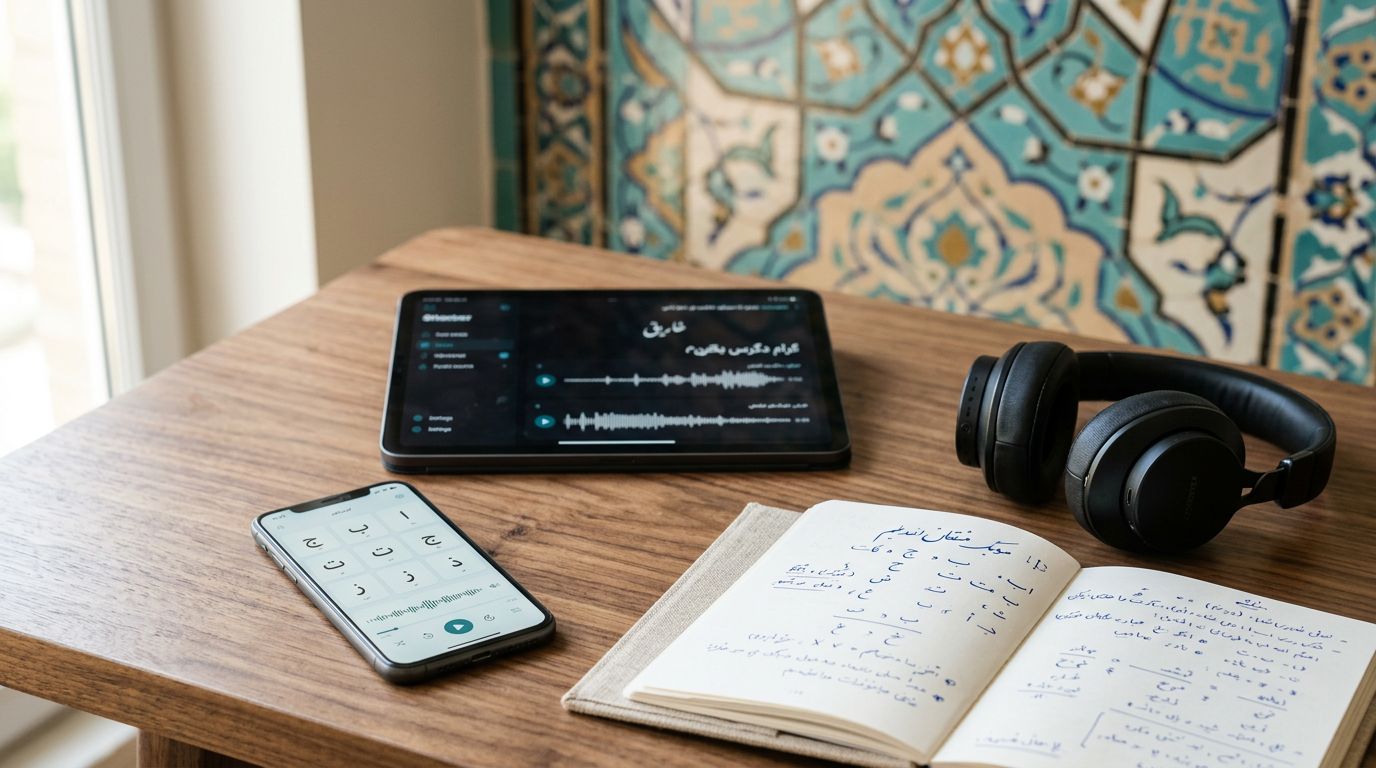
Farsi apps can get you through greetings fast. They can also waste months if they stop at matching words and tapping pictures.
Serious learners need more. You need Iranian Persian pronunciation, script practice, grammar help, real listening, and a path to conversation. Most apps only cover part of that, so the right mix matters.
In 2026, the strongest options are clear once you separate polished marketing from real study value. The best Farsi learning apps are the ones that help you read, hear, speak, and recall in the same week.
What serious learners need from a Farsi app
Most Farsi apps teach Iranian Persian, which is the variety most learners want. If you need Dari or Tajik, your options shrink fast, so check the course label before you pay.
Script matters early. The Persian alphabet is part of reading, spelling, and vocabulary recall. An app that hides it for too long leaves you guessing when you should be reading.
Pronunciation is another fault line. Persian has sounds that many English speakers flatten, and speech practice helps only when the app gives you enough repetition. Good audio also matters, because word lists without full sentences sound neat but teach little.
Finally, a serious app should support real study habits. That means spaced review, useful grammar notes, offline access when you need it, and enough structure to keep you moving after the first week.
A good Persian app gets you past recognition and into response. If you can only tap the right card, you are still at the start.

The best Farsi apps at a glance
If you want a fast scan before you commit, this comparison makes the trade-offs obvious. For a wider market overview, this Persian app comparison gives a broader list, but serious learners should still filter for depth, script, and audio quality.
| App | Best for | Platform | Pricing model | Main limits |
|---|---|---|---|---|
| Pimsleur | Speaking early and pronunciation | iOS, Android, web | Subscription plans | Little script work, limited grammar depth |
| Ling | Balanced daily study | iOS, Android | Freemium with paid unlocks | Not enough for full mastery alone |
| Mondly | Beginner vocabulary and quick drills | iOS, Android, web | Free tier, subscription, or lifetime-style plans | Shallow for advanced work |
| PersianPod101 | Listening and transcripts | iOS, Android, web | Free sample lessons, paid tiers | Interface can feel busy |
| HelloTalk and Tandem | Real conversation and correction | iOS, Android | Free core use, paid VIP options | No curriculum, quality varies |
The pattern is simple. Pimsleur and Ling are the strongest anchors. PersianPod101 adds input. HelloTalk and Tandem add people. Mondly is useful, but mostly as a starter.
How to test an app before you subscribe
Try the first few lessons in a short burst, not just one sample screen. You want to see whether the app teaches Persian script, not only transliteration. If it keeps everything in Latin letters for too long, your reading will lag later.
Next, check whether the app makes you produce Persian. Tapping a multiple-choice answer is not the same as recalling a sentence. Good apps ask you to listen, repeat, type, or record your voice.
Then look at the ceiling. Does the app still feel useful after the basics? If the answer is no, use it as a starter and move on before you lose time.
If an app cannot push you past recognition, it is a helper, not a course.
Best overall app for most serious learners
Ling is the best overall choice for most serious Farsi learners in 2026. It gives you enough structure to build vocabulary, read script, and practice basic grammar without feeling like a toy.
That balance matters because many apps do one thing well and ignore the rest. Ling is not a full curriculum, but it gives you a real daily routine. For a lot of adults, that is what keeps progress alive.
If speaking confidence matters more than balance, Pimsleur moves ahead. If you mainly want fast beginner phrases, Mondly is easier to start. For most learners who want one main app, though, Ling is the safest pick.
Because pricing changes often, check the current plan before you subscribe. The value is highest when you use it every day, not when you keep comparing stores.
Pimsleur: the strongest choice for speaking first
Pimsleur is one of the best options if you want to talk from the start. It uses short audio lessons that force recall, which helps your mouth and ear work together faster than passive study.
That format suits Iranian Persian well. You hear complete phrases, repeat them, and build sentence rhythm before you get lost in too much theory. Many learners use it while commuting, walking, or doing chores.
Its weakness is clear. Script coverage is limited, so you still need another tool for reading. Grammar is also lighter than most serious learners want. Pimsleur teaches you to respond, but it does not try to be your whole study system.
The current Pimsleur Farsi course uses a subscription model, which puts it in the pricier group. It is worth the cost if you actually finish the lessons in order.
Ling: the best all-around app
Ling works well because it covers more ground than most language apps. It mixes vocabulary, reading, speaking, and review in a way that gives you a real habit.
That makes it useful for adult learners who want one place to start after work or class. You can do a little bit every day and still touch several skills. For Iranian Persian, that matters because script and sound need to grow together.
Still, Ling is an anchor, not a finish line. Its grammar support helps, but it will not replace books, tutors, or native input. Serious learners usually outgrow it once they reach the lower-intermediate stage.
Offline access and plan features can vary, so check the current app details before you buy. If you want a single app with the best mix of structure and breadth, Ling deserves the top spot.
Mondly: good for beginners, limited for serious study
Mondly is polished and easy to use. That makes it pleasant for short sessions, especially if you want a low-friction start with core vocabulary and basic sentences.
It also helps with confidence. The short lessons feel manageable, and the speech exercises can take the edge off early speaking anxiety. For a learner who feels overwhelmed by Persian script, that softer entry point has value.
The problem is depth. Mondly is better at quick review than at serious progression. Once you need grammar clarity, longer listening, or reading practice, you will feel its limits. It works as a ramp, not a road.
If you want to check the current Persian course details, the Google Play Persian listing is a useful reference point. The app is fine for warm-ups, but it should not be your main plan for long.
PersianPod101: strong listening support, uneven polish
PersianPod101 is most useful when you want more Persian in your ears. The lesson library gives you graded audio, transcripts, vocabulary support, and a lot of material to cycle through.
That makes it a solid choice for learners who want listening practice with structure. It also works well once you can already handle some script and want more input. For university students and self-directed adults, that library can fill a real gap.
The downside is the interface. It can feel busy, and you need discipline to keep your study clean. The lessons are useful, but they are not always as direct as the best course apps. You get plenty of content, yet you still have to organize your time.
PersianPod101 is strongest when you pair it with an app that pushes speaking. On its own, it can leave you informed but quiet.
HelloTalk and Tandem: the real conversation layer
HelloTalk and Tandem solve a problem most course apps ignore, real exchange. You can text, send voice notes, and get corrections from native speakers. That matters once you can produce simple sentences.
These apps are not traditional courses. They are practice spaces, and that means the results depend on how you use them. Some chats will stall. Some partners will disappear. Some people want a language exchange, others want casual conversation. You need a clear purpose.
Used well, they are excellent for spelling, informal phrasing, and listening to unscripted Persian. They also expose you to everyday Iranian usage in a way no lesson deck can match. That makes them essential once you move beyond textbook sentences.
Used casually, they waste time. If you open them without a plan, they become noise. If you open them with questions, prompts, and a review routine, they become one of the best parts of your study.
A course-style option worth a look
Some learners want more guidance than a chat app but more personality than a plain drill app. In that space, Rocket can still make sense for serious beginners.
The Rocket Languages Persian review covers why it helps learners who want a guided audio path and where its ceiling shows up. It is useful early on, but advanced learners will still need native input and conversation practice.
Rocket is not the first choice for everyone. Still, it belongs in the conversation if you prefer a more structured course than the social apps give you.
The best app combinations for serious learners
A single app can help, but two good apps work better for most adults. One app should build structure. The other should force output.
- Ling + HelloTalk or Tandem: This is the best balanced setup. Ling gives you script, vocabulary, and routine. HelloTalk or Tandem gives you real replies and corrections.
- Pimsleur + HelloTalk or Tandem: This is the best speaking-first setup. Pimsleur builds sentence reflexes. The conversation app tests whether you can use them with real people.
- PersianPod101 + a conversation app: This is a strong listening-first path. PersianPod101 gives you transcripts and graded audio. The chat app turns that input into usable speech.
Mondly can sit in the mix if you want a gentle warm-up app, but it should not carry the whole load. For serious learners, depth beats novelty every time.
Which app fits which learner
Heritage learners usually need reading, spelling, and correction more than basic vocabulary. For them, Ling plus HelloTalk or Tandem makes sense because it supports script and real output.
Travelers often want fast spoken phrases and good recall. Pimsleur is the strongest starting point here, and Mondly can help with light daily review before a trip.
University students need listening, transcripts, and enough structure to study in blocks. PersianPod101 paired with Ling gives them that mix without forcing them into one style.
Professionals planning a longer stay need more than travel phrases. They need listening, reading, and the ability to handle live speech. For that group, Pimsleur or Ling should sit beside a conversation app, and a tutor can fill the gaps.
If you already read some Persian but freeze when speaking, skip the beginner-only tools. Go straight to audio plus exchange. That combo produces faster gains than more streak-based practice.
Conclusion
The best Farsi apps in 2026 are the ones that move you past recognition and into real use. For most serious learners, Ling is the best single app, Pimsleur is the strongest speaking-first option, and HelloTalk or Tandem provides the human practice those courses cannot replace.
The smartest setup is usually one course app plus one conversation app. That mix gives you structure, input, and output without drowning you in fluff.
If an app does not help you read, listen, and answer in Persian, it is only buying time.