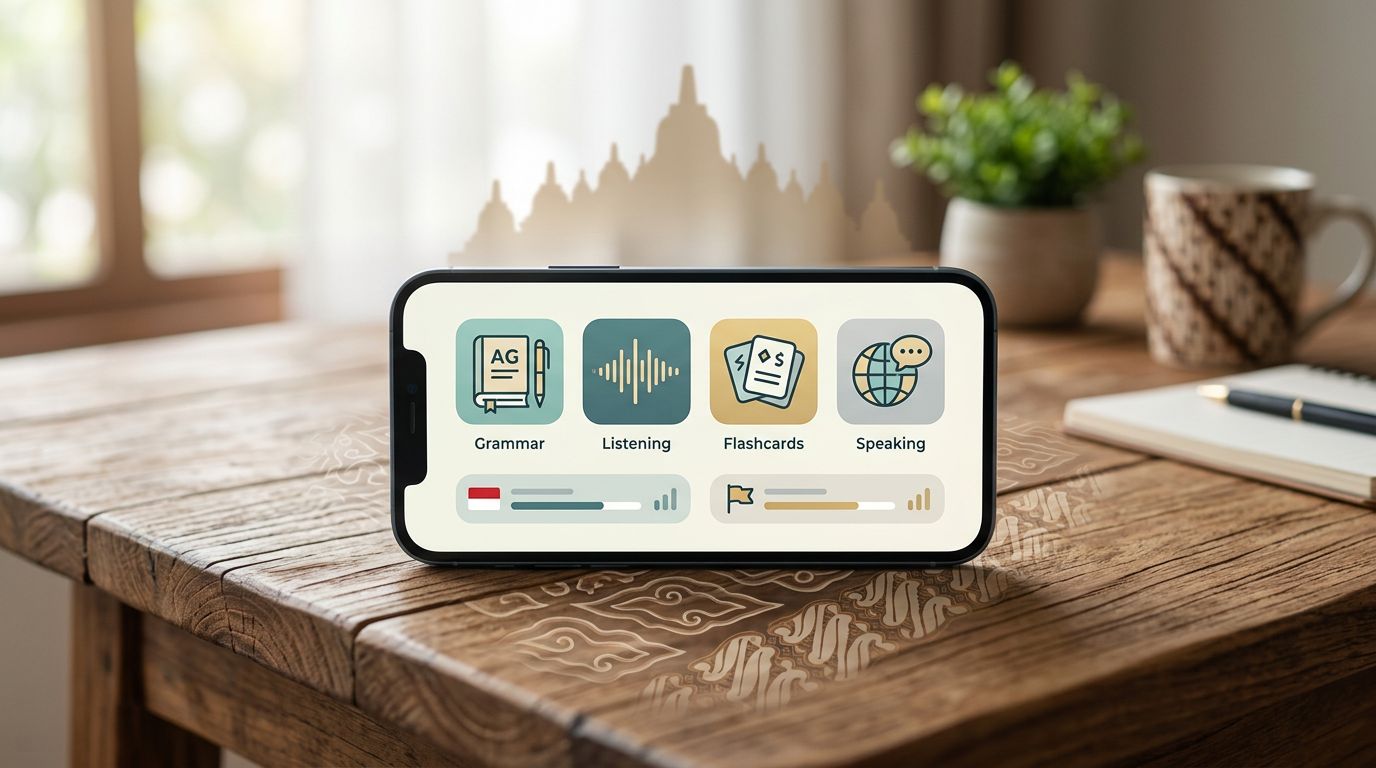
What if your Indonesian app could still help you after the first month, not just the first week? That is the real test for serious learners. A good app should teach grammar, build listening skill, and keep you moving when the novelty fades.
The best Indonesian learning apps in 2026 do not all work the same way. Some are built as full courses, some are better for speaking, and some are simple support tools that keep your memory sharp. The right mix depends on whether you want a main course, daily practice, or extra review.
What serious learners should expect from an Indonesian app
A serious app should do more than hand you travel phrases. It should give you a path, let you review weak points, and push you toward real output. If an app only rewards tapping, it will feel thin by month two.
A useful way to judge any app is to ask four questions. Does it teach grammar in a clear order? Does it help with listening and pronunciation? Does it give you space to speak or write? Does it work after the beginner stage?
If you want a benchmark for structured language courses, the flow in our Rocket Languages comprehensive review is a useful reference point. For video-heavy input, the FluentU immersive learning review shows how comprehension practice can be built around native content.
The strongest Indonesian learning apps in 2026
Here is the fastest way to compare the main options before you commit time or money.
| App | Best for | Core strength | Main weakness | Best role |
|---|---|---|---|---|
| Talk In Indonesian | Learners who want one dedicated Indonesian path | Structured lessons and broad coverage | Less useful for live conversation | Primary course |
| Pimsleur | Audio-first learners | Listening and spoken recall | Light on reading and writing | Primary for speaking |
| HelloTalk | Learners ready for real exchanges | Native-speaker chat and correction | Quality depends on the partner | Supplemental conversation |
| Duolingo | Beginners who need daily momentum | Easy habit-building and quick drills | Too shallow for advanced progress | Supplemental habit tool |
| Taalhammer | Self-studiers who want sentence practice | Output-focused repetition | Smaller ecosystem | Secondary drill tool |
| FunEasyLearn, Anki, KBBI | Review and vocabulary work | Offline study, flashcards, precise meanings | No full course path | Supplemental tools |
The pattern is simple. Only a few apps can carry your whole plan. The rest are there to patch gaps, reinforce recall, and give you more contact with the language.
Talk In Indonesian
Talk In Indonesian is the strongest dedicated option in current 2026 roundups. It suits learners who want a clear path through Indonesian, not a random pile of phrases. For that reason, it works best as a primary course.
Its biggest advantage is focus. You stay inside Bahasa Indonesia instead of a general language framework that may feel built for everyone and no one at once. That matters when you want steady progress beyond greetings and food words.
The tradeoff is that no course app can replace live use. You will still need speaking practice, reading, and a dictionary. Still, if you want one app to anchor your study, this is the first one to test.
Pimsleur
Pimsleur is the safest choice if speaking feels hard at the start. It suits commuters, busy adults, and anyone who learns best by listening out loud. It works best as a primary audio course.
The lessons train your ear and push you to answer before you can overthink. That helps pronunciation and recall. The downside is that reading and writing stay light, so you will need support from another app.
Use Pimsleur when you want to sound clearer and stop freezing in real time. It is strong for oral habits, and that is still rare enough to matter.
HelloTalk
HelloTalk is for learners who are ready to talk to people, not just apps. It suits expats, heritage learners, and travelers who want real interaction. As a result, it works best as a supplemental conversation tool.
You get chat, voice notes, and correction from native speakers. That makes it useful once you know basic sentence shapes. However, the quality of your progress depends on how active and serious you are.
A language exchange app can feel messy at first. That is normal. Real conversation usually is. If you keep showing up, HelloTalk can turn passive study into actual use.
Duolingo
Duolingo still has one major advantage, it makes daily practice easy to start. It suits beginners who need momentum and do not want a heavy lesson every day. Use it as a supplemental habit builder, not a full course.
For a closer look at where it helps and where it stops, see the Duolingo review for serious language learners. The app is polished, free to start, and simple to open on mobile or web. That makes it useful for short reviews between larger study blocks.
Its weakness is depth. For Indonesian, it works best as a warm-up, not the main event.
Taalhammer
Taalhammer has become more interesting for Indonesian because it pushes sentence practice instead of passive tapping. It suits self-studiers who want more output and less guessing. That makes it a secondary drill tool.
A 2026 comparison of Indonesian tools from Taalhammer places sentence practice near the center, and that fits how the app feels. It is useful when you already know some basics and need more repetition with meaning.
This kind of app helps you move from recognition to production. It is less useful if you want a complete guided path from zero.
FunEasyLearn, Anki, and KBBI
FunEasyLearn, Anki, and KBBI fill the gaps that course apps leave behind. FunEasyLearn is handy for offline vocabulary and phrase review, and its Google Play Indonesian app is easy to keep on a phone. Anki is better when you want total control over flashcards. KBBI helps you check exact meanings, affixes, and usage.
These are all supplemental tools, but serious learners use them more than they expect. They are especially useful when you notice the same words slipping away after lessons. If you want a broader list of app and resource combinations, Kaiwa’s 2026 Indonesian resource roundup is a useful place to compare options.
Building a consistent Indonesian study routine
Serious progress usually comes from a stack, not a single app. Pick one primary course, add one conversation channel, and keep one review tool ready. That mix covers grammar, listening, speaking, and memory.
The best app is the one that still feels useful after the novelty wears off.

A simple weekly plan works well. Use your main app four days a week, spend two short sessions on speaking, and do daily review in flashcards or a dictionary check. If you live in Indonesia, move HelloTalk or live conversation higher in the stack. If you travel often, offline tools matter more than social features.
The goal is consistency, not app collecting. One strong app plus two support tools will beat six half-used apps every time.
Which app mix fits your goal
Different learners need different combinations, and that is where the decision gets easier.
- Absolute beginners should start with Talk In Indonesian and keep Duolingo nearby for short daily practice.
- Speaking-focused learners should pair Pimsleur with HelloTalk, then add KBBI for word checks.
- Self-studiers who like control should use Taalhammer, Anki, and KBBI as a tight review system.
- Travelers and expats should combine Pimsleur, HelloTalk, and an offline option like FunEasyLearn.
- Learners who want one main app should test Talk In Indonesian first, then add a speaking tool later.
The right mix depends on your weak point. If you need structure, start there. If you need confidence in conversation, make speaking the priority. If you keep forgetting words, build a review habit before you add another course.
Conclusion
The best Indonesian app in 2026 is the one that matches your weak spot and stays useful after the first rush. For most serious learners, that means one primary course, one speaking tool, and one review system.
Talk In Indonesian looks strongest as a main course. Pimsleur helps when listening and speaking need work. HelloTalk, Duolingo, Taalhammer, FunEasyLearn, Anki, and KBBI all make more sense as support tools.
If your goal is real progress in Bahasa Indonesia, choose the app stack that helps you study tomorrow, not just today.
Ready to Take Your Language Learning Further?
Your favorite language-learning app is a great place to start. Rocket Languages can help you go further with interactive audio lessons, pronunciation practice, real-world conversations, and structured learning.
Explore Rocket Languages →Affiliate disclosure: We may earn a commission if you purchase through this link, at no additional cost to you.